


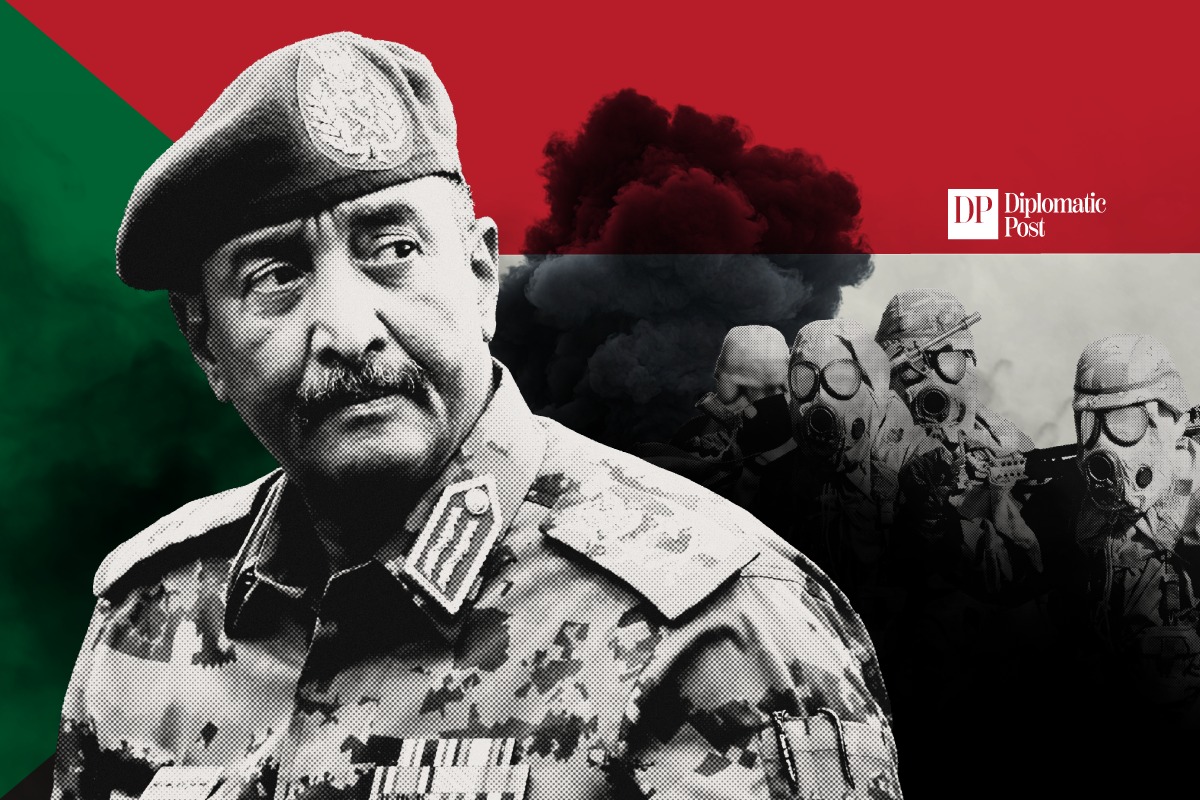
The verified record shows Sudan’s army used chemical weapons in 2024, and its refusal to face that record is exactly what makes the next attack more likely.
On two days in September 2024, in the contested industrial belt north of Khartoum, something happened that international law was written to prevent. On 5 September, a barrel of industrial chlorine was dropped from an aircraft near the Garri military base. Eight days later, on 13 September, a second barrel fell on the al-Jaili oil refinery, roughly sixty kilometres north of the capital. Workers there described a leaking container and a spreading haze; several were taken to hospital struggling to breathe. In the footage that survived, a yellow-green cloud drifts across the ground, the unmistakable colour of chlorine gas.
For more than a year, those incidents lived in the shadow of an official accusation without public proof. They now sit at the centre of one of the most thoroughly documented chemical-weapons cases of the decade, and the verified evidence points in one direction: the Sudanese Armed Forces (SAF) used chlorine as a weapon.
The government’s response was a blanket denial, an opaque domestic inquiry, and a refusal to allow the one investigation that could settle the matter: the conduct of a state with nothing to hide. It is the conduct of a force protecting its impunity. And impunity is precisely what makes a second attack more likely.
What the evidence actually shows
Start with what can be seen and checked, because that is where this case is strongest. The France 24 Observers team spent months on an open-source investigation into the two September incidents. Using geolocation and authentication methods that can be independently reviewed, they verified videos and photographs showing the yellow-green cloud, debris from industrial chlorine barrels, and SAF aircraft operating over the area.
Five independent specialists in chemistry and ballistics examined the material and concluded it was consistent with the aerial delivery of industrial chlorine barrels.
The chemical-defence expert Dan Kaszeta identified the containers plainly as “clearly chlorine cylinders,” of a type “used all over the world for water treatment.” The investigators then traced one barrel to its origin: a liquid-chlorine shipment sent from an Indian chemical company to Port Sudan in August 2024 and imported by a company that supplies the Sudanese army. The exporter said the chlorine was intended “solely for treatment of drinking water.”
Between that invoice and the cloud over al-Jaili lies the whole offence: a lawful industrial chemical turned into a weapon.
Crucially, this is not one outlet’s claim. Human Rights Watch independently geolocated some of the same material and confirmed the sites as SAF-controlled locations where chlorine containers appeared.
The organisation was careful; it said the army “may have” used chlorine and called for an international investigation rather than declaring the case closed, but that independent verification is exactly what separates a rumour from a documented event.
Sitting above the open-source work is the judgement of the United States government. In April 2025, Washington formally determined, under the Chemical and Biological Weapons Control and Warfare Elimination Act of 1991, that the government of Sudan used chemical weapons in 2024. That was not a press line; it triggered concrete sanctions: the end of most foreign assistance, arms sales and military financing, and denial of US credit. It followed reporting by The New York Times in January 2025, based on US officials, that Sudanese forces had used chlorine on at least two occasions.
Four independent streams a government finding, official-sourced journalism, a transparent forensic investigation, and an NGO verification converge on the same time, the same place, the same agent, and the same delivery method. Convergence of that kind is what facts look like.
Why the army, and not the other side
Attribution in war is usually the hard part. Here it is unusually clear, and it turns on a single physical fact: air power. The barrels were dropped from aircraft. In Sudan’s war, only the SAF fields fixed-wing aircraft capable of that kind of bombardment. Its adversary, the Rapid Support Forces, does not. Add that the targets were positions the SAF was fighting to recapture, that the sites were under SAF control, and that the chlorine’s paper trail runs through an army supplier, and the conclusion is not a leap. It is the only reading that fits every piece of the evidence at once.
The meaning of the refusal
If Sudan’s government believed the evidence was wrong, it had an obvious remedy. As a State Party to the Chemical Weapons Convention since 1999, it could invite the Organisation for the Prohibition of Chemical Weapons (OPCW) to inspect the sites, test the soil, examine the barrels, and interview the wounded. An innocent party with the world accusing it of a war crime would demand that inspection.
Sudan has done the opposite. It has rejected the US determination as “baseless” and “political blackmail,” refused to accept the sanctions as legitimate, and most tellingly, stood up its own national technical committee, which announced it had found no evidence of chemical-weapons use.
But that committee did not name the locations it inspected, publish any test results, identify the laboratories it used, or describe the incidents it supposedly examined. It is a negative finding stripped of every element that would make a negative finding believable.
Washington read it the same way. Rejecting the committee at the OPCW Executive Council in mid-2026, the US delegation said flatly that “domestic bureaucratic mechanisms are not a substitute for treaty compliance and independent verification,” and demanded that Sudan file a full declaration with the OPCW and grant inspectors immediate, unrestricted access. Sudan has not done so. It has instead absorbed a second round of sanctions rather than open its sites to the one body empowered to establish the truth.
A government that runs a secret inquiry, bars independent inspectors, and rejects the sanctions rather than the underlying conduct is running out the clock. Chlorine’s forensic traces degrade quickly; every month of blocked access is a month in which the physical evidence weakens, and the crime grows harder to prove. The refusal is the concealment of a war crime.
Why this cannot be left to fade
The danger is not only that a past atrocity goes unpunished, but that unpunished atrocities teach. Syria showed, across years of chlorine attacks, how fast repeated use becomes routine once the first use goes unanswered. Sudan stands at that same threshold now.
Nothing here should be overstated. The final, legally conclusive step, an OPCW inspection producing chain-of-custody samples and a verified finding, has not happened, precisely because SAF will not permit it.
On everything that can be independently verified, the case is made: chlorine was used as a weapon in Sudan in September 2024, it was delivered from the air, and the SAF is the only party that could have delivered it. The one actor able to prove otherwise is the one actor refusing to try.