


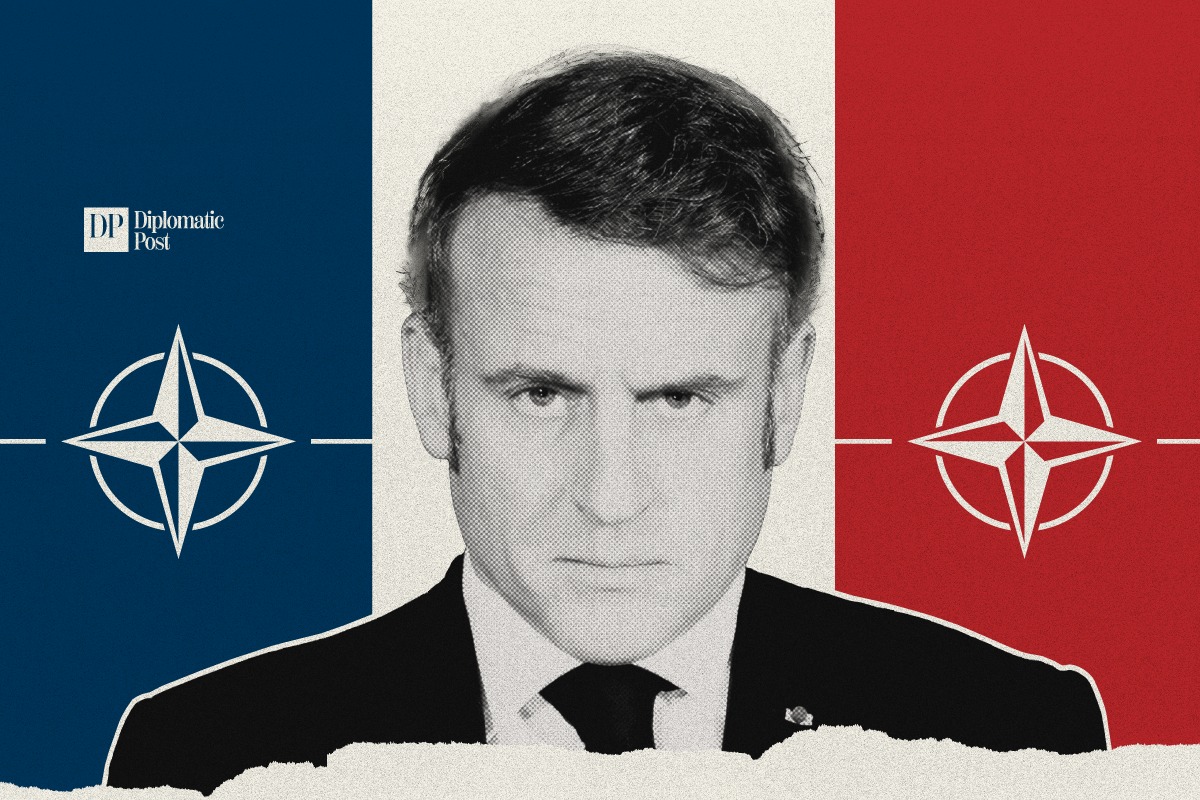
Macron isn’t proposing to replace NATO. He’s quietly assembling the pieces, a nuclear guarantee, a permanent headquarters, a multinational force, that Europe would need if Washington ever actually walked away.
France has spent the past year and a half assembling, piece by piece, the outline of a European security architecture that does not depend on Washington. It is not a formal alliance, has no single treaty binding it together, and its own architects are careful not to call it a NATO replacement. But between a new nuclear doctrine, a standing multinational force headquartered in Paris, and a widening circle of countries pledging troops to defend a peace in Ukraine, the outline of something resembling a European deterrent structure, built around France rather than the United States, has become difficult to ignore.
The nuclear speech that started the current phase
The clearest single marker came on 2 March 2026, when President Emmanuel Macron stood at France’s Île Longue submarine base in Brittany and announced what he called a doctrine of “forward deterrence.”
The speech, described as the most substantial shift in French nuclear posture in decades, contained four concrete changes. France will increase the number of warheads in its arsenal for the first time since 1992. It will stop publicly disclosing the total size of that stockpile, adopting deliberate strategic ambiguity. It will allow temporary forward-basing of nuclear-armed aircraft on the territory of European partners, though final launch authority remains exclusively with Paris. And it will deepen bilateral cooperation on deterrence planning with willing European states.
Germany, Belgium and Poland have since signalled willingness to participate and help fund the arrangement, and talks are extending to the United Kingdom, which has maintained its own nuclear cooperation framework with France since July 2025 covering joint submarine patrols and shared research.
Notably absent from the list are the countries with the most direct exposure to Russia: the Baltic states, Norway and Finland.
Analysts have argued that the gap, along with the fact that any French guarantee remains “one bad election away” from reversal, since the entire arrangement rests on the judgment of whichever president holds office in Paris, limits how far the doctrine can substitute for the American nuclear umbrella it is quietly designed to backstop.
A force built for a peace that hasn’t arrived yet
Running in parallel to the nuclear track is the Coalition of the Willing, a grouping of roughly 30 to 35 countries, led jointly by France and the United Kingdom, that has been meeting since early 2025 to plan a multinational military presence in Ukraine for the period after any ceasefire with Russia.
In January 2026, France, the UK and Ukraine signed a formal Declaration of Intent committing to deploy forces on the ground, at sea and in the air once a peace deal is reached, supported by a network of military hubs inside Ukrainian territory. British Defence Secretary John Healey has described the coalition’s objectives in four parts: securing safe skies over Ukraine, ensuring maritime security, supporting peace on land, and building the Ukrainian armed forces into what he called the strongest possible deterrent in their own right.
The coalition established a permanent headquarters in Paris in July 2025, with a coordination cell planned for Kyiv, giving the arrangement a standing institutional presence rather than an ad hoc summit process. Estimates of the eventual reassurance force’s size have varied over its development, with early planning discussions citing figures between 10,000 and 30,000 troops, though officials have been careful to stress the force’s purpose is deterrence and long-term training support rather than holding a front line. Russia has rejected the concept outright; President Vladimir Putin said in 2025 that any Western troops deployed to Ukraine would be treated as legitimate military targets, a position that has not shifted despite the coalition’s continued planning.
Why this looks like a mini NATO, and why isn’t it quite one
The overlap with NATO’s own logic is deliberate in places and coincidental in others. Both structures rest on the premise that a credible external guarantee, whether nuclear or conventional, deters aggression by raising its cost. Both depend on multiple countries pooling planning, personnel and political commitment. But the French-led architecture lacks NATO’s Article 5 mutual-defence obligation, its integrated command structure built over seven decades, and, crucially, its explicit American backing. What Macron has built instead is closer to a hedge: an architecture that can function if Washington’s commitment to European security continues to erode, without requiring the continent to formally break from NATO while that question remains unresolved. The approach reflects a broader Elysée judgment, stated by Macron himself, that Europe’s future does not have to be decided in Washington or Moscow, a message aimed as much at reassuring nervous European capitals as at deterring Russia directly.
The entire structure shares a single vulnerability: it depends heavily on continuity in Paris. Jordan Bardella, the National Rally figure currently favoured to become France’s next prime minister after next April’s presidential election, has been openly critical of “Europeanising” the French nuclear deterrent, arguing French strategic assets should remain a national instrument rather than a shared European one. Should Bardella or Marine Le Pen shape French foreign policy after the election, commitments made under Macron, both the nuclear framework and France’s leadership of the Coalition of the Willing, would not automatically survive the transition.
European partners investing political and financial capital in Macron’s framework now are, in effect, betting on a French political outcome that is itself far from settled, a reality that leaves the entire architecture provisional for as long as that uncertainty persists.