


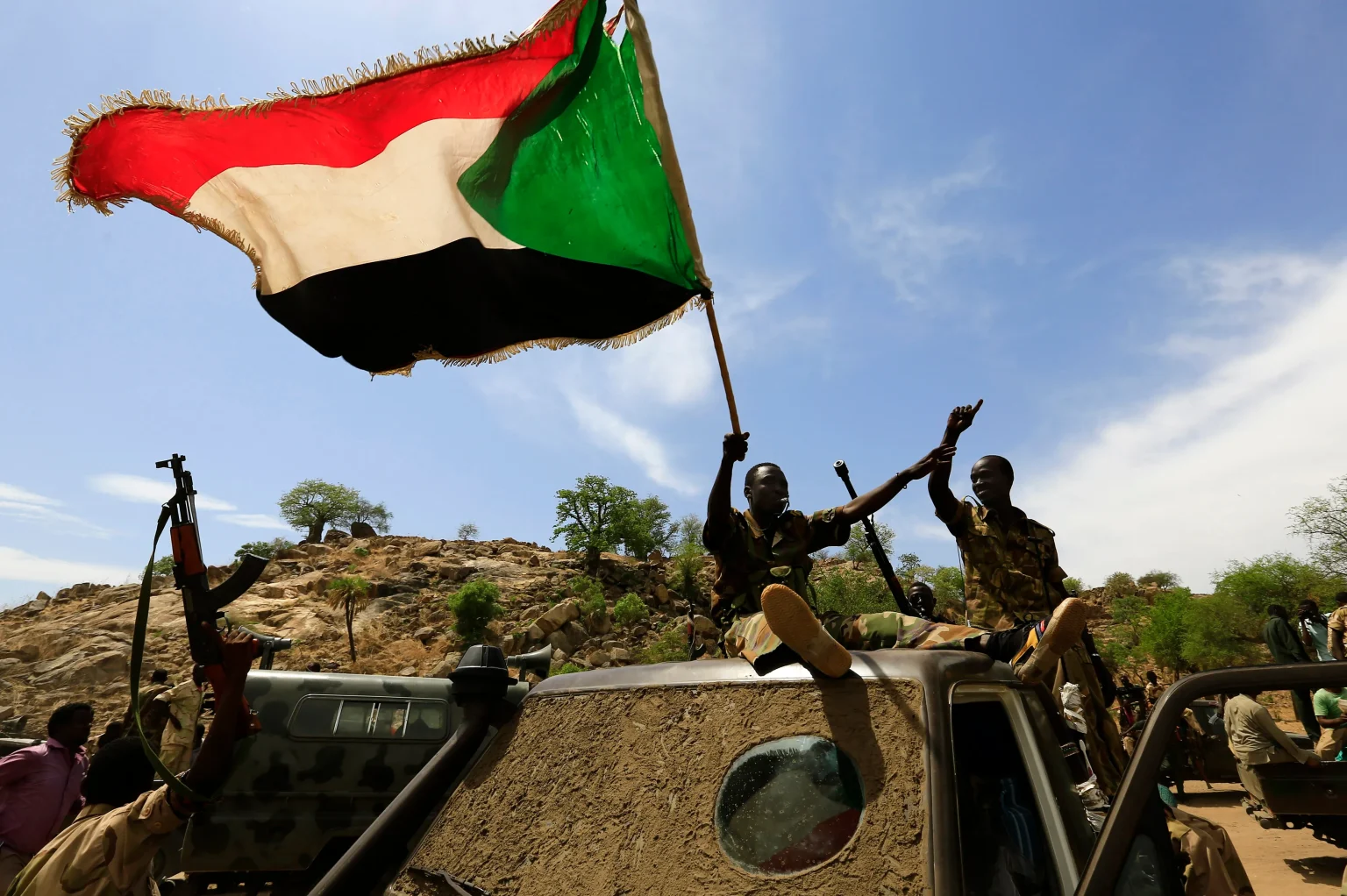


Cairo’s strategic interests in gold, water, and regional dominance have drawn it into direct military involvement in Sudan’s civil war.
This analysis examines Egypt’s evolving role in Sudan’s civil war, which entered its fourth year in April 2026. Drawing on verified field reports, international investigative journalism, think-tank research, and confirmed eyewitness testimony, it argues that Egypt has progressively moved from covert political and logistical support for Sudan’s Armed Forces (SAF) to direct military engagement inside Sudanese territory most recently in a series of drone and airstrike operations that culminated in an aerial attack on artisanal gold miners in the Jabal Al-Aqaydat area of River Nile State on June 17, 2026.
Egypt’s motivation is not purely strategic alignment with an allied government, but is shaped by concrete material interests: access to Sudanese gold reserves that have fortified Egypt’s depleted central bank, control over Nile water politics, and the suppression of a sovereign Sudan capable of asserting its own economic and agricultural independence. These interests, taken together, create a structural incentive for Egypt to perpetuate Sudan’s instability.
The Jabal Al-Aqaydat Attack: What We Know
In the early morning hours of Tuesday, June 17, 2026, aircraft and drones struck artisanal gold mining sites in the Jabal Al-Aqaydat area of River Nile State, northern Sudan one of the country’s largest gold-mining zones, home to an estimated 6,000–7,000 traditional miners from across Sudan and from Chad.
The core facts, as established by multiple independent sources:
Darfur24 reported at least 15 dead and 50+ wounded. SPT, citing field testimonies, reported at least 35 dead and approximately 80 wounded, with dozens missing. Casualty figures in active conflict zones routinely vary in early reporting; the range of 15–35 dead represents a serious atrocity regardless of which figure proves accurate.
Miners, eyewitnesses, and local observers attributed the strikes to Egyptian military forces. Sudan Tribune independently confirmed that survivors blamed the Egyptian military, citing a combat camp established near the al-Ansari and al-Ogaidat mining sites. Egyptian authorities offered a counter-narrative: that Sudanese prospectors had illegally crossed into Egyptian territory to mine near an Egyptian-managed concession.
Eyewitnesses described four warplanes tentatively identified as MiG or Sukhoi aircraft accompanied by drones. The use of drones is consistent with established reporting on Egyptian military operations from East Oweinat.
One witness reported Egyptian aircraft had been conducting surveillance flights over the area since the preceding Friday, suggesting deliberate reconnaissance before the strike behaviour consistent with planned targeting, not a reactive border incident.
More than 24 hours after the incident, neither the Egyptian government, the Egyptian military, nor Egyptian state media had issued any statement. The Sudanese army’s official spokesperson did not respond to media inquiries.
Egypt’s refusal to deny the strikes a standard diplomatic reflex when allegations are false combined with the Sudanese army’s non-response strongly suggests the attack is real and that Khartoum, whose war effort depends on Egyptian support, has calculated that acknowledging the killing of its own civilians by its patron is politically untenable.
Egypt’s Military Footprint in Sudan: The Documented Record
The June 17 attack did not occur in a vacuum. It is the most visible point in a trajectory of escalating Egyptian military involvement that has been documented by major investigative outlets over the preceding two years.
The East Oweinat Base
In February 2026, The New York Times and Reuters published investigations revealing that Egypt had been operating a covert drone hub from East Oweinat a remote desert base near the tripoint border of Egypt, Sudan, and Libya. According to these reports, advanced Turkish-made Akinci combat drones among the most capable unmanned aerial vehicles available, had been conducting strikes deep inside Sudan for at least six months. The Akinci can travel at high altitude, remain airborne for 24 hours, and carry a wide range of munitions. At least two Akinci drones were observed on the tarmac after Turkish cargo aircraft delivered them to the base. They conducted strikes more than 800 miles inside Sudan against Rapid Support Forces (RSF) positions.
Arms Supply and the Joint Defence Pact
The Sudan-based operations monitoring platform liveuamap.com further documented that from June 2025 through January 2026, Egyptian aircraft and drones struck convoys of Emirati weapons transiting the Libya-Sudan border, including convoys that had inadvertently crossed into Egyptian-controlled territory.
Egypt’s support for the Sudanese Armed Forces (SAF) has been consistent since the April 2023 outbreak of war. Cairo provided logistics, intelligence sharing, and military equipment throughout the conflict. In 2024, the Washington Institute for Near East Policy documented this support as a deliberate strategic policy, reflecting Egypt’s longstanding alliance with Sudan’s military establishment.
In October 2024, RSF commander Mohamed Hamdan Dagalo (Hemedti) publicly accused the Egyptian Air Force of striking his positions near Jebel Moya in Sennar State marking the first public attribution of direct Egyptian aerial combat operations inside Sudan. Egyptian officials did not deny the allegation.
Egyptian President Abdel Fattah el-Sisi and Sudan’s Sovereign Council Chairman Abdel Fattah al-Burhan subsequently moved to formalise their military relationship, calling for activation of a joint defence agreement. The Middle East Eye reported in 2024 that Egypt and Turkey had coordinated to boost SAF support following key RSF gains.
The pattern is unmistakable. Egypt began with logistical and intelligence support, graduated to covert drone strikes against RSF forces, and has now if the June 17 evidence holds struck unarmed civilian miners inside Sudan proper. This is an escalation ladder, not an aberration. Each step has gone largely unchallenged internationally, likely reinforcing Cairo’s calculation that it can act with impunity.
The Economics of War: Gold, Resources and Strategic Interest
To understand why Egypt would risk the diplomatic and moral costs of military operations inside Sudan, one must follow the money and here the evidence is substantial.
The Gold Pipeline
Sudan is one of Africa’s largest gold producers. The civil war has disrupted formal export routes and created a parallel economy in which smuggled gold flows northward into Egypt. According to Chatham House’s March 2025 research on gold and Sudan’s war, unofficial and smuggled gold exports from Sudan to Egypt account for approximately 60 percent of production from Northern, River Nile, and Red Sea states. Jabal Al-Aqaydat the very site of the June 17 attack sits within this corridor.
African Business magazine reported in September 2025 that Egypt had adjusted central bank policies to absorb Sudanese gold, with the proceeds significantly strengthening Egypt’s foreign currency reserves at a time when Cairo faces severe economic pressure and IMF scrutiny. The SAF itself has supported this export route.
Darfur Followups documented in October 2025 that Egyptian intelligence had become the dominant actor managing Sudan’s artisanal gold economy, with networks controlling both extraction and export logistics across northern Sudan.
Survivors of the June 17 attack were unanimous in their assessment of motive. As one witness told SPT: “Egypt does not see Sudan as a homeland, nor Sudanese as a people. They see only land and resources.” Another said Egyptian forces had previously conducted ground operations seizing gold and mining equipment in the same area before escalating to aerial bombardment.
If Egypt’s forces did target the Jabal Al-Aqaydat miners, as the evidence strongly suggests, the most plausible motive is not border security. It is control. The attack bears the hallmarks of an attempt to clear independent artisanal miners from territory that Egyptian interests wish to manage directly. Killing miners and seizing their equipment is, bluntly, resource predation under cover of a war.
The Nile Dimension
Egypt’s relationship with Sudan is also inseparable from the politics of the Nile. Egypt draws approximately 97 percent of its renewable water supply from the river and has historically relied on Sudan as a compliant downstream partner in negotiations with Ethiopia over the Grand Ethiopian Renaissance Dam (GERD). A stable, sovereign, and assertive Sudan could challenge this arrangement, pressing its own claims to a greater share of Nile waters, developing its own irrigation infrastructure, and aligning with Ethiopia rather than Cairo.
A prominent Sudanese political figure, quoted anonymously by SPT, made the connection explicit: “While Sudanese blood continues to be shed, Nile waters including Sudan’s shar continue to flow into Egypt.” This is not merely rhetorical. A Sudan mired in civil war cannot build dams, irrigate farmland, or negotiate water treaties from a position of strength.
Diplomatic Duplicity: The Peace Facade
Egypt has publicly presented itself as a peacemaker throughout Sudan’s civil war. Cairo participated in ceasefire negotiations mediated by the United States and Saudi Arabia, joined the Quadrilateral Initiative for peace, and has offered humanitarian rhetoric.
But multiple Sudanese political sources, including figures within the Civil Democratic Forces Alliance, allege that Egypt’s public diplomacy is systematically undermined by its private conduct. Specifically, they assert that the Egyptian regime has used its leverage over SAF leadership to block or delay peace agreements, calculating that a prolonged war preserves Egypt’s economic extraction opportunities and prevents the emergence of a stable, independent Sudanese state.
A senior Sudanese political figure told SPT, on condition of anonymity, that while Egypt publicly endorses the Quadrilateral Initiative, it privately pressures army leaders to reject it. The same source noted that Sudanese gold has “significantly strengthened the reserves of Egypt’s Central Bank throughout the years of war” raising what he called “serious questions about the extent to which the Egyptian regime benefits from the continuation of the conflict.”
Horn Review, in an April 2026 analysis titled “How Deep Is Egypt in Sudan’s War?”, described Egypt’s shift from indirect support to battlefield involvement as a qualitative change in the nature of the conflict one that internationalises the war and diminishes prospects for a negotiated settlement.
A country cannot simultaneously claim to be a peace mediator and operate combat drones over the territory of the country it is mediating for. Egypt’s diplomatic posture is a fig leaf. It serves to forestall international pressure while Egyptian forces and Egyptian economic interests operate freely inside a collapsing Sudan. The international community, including the United States and the European Union, which have publicly engaged with Egypt on Sudan, must confront this contradiction directly.
The Human Cost: A War Without Accountability
Sudan’s civil war is, by multiple UN assessments, the world’s worst humanitarian crisis. As the war entered its fourth year in April 2026, the scale of suffering is staggering:
Nearly 14 million people have been forcibly displaced nine million internally and 4.4 million across borders into Chad, Egypt, South Sudan, and other neighbouring countries. This represents one of the largest displacement crises in recorded history.
Estimates range from tens of thousands to 150,000 dead since April 2023, though the true figure is impossible to establish given access restrictions.
The UN’s rights chief reported that drone strikes killed nearly 700 civilians in just the first three months of 2026, with at least 245 child casualties a sharp increase over the same period in 2025.
More than 1,600 health workers and patients have been killed in attacks on healthcare facilities.
12.7 million people require support services for sexual and gender-based violence, according to UN Women.
Against this backdrop, the June 17 Jabal Al-Aqaydat strike killed people who had already fled violence elsewhere in Sudan miners who had come to the region to earn a living under difficult conditions. As one survivor told SPT: “We fled the war and came here to earn a living through our own hard work under extremely difficult conditions, yet we are being killed by the aircraft of a hostile state inside our own country.”
The miners of Jabal Al-Aqaydat are precisely the population a war is supposed to spare. They were not combatants. They were not affiliated with either warring faction. They were economic migrants within their own country, seeking survival. Their deaths whether caused by Egyptian forces acting in aggressive resource competition, or by a border security operation gone catastrophically wrong represent a war crime under international humanitarian law and must be investigated accordingly.
What Must Happen: A Call for International Action
Sudanese civilian groups and democratic political forces have articulated a clear set of demands for the international community, particularly the United States and the European Union. These include:
Egypt has provided sanctuary for Islamist political and media networks aligned with Sudan’s former regime — networks that complicate any democratic transition.
Egypt’s military supply lines to the Sudanese army extend the capacity of one party to prosecute the war, foreclosing negotiated settlements.
The covert drone base has been documented by The New York Times. International pressure to close or inspect it would directly reduce civilian casualties.
The attack must be independently investigated. If Egyptian forces are responsible, this constitutes a violation of Sudanese sovereignty and international law. If the counter-narrative that Sudanese miners crossed into Egyptian territory is accurate, Egypt is still obligated to use proportionate force against unarmed civilians.
More broadly, influential Sudanese civilian voices argue that no peace process will succeed unless Egypt’s role as a structural driver of the conflict is confronted. The formula is straightforward: as long as Egypt profits materially from Sudan’s disorder in gold, in water politics, in suppressed agricultural competition it has no rational incentive to support a genuine peace settlement.
The international community’s willingness to treat Egypt as a responsible regional actor while that country operates secret drone bases and strikes civilian mining sites is a wrong choice. Egypt depends on IMF support, Western financial flows, and diplomatic legitimacy. These are leverage points. They have not been used. Until they are, the incentive structure driving Egyptian conduct in Sudan will not change.
Conclusion
Egypt began Sudan’s civil war as a partisan backing the SAF diplomatically and logistically in a conflict that is, among other things, a proxy contest for regional influence. That partisan role has become something more dangerous: a direct military actor striking inside Sudan’s territory, killing Sudanese civilians, and extracting Sudanese resources under the cover of a conflict it has helped sustain.
The June 17 attack on Jabal Al-Aqaydat is the clearest expression yet of this transformation. Whether characterised as an act of resource predation, a border security operation, or a deliberate escalation, it killed civilians, was conducted without warning in a densely populated mining area, and has been met with silence by both Cairo and Khartoum the silence of complicity.
Sudan’s war is often described as a proxy conflict between regional powers. What the evidence increasingly shows is that at least one of those proxies has gone well beyond the proxy role. Egypt is no longer merely backing a side. It is fighting and profiting from within.