




Power rarely announces itself. More often it gathers quietly behind closed doors, beyond public scrutiny, where relationships matter more than institutions and influence flows through private conversations rather than parliamentary debate. That is why the recent leak exposing the inner workings of Dialog, an invitation only network co founded by technology investor Peter Thiel and venture capitalist Auren Hoffman, deserves attention far beyond the usual fascination with secretive elite gatherings.
The leaked documents reveal far more than the guest list of another exclusive conference. They offer an unusually detailed glimpse into a world where senior government officials, military leaders, artificial intelligence executives, investors, academics and influential entrepreneurs meet away from public accountability. According to the leaked material, discussions covered subjects ranging from artificial intelligence and military strategy to political movements, social influence and global security. Even more revealing was an internal system reportedly used to rank participants according to their perceived importance, influence and potential value to the network.
None of this proves wrongdoing. Private discussions among influential people are neither illegal nor unusual. Business leaders, politicians and scholars have long gathered in confidential settings to exchange ideas. Yet the Dialog leak raises a more profound question about the changing architecture of political power. Increasingly, the people designing digital infrastructure, financing emerging technologies and advising governments belong to the same tightly connected circles.
The significance of the leak therefore lies less in secrecy itself than in what it reveals about the growing concentration of technological, financial and political influence. Liberal democracies have traditionally relied on visible institutions that separate public authority from private interests. The networks exposed through Dialog suggest those boundaries are becoming increasingly blurred as artificial intelligence transforms both economic competition and national security.
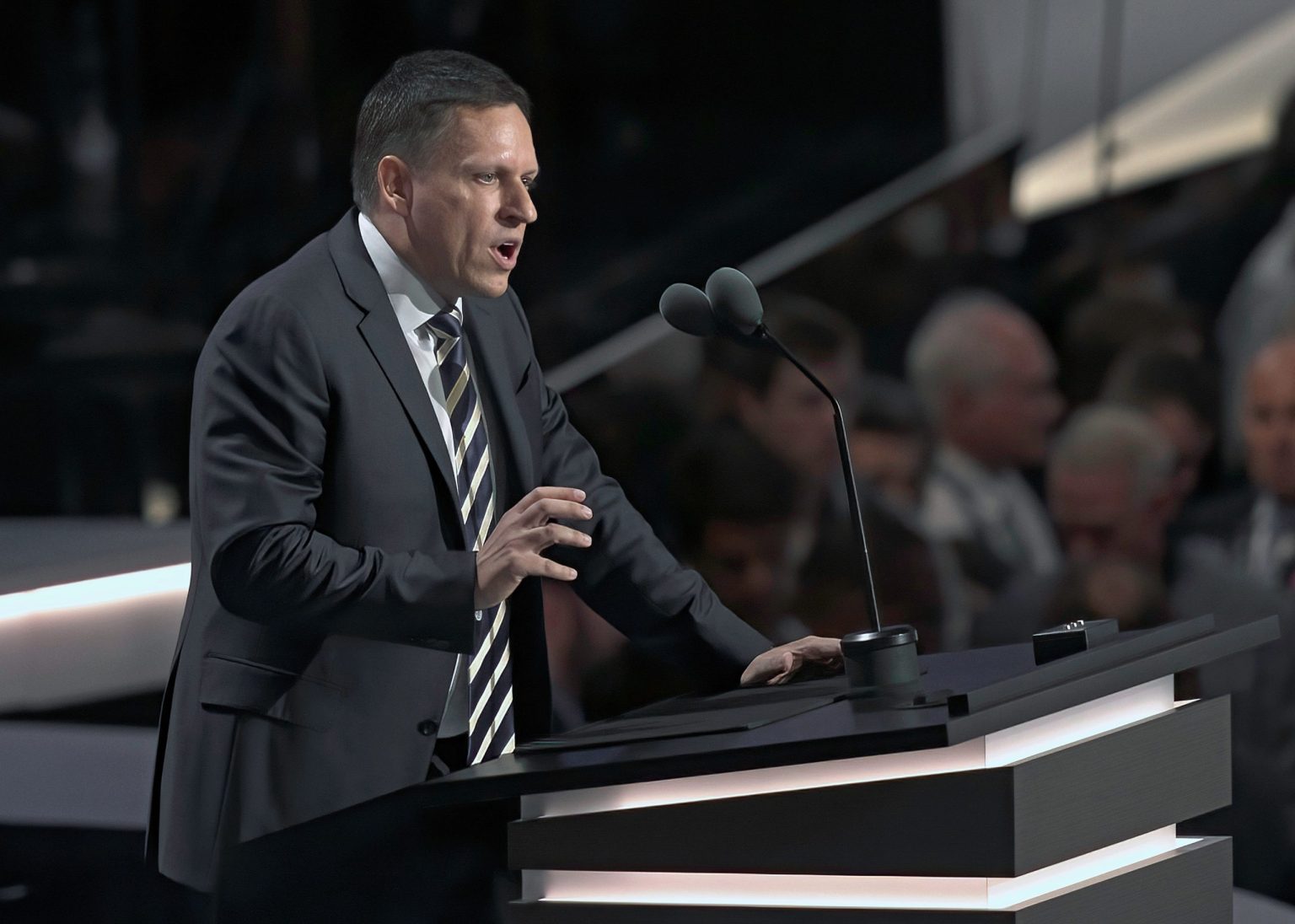
Peter Thiel has occupied a distinctive position within this transformation for more than two decades. A co founder of PayPal, an early investor in Facebook and chairman of defence technology company Palantir, he has become one of Silicon Valley’s most influential political thinkers as well as one of its most controversial investors. His financial success has allowed him to support an ecosystem of entrepreneurs, research institutions, venture capital firms and political candidates that extends far beyond traditional business interests.
Unlike many technology executives, Thiel has never hidden his scepticism towards aspects of liberal democracy. His published essays, speeches and interviews have questioned whether democratic politics can always coexist comfortably with rapid technological innovation. While many critics regard these views as deeply troubling, supporters argue that he is challenging complacent assumptions about government efficiency and technological progress. Those ideas have become increasingly influential as artificial intelligence reshapes economic competition and geopolitical rivalry.
The Dialog network appears to reflect that broader intellectual project. According to media reports based on the leaked records, the organisation has spent years bringing together individuals from politics, finance, academia, defence and technology who would rarely share the same private forum. Organisers describe Dialog as politically diverse and designed to encourage open conversation across ideological divisions. Critics argue that the concentration of power itself is the problem, regardless of political diversity.
The timing of the leak is equally significant. Artificial intelligence has rapidly become one of the defining strategic technologies of the twenty first century. Governments increasingly depend on private companies to develop the large language models, cloud infrastructure, semiconductor supply chains and data systems that underpin both civilian services and military capability.
This shift has fundamentally altered the relationship between states and corporations. During much of the twentieth century governments largely directed technological development through defence spending and public research institutions. Today, many of the most advanced AI systems are designed, financed and controlled by private firms whose commercial ambitions extend across multiple jurisdictions.
The result is an unprecedented concentration of strategic capability. A relatively small group of companies controls enormous computing infrastructure, proprietary AI models and the engineering talent required to develop them further. These same companies increasingly advise governments on regulation while simultaneously competing for lucrative defence and intelligence contracts.
Palantir illustrates this changing landscape particularly well. Originally developed with support from intelligence agencies, the company has become one of the world’s leading providers of software for military planning, intelligence analysis and government administration. Its platforms are now used across defence, healthcare, immigration management and law enforcement in several countries. Supporters argue that such systems improve efficiency and decision making. Critics question whether democratic oversight has kept pace with their expanding role.
Artificial intelligence further complicates this relationship because governments often lack equivalent technical expertise. Regulators increasingly rely upon the same companies they seek to supervise for advice on safety standards, cybersecurity, model evaluation and deployment practices. This creates an uncomfortable dependency in which private firms simultaneously shape the technology, define the risks and help write the rules governing both.
How did this all get leaked?
The Dialog leak also highlights another emerging feature of elite influence. Power today is increasingly networked rather than institutional. Relationships developed through private conferences, venture capital partnerships, university connections and technology investments can become as influential as formal government structures.
This phenomenon extends beyond any single individual. Similar concerns have surrounded exclusive gatherings involving political leaders, financial executives and corporate decision makers for decades. What distinguishes today’s networks is the central role of artificial intelligence and digital infrastructure. Control over algorithms, cloud computing, data collection and semiconductor investment now carries geopolitical significance comparable to energy resources or industrial production in earlier eras.
Privacy represents another important dimension of the story. Ironically, an organisation reportedly dedicated to confidential dialogue suffered a major data exposure that reportedly revealed personal information, internal rankings and organisational records. According to security researchers, the breach exposed not only attendance details but also sensitive internal material concerning participants.
The episode serves as a reminder that no organisation, regardless of wealth or influence, is immune from cybersecurity failures. More importantly, it demonstrates how digital systems capable of organising elite networks can themselves become points of vulnerability. As governments and corporations increasingly rely upon interconnected digital platforms, questions surrounding data governance become inseparable from questions about political accountability.
The broader democratic challenge is therefore not whether influential people should meet privately. Confidential discussions remain essential for diplomacy, business negotiations and scientific collaboration. Rather, the issue concerns transparency surrounding the intersection of public office, commercial interests and strategic technologies.
The Rise of Silicon Valley’s Shadow Establishment
When technology executives advise governments on artificial intelligence regulation while leading companies competing for defence contracts, legitimate questions arise about conflicts of interest. When investors finance both emerging technologies and political movements, distinctions between commercial influence and democratic representation become increasingly difficult to define. When digital platforms shape public discourse while their owners maintain extensive relationships with political elites, accountability becomes more complicated than traditional democratic institutions were designed to manage.
None of these developments necessarily reflect coordinated intent. Modern technological ecosystems naturally encourage close relationships between governments, universities, investors and private industry. Innovation frequently depends upon collaboration across institutional boundaries. Yet the cumulative effect is unmistakable. Decision making concerning some of the world’s most consequential technologies is becoming concentrated within relatively small circles of individuals whose influence extends simultaneously across finance, defence, politics and artificial intelligence.
The leaked records from Dialog do not reveal a hidden government or confirm sweeping conspiracy theories. They reveal something arguably more important. They expose how political influence increasingly operates through networks that exist alongside formal democratic institutions rather than entirely within them. As artificial intelligence becomes essential to economic growth, military capability and public administration, the balance of power is shifting towards those who own the technologies, finance their development and control the relationships connecting both. The central question raised by the Dialog leak is therefore not simply who attended a private gathering. It is whether democratic institutions remain sufficiently equipped to oversee a technological age in which private networks increasingly shape decisions that affect entire societies.