


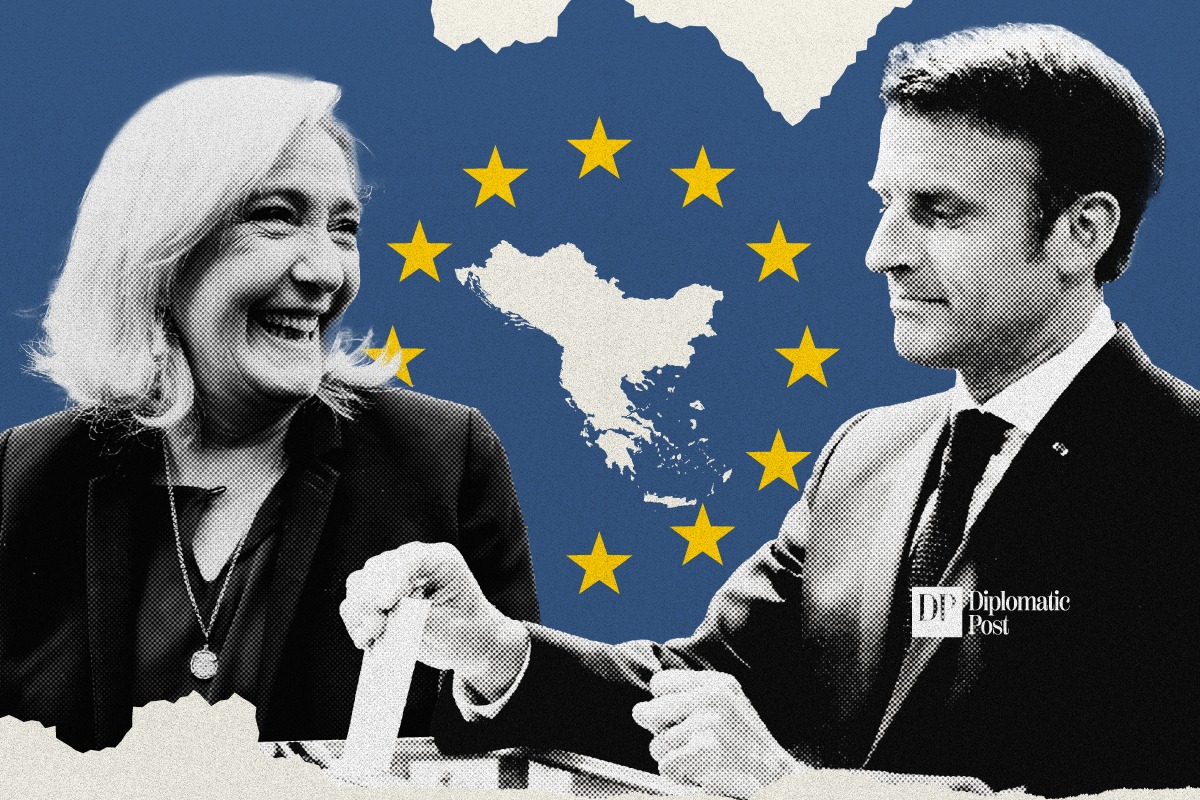
The European Union’s renewed drive to expand eastwards could face its biggest political obstacle yet if French far-right leader Marine Le Pen wins the 2027 presidential election, potentially derailing accession hopes for Ukraine and the Western Balkans at one of the most critical moments in the bloc’s history.
A single ruling from a Paris courtroom this month has done more to unsettle the European Union’s enlargement plans than a decade of vetoes from Budapest and Sofia combined. When judges shortened Marine Le Pen’s ban from public office on 7 July, they did not just reopen her path to the Élysée Palace. They also placed a question mark over the EU’s most ambitious eastward expansion drive since the fall of the Berlin Wall, one that stretches from Podgorica to Kyiv and involves nine candidate countries waiting, in some cases, for two decades to join the bloc.
The stakes could hardly be higher. Montenegro hopes to become the Union’s twenty eighth member by January 2028. Albania is chasing accession the following year. Moldova and Ukraine are aiming to close negotiations around 2028, with membership pencilled in for 2030.
According to official statements from Brussels, enlargement has shifted from a distant aspiration to what the European Commission president has called a genuine strategic choice, driven by Russia’s war in Ukraine and doubts about the durability of American security guarantees in Europe. Yet every one of these timelines depends on unanimous agreement among all twenty seven current member states at more than 150 separate junctures in the accession process. That gives any single government, including a French one, extraordinary power to jam the machinery.
France under a National Rally presidency would not merely be a reluctant participant in that machinery. According to analysis from European foreign policy researchers, it would become the most vocally opposed government among the bloc’s major states. The party’s members of the European Parliament have already voted as a bloc against further enlargement and against deeper European integration, and Jordan Bardella, the RN president who was widely tipped to be the party’s candidate before the court’s decision, has previously argued that admitting Ukraine, with its vast agricultural sector, would represent what he called the final blow to French farming.
Analysts tracking the party’s foreign policy note that National Rally has also warned enlargement would push up the EU’s budget contributions demanded of Paris and further concentrate power in Brussels at the expense of individual states, arguments that resonate strongly with the party’s rural and provincial voter base.
Why Le Pen changes the political maths
Until this month, most observers assumed Bardella, Le Pen’s thirty year old protégé, would be the RN’s standard bearer in April 2027, given her conviction for embezzling European Parliament funds. Recent polling from French pollster Elabe put the RN camp on roughly thirty four to thirty seven per cent of first round voting intentions, comfortably ahead of any rival grouping, with President Emmanuel Macron barred from a third term by constitutional limits and his own centrist bloc badly weakened. The appeals court ruling has now returned Le Pen herself to the race, and according to the same poll she has actually extended her lead since the verdict, gaining several points as sympathy and defiance among her base translated into support.
The distinction between Bardella and Le Pen matters more than it might first appear for enlargement watchers. Both figures share the party’s core scepticism, but Le Pen carries decades of personal association with a harder edged, more confrontational brand of nationalism, along with a history of warmer rhetoric towards Moscow that has only recently been played down.
“Le Pen will probably remain high in opinion polls and will be the favourite to win a plurality of votes in the first round,” the EPC wrote, although it noted that France’s two-round electoral system means she would still need to assemble a majority in the runoff.
Security analysts examining the party’s foreign policy record describe an outfit that has never developed a coherent international vision, instead treating issues such as Ukraine and enlargement as convenient wedge issues to be deployed when politically useful. That unpredictability is itself a source of anxiety for the Western Balkan governments and Ukraine, all banking on a stable, well telegraphed accession timetable from Brussels over the coming years.
What a Le Pen or Bardella presidency would mean in practice has already been sketched out in scenario planning by European policy researchers. Rather than simply abstaining from summits, a National Rally government could actively skip EU Western Balkans gatherings while sending senior officials to rival bilateral meetings with candidate country leaders, framing enlargement as unnecessary for regional partners who could instead deepen trade ties with Paris outside the Union’s institutional structure. Such an approach would not technically require a veto to inflict damage. Simply refusing to engage constructively at any of the numerous unanimity points in the negotiating process, from opening chapters to ratifying final accession treaties in the French parliament, would be enough to stall or indefinitely delay countries that are otherwise close to the finish line.
The frontrunners with the most to lose
Montenegro is widely regarded as the closest to completion, having provisionally closed a substantial share of its thirty three negotiating chapters and received praise from the Commission for maintaining reform momentum. Its government has warned publicly that failure to deliver on its accession would send what one senior Montenegrin official described as a dreadful signal to the rest of the region, undermining the EU’s credibility just as it is trying to prove enlargement is not merely rhetorical. Albania sits close behind, with only a residual bilateral dispute with Greece over maritime borders left to resolve. Serbia, North Macedonia and Bosnia and Herzegovina trail further back, hampered respectively by political unrest, unresolved constitutional issues and an internal crisis in Republika Srpska.
Crucially, even a French veto exercised late in the process, for instance at the ratification stage after all thirty three chapters have closed, could theoretically unwind years of painstaking work by candidate governments. Accession treaties require ratification by every national parliament, and the French National Assembly, where the RN and its allies already command a substantial bloc of seats, would offer another potential chokepoint even in scenarios where the party did not control the presidency outright.
None of this is guaranteed to happen. Enlargement sceptics have wielded outsized influence in the EU before without ultimately blocking accession altogether, as North Macedonia’s decade long stand off with Greece and Bulgaria demonstrated before both disputes were eventually resolved. French governments across the political spectrum have also historically balanced domestic scepticism about enlargement with a reluctance to be seen isolating themselves diplomatically from Berlin, Warsaw and the Baltic states, all of whom view rapid Balkan and Ukrainian accession as a matter of hard security in the shadow of Russian aggression. A National Rally presidency determined to pick fights with Brussels and with fellow European governments simultaneously would risk precisely the kind of French isolation that has previously constrained even the most Eurosceptic voices in Paris.
What is different this time is the calendar. Montenegro’s 2028 target, Albania’s 2029 ambition and Ukraine’s 2030 horizon all fall squarely within the term of France’s next president, who takes office in May 2027. For the first time, a French election result could arrive at precisely the moment several candidate countries are approaching their final, most vulnerable stretch, when unanimity is hardest to secure and a single obstructive capital carries the greatest weight. Decision makers in Podgorica, Tirana and Kyiv now have good reason to watch the French campaign as closely as they watch Brussels itself, because the road to membership may run, in the end, through a ballot box in Paris rather than through any negotiating chapter.