




Brazil is seeing increasing demand for its vast reserves of rare earth elements. Global mining giants are betting on Brazil as the next powerhouse for critical magnetic metals and an alternative to China’s dominance.
Brazil holds the West’s best alternative to Chinese rare-earth dominance, but its institutions are not built for the pace the moment demands. There is a new rush for resources taking shape in Brazil. But this time, it is not about gold, coffee or rubber. Instead, the focus is on the gold of the artificial intelligence and renewable energy era: rare earths.
“The next big rare earth projects in the world will be in Brazil,” the geologist Andrew Tunks, CEO of the Australian mining company Meteoric Resources, told DW. “I don’t know how long it will take,” Tunks said, “but I think in time [Brazil] will compete with China.”
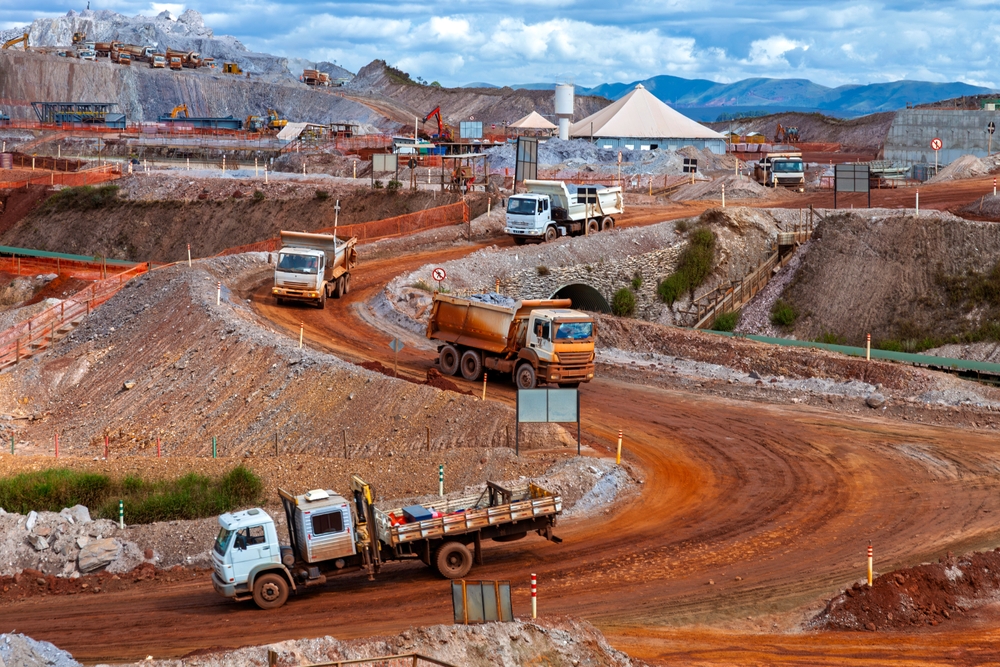
Meteoric is investing heavily in rare earth mining in Brazil. Its so-called Caldeira project, located in the state of Minas Gerais, is believed to be the world’s largest ionic clay deposit.
Ionic clay deposits are among the most important sources of “medium” and “heavy” rare earths, such as dysprosium and terbium, which are essential for the high-performance magnets used in wind turbines and electric vehicles.
What is happening in Brazil right now is not a single deal but a queue. The European Union pitched Brasília a critical minerals partnership last month. The United States, South Korea, Japan, India, Canada, Australia, and China are all already in line ahead of it.
Every one of them wants access to the same thing: reserves that make Brazil the world’s second-largest holder of rare earths, the group of seventeen elements that go into fighter jet magnets, missile guidance systems, electric motors, and wind turbines, and that China currently processes almost entirely on its own.
The scale of interest reflects how critical mineral security has become a defence and industrial planning problem rather than a purely commercial one. What it does not reflect is Brazil’s actual capacity to deliver.
Brazil holds an estimated 21 to 22 million tonnes of rare earth reserves, against China’s roughly 44 million tonnes, according to Brazilian government and industry data. Yet the country accounts for less than two per cent of global rare earth production.
Its first commercial-scale operation, the Serra Verde mine in Goiás state, took a decade to move from discovery to production, delayed by licensing, permitting, and logistical bottlenecks that mining executives describe as characteristic of Brazil’s regulatory environment. Communities near prospective sites, wary since fatal tailings dam disasters in Minas Gerais, have hardened resistance to new projects, and permitting for a mine can still take five to ten years.
Serra Verde is nonetheless the proof of concept that the rest of the world is now racing to control. It is the only site outside Asia currently capable of producing all four magnetic rare earths at commercial scale: neodymium, praseodymium, dysprosium, and terbium, the elements that go into the permanent magnets used in everything from precision-guided munitions to electric vehicle motors.
Washington’s Foothold
In April, Oklahoma-based USA Rare Earth agreed to acquire Serra Verde’s parent company for close to 2.8 billion dollars in cash and stock, the largest single foreign investment yet in Brazilian rare earth infrastructure. The deal gives the company an integrated mine-to-magnet platform spanning Brazil, the United States, and beyond, pairing an operating asset in Goiás with its own Round Top project in Texas.
The transaction followed a three-hour White House meeting between President Donald Trump and Brazilian President Luiz Inácio Lula da Silva in May, convened as Washington sought to line up alternatives to Chinese supply ahead of a separate diplomatic engagement with Beijing.
But Lula’s message at that meeting was pointed. Brazil’s reserves, he said, were open to China and any other nation willing to mine, separate, and process the minerals on Brazilian soil. He has repeated the same formula to European, Japanese, and German officials. Brazil’s antitrust regulator, CADE, is still reviewing the Serra Verde transaction, and Brasília has made clear that no foreign buyer receives exclusivity simply by writing the largest check.
Brussels’ Counter-Pitch
The European Union has tried to compete on different terms. Sourcing all of its heavy rare earths from China as of 2023, the bloc’s Critical Raw Materials Act sets a target of processing 40 per cent of its strategic mineral consumption domestically by 2030 and caps any single non-EU supplier at 65 per cent of a given material. During a visit to Brazil last month, the EU’s international partnerships commissioner argued Brussels was offering better terms than Washington or Beijing precisely because its pitch centred on funding local refining rather than extraction alone, pointing to a rare earth research and separation facility in Minas Gerais run by an Australian miner as a model.
A parallel EU-Mercosur trade agreement, still awaiting full ratification, envisions rare earth separation facilities inside Brazil as part of its critical minerals provisions, though European Parliament review and opposition from several member states mean ratification is unlikely before 2027.
Beijing’s Quiet Advantage
For all the Western diplomatic activity, China remains the destination for more than 60 per cent of Brazil’s rare earth exports, absorbing the bulk of unprocessed material regardless of who owns the mine it came from. That is the structural problem underneath the entire competition: without domestic separation and refining capacity inside Brazil, ore extracted under American, European, or Australian ownership still travels to Chinese refineries because no comparable processing capacity exists anywhere else at scale.
Brazilian officials have acknowledged this gap explicitly, and it is why Lula’s government has tied foreign investment to a hard condition, that processing stay onshore, rather than treating extraction rights as the prize.
Chinese capital, meanwhile, has not been frozen out. Brazil attracted the largest share of China’s outbound investment of any single country in 2025, according to figures from the Brazil-China Business Council, and Beijing has continued to frame its role as a stabilising supplier of technology and capital rather than a rival to be excluded.
Brazil’s Congress is still assembling the legal architecture meant to govern all of this. As of April, lawmakers were weighing thirteen separate bills addressing rare earths and critical minerals, alongside a package combining a two-billion-dollar guarantee fund and roughly five billion dollars in tax credits meant to de-risk domestic processing investment.
None of it is finished law, and none of it is insulated from Brazil’s October elections, a contest between the 80-year-old Lula, seeking an unprecedented fourth term, and Flávio Bolsonaro, son of the former president and a candidate expected to tilt further toward Washington. Lula currently leads narrowly in polling, but investors weighing decade-long infrastructure commitments have to price in the chance that the rules change with the government.
Brazil, in other words, holds the geology the rest of the world is competing over, without yet holding the institutions to convert that geology into finished supply chains on anyone’s timeline but its own. Serra Verde took ten years to reach first production.
Whether it’s new American owners, its European suitors, or its long-standing Chinese customers, getting there any faster than that is still, for now, an open question inside Brasília’s own bureaucracy.