




Beijing’s new four-stage account of Communist Party history hands Xi Jinping a legacy separate from Deng Xiaoping, just as the military he commands is being hollowed out from within
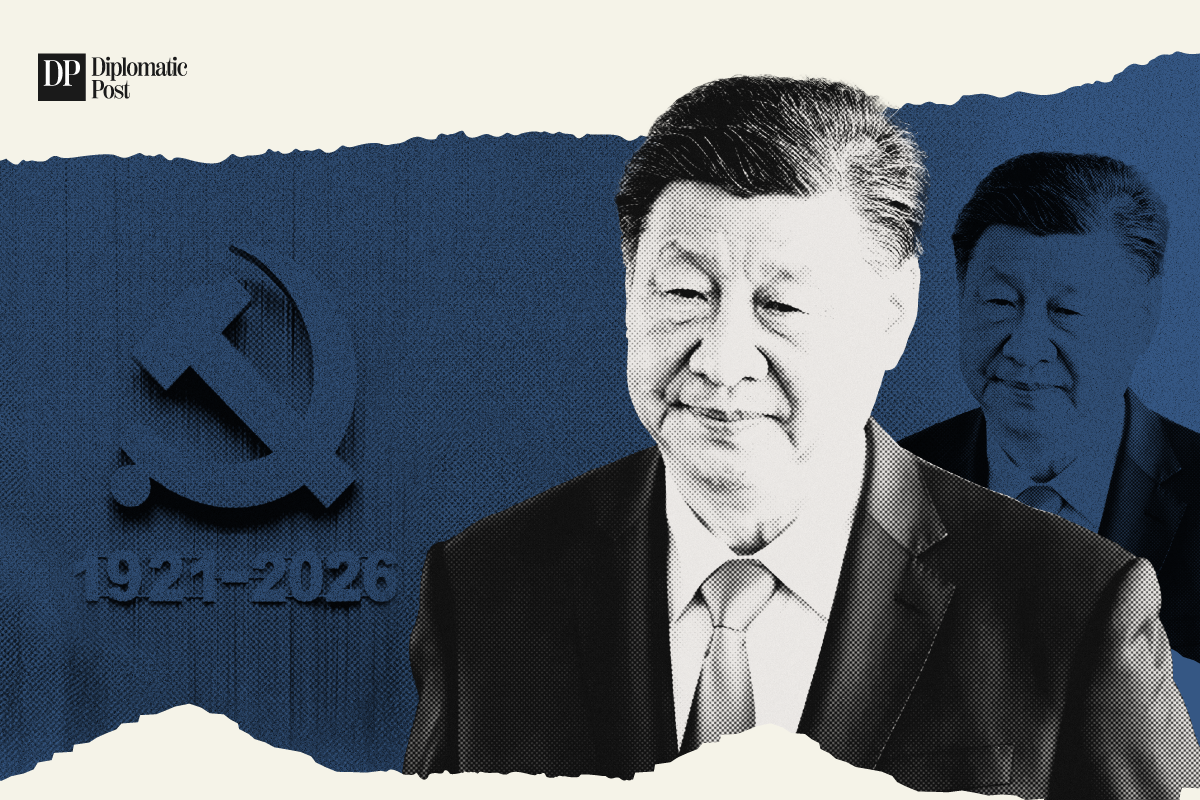
What Xi Jinping did on July 1 was rewrite the Chinese Communist Party’s own timeline. At the ceremony marking the party’s 105th anniversary, Xi described its history as moving through four stages: revolution, construction, reform, and what he calls the New Era. For decades, official doctrine treated reform and opening up, the period Deng Xiaoping launched in 1978, as continuing indefinitely. Xi has now cut a separate chapter out of it and put his own name on the label.
This is not archival housekeeping. In a system where legitimacy runs through the person who leads the party rather than through elections or courts, deciding who owns which era of history is one of the most consequential things a Chinese leader can do.
A Fourth Chapter, Written by Its Author
Under the old three-stage account, Mao Zedong owned revolution and the founding of the state. Deng owned the reform, though he had to share that credit with successors Jiang Zemin and Hu Jintao, who deepened market opening and pursued China’s entry into the global economy. Xi’s insertion of a fourth stage lets him claim a period that belongs to him alone, distinct from Jiang and Hu and, in ambition, from Deng himself.
According to analysts who track CCP ideological messaging, the distinction Xi is drawing is between wealth and strength. Deng’s project addressed how China could become rich.
Xi’s New Era is framed around how China becomes strong, militarily, technologically, and in its capacity to set terms with the outside world, rather than simply join a system built by others. Xi has not challenged Mao’s position atop the hierarchy. His portrait still hangs over Tiananmen Square, and his image remains on the currency. But the New Era designation positions Xi to stand second only to Mao, ahead of Deng, in the party’s own account of itself.
The July 1 speech reinforced this with an additional layer. According to Chinese state media, a party symposium in June formally elevated “Xi Jinping Thought on Party Building” alongside existing doctrines on the economy, law, culture, ecology, military affairs, diplomacy, and national security. Party building now sits as a named pillar of Xi’s ideological system, on the same level as the military and foreign policy theories that already carry his name.
The Military Underneath the Rhetoric
The speech’s substance on defence matched its ambition on history. Xi called for accelerating military modernisation and building what he termed a world-class military, alongside tighter political control over the People’s Liberation Army. On Taiwan, he repeated the party’s standing position that unification remains an unshakeable historical mission, while warning against outside interference.
That rhetoric sits uneasily against the condition of the institution meant to deliver it. Since 2022, more than 100 PLA officers holding three-star rank or above have been purged or are believed to be under investigation, according to regional security analysts tracking the campaign.
Of 47 officers who held that rank in 2022 or were promoted to it afterwards, analysts estimate that as many as 41 have been removed. The Central Military Commission, the body that sits atop the entire military chain of command and normally carries seven members, now operates with two: Xi himself and a political commissar who previously ran internal disciplinary investigations.
The two most senior officers purged, CMC vice chairman Zhang Youxia and Joint Staff Department chief Liu Zhenli, were removed in January 2026. Zhang was among the last serving PLA officers with actual combat command experience, dating to China’s 1979 war with Vietnam. His departure, alongside the earlier removal of Rocket Force commander Wang Houbin and other senior political officers, has stripped out a significant share of the institutional knowledge needed to plan and execute a large joint operation.
Taiwan and the Widening Gap
The timing matters because Beijing has simultaneously escalated its rhetoric on Taiwan. The PLA carried out a large encirclement exercise around the island in late 2025, and Xi personally warned President Donald Trump in a May 2026 summit that mishandling the Taiwan question could push the relationship toward direct clashes. Yet regional security analysts argue the purge cuts against any near-term operational timeline, precisely because it has hit hardest in the Joint Staff Department, the body responsible for combat planning and the coordination a Taiwan campaign would require.
China’s shipbuilding and hardware programme has not slowed. The PLA Navy has commissioned twelve submarines, an aircraft carrier, and multiple destroyers and frigates since 2024, giving it more hull numbers than the US Navy, and the defence budget rose again this year to roughly 276.7 billion dollars. What has been disrupted is command continuity rather than production. Analysts assessing the purge’s effects note that officers under a cloud of suspicion tend to default to rigid compliance with existing procedure rather than the judgment and initiative a complex amphibious operation would demand.
Why Does History Matter Now
Read together, the ideological and military stories point to the same underlying condition. Xi’s New Era claim to history is, in part, an attempt to resolve a succession question the party has never formally answered under his rule. Jiang and Hu each operated within a system that assumed an orderly, term-limited transition. Xi abolished presidential term limits in 2018 and has not designated a successor. A four-stage history that ends with him, rather than treating reform as an open-ended, shared project, forecloses the possibility that a future leader simply continues Deng’s era under a different name.
The same logic explains the depth of the military purge. A leader whose legitimacy rests on personal authority rather than institutional process has a strong incentive to treat any concentration of loyalty elsewhere, even among generals he personally promoted, as a threat rather than an asset. The cost is a command structure that looks, on paper, unprecedented in scale and modern in equipment, and that in practice runs through a Central Military Commission of two.
Xi’s speech asked the party to remember its history as an unbroken march toward strength under his personal direction. The Central Military Commission’s empty seats are a part of that history nobody read aloud on July 1.