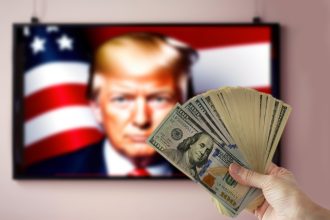





Donald Trump has just disclosed that he earned more than $1.4 billion from cryptocurrency ventures in his first year back in office. The industry he profited from was the same industry he spent that year deregulating. No law stopped him from doing either.
Donald Trump did not merely return to the White House. He returned as one of the biggest winners of the cryptocurrency boom. Financial disclosures released this week show that the US president earned more than $1.4 billion from crypto-related ventures in 2025 alone, an extraordinary sum that places him at the centre of an industry his own administration has spent the past year helping to reshape.
The filings reveal a presidency unlike any America has seen before. Trump reported $635 million in royalties from Celebration Coins, the company behind the $TRUMP memecoin launched just before his inauguration, and more than $500 million from World Liberty Financial, a cryptocurrency platform co-founded by his sons alongside the family of his Middle East envoy, Steve Witkoff. Altogether, his declared income exceeded $2.2 billion, more than three times the amount reported a year earlier.
The timing is impossible to ignore. While these ventures generated unprecedented wealth for the president, the White House pursued one of the most crypto-friendly policy agendas in modern US history.
Regulators softened their approach, enforcement actions were dropped, and Congress advanced legislation designed to expand the digital asset industry. The result is an extraordinary overlap between public policy and private profit that is likely to become one of the defining ethical and political controversies of Trump’s second presidency.
The Mechanics of What Cannot Be Called Illegal
The central legal fact of Trump’s crypto fortune is that it exists in a space that American law has not closed. Unlike virtually every other senior government official, the president and vice president of the United States are explicitly excluded from federal conflict-of-interest statutes.
The law that prevents a cabinet secretary from holding financial interests in companies they regulate does not apply to the person sitting above every cabinet secretary. Trump has noted this himself, correctly. When reporters asked about his earnings on Wednesday, he responded with characteristic brevity: “I don’t get involved in my personal finances; we have funds that run my money.”
The White House has repeated its standard denial with equal brevity. Neither the president nor his family has ever engaged in conflicts of interest, a spokesman stated, and any suggestion otherwise repeats a false narrative pushed by the opposition for a decade. The Trump Organisation described the filing’s length as evidence of transparency.
Ethics officials and legal scholars took a different view. The former chief White House ethics lawyer under President George W. Bush told the BBC, without qualification, “Of course it’s a conflict of interest.”
The former acting head of the federal Office of Government Ethics, citing decades of precedent, observed that voluntary adherence to conflict-of-interest standards had been a consistent expectation for presidents going back to Watergate, and that with Trump “those norms are just totally out the window.” A Rice University historian summarised the filing’s most striking quality plainly: no president in the 20th or 21st century has had anything “vaguely comparable.”
Trump broke with the practice of every recent predecessor by entering office without selling his holdings or placing them under independent management, a decision whose consequences are now documented in 927 pages of required government disclosure.
The specific transactions that generated the most scrutiny go beyond the headline crypto numbers. The disclosure shows that Trump’s investment accounts purchased shares in the GEO Group, a private prison company and one of the largest contractors with the federal Immigration and Customs Enforcement agency, beginning ten days after his inauguration.
As the number of immigrant detainees doubled from 35,000 to nearly 70,000 during his first year, the purchases continued. Separately,
Trump purchased shares in Nvidia after his administration announced that the chipmaker would be permitted to resume selling its H20 chips to China in exchange for export cooperation, a sequence that ethics lawyers described as a pointed example of the problem the conflict-of-interest statutes were designed to address and cannot, in the president’s case, address.
A UAE-linked company’s purchase of a 49 per cent stake in World Liberty Financial for $500 million, made before Trump’s administration approved the export of advanced Nvidia chips to the United Arab Emirates, added an international dimension. No formal connection between the two transactions has been established. The timing has generated bipartisan demands for an investigation.
What the Disclosure Reveals About Power Without Accountability
The $TRUMP memecoin that generated $635 million for the president has lost more than 97 per cent of its value since its January 2025 launch peak of over $74. It now trades below $2. World Liberty Financial tokens have lost roughly 80 per cent of their value.
The investors who bought these instruments on the strength of their direct association with a sitting head of state lost the overwhelming majority of what they put in. The president, who received 75 per cent of net revenue from World Liberty token sales under the project’s terms, kept the proceeds.
A poll conducted in May 2026 found that 62 per cent of registered American voters did not trust the Trump administration to regulate cryptocurrency. The disclosure filed on Tuesday explains, in 927 pages of granular detail, the precise nature of their concern.
The president made $1.4 billion from an industry he regulated in directions that benefited it. The investors who followed him into that industry collectively lost most of what they spent. No law was broken. No sanction will follow. The only accountability mechanism available is the one that published these figures on Tuesday, and which Trump is legally obliged to complete once a year, and which the White House described as evidence of transparency.