


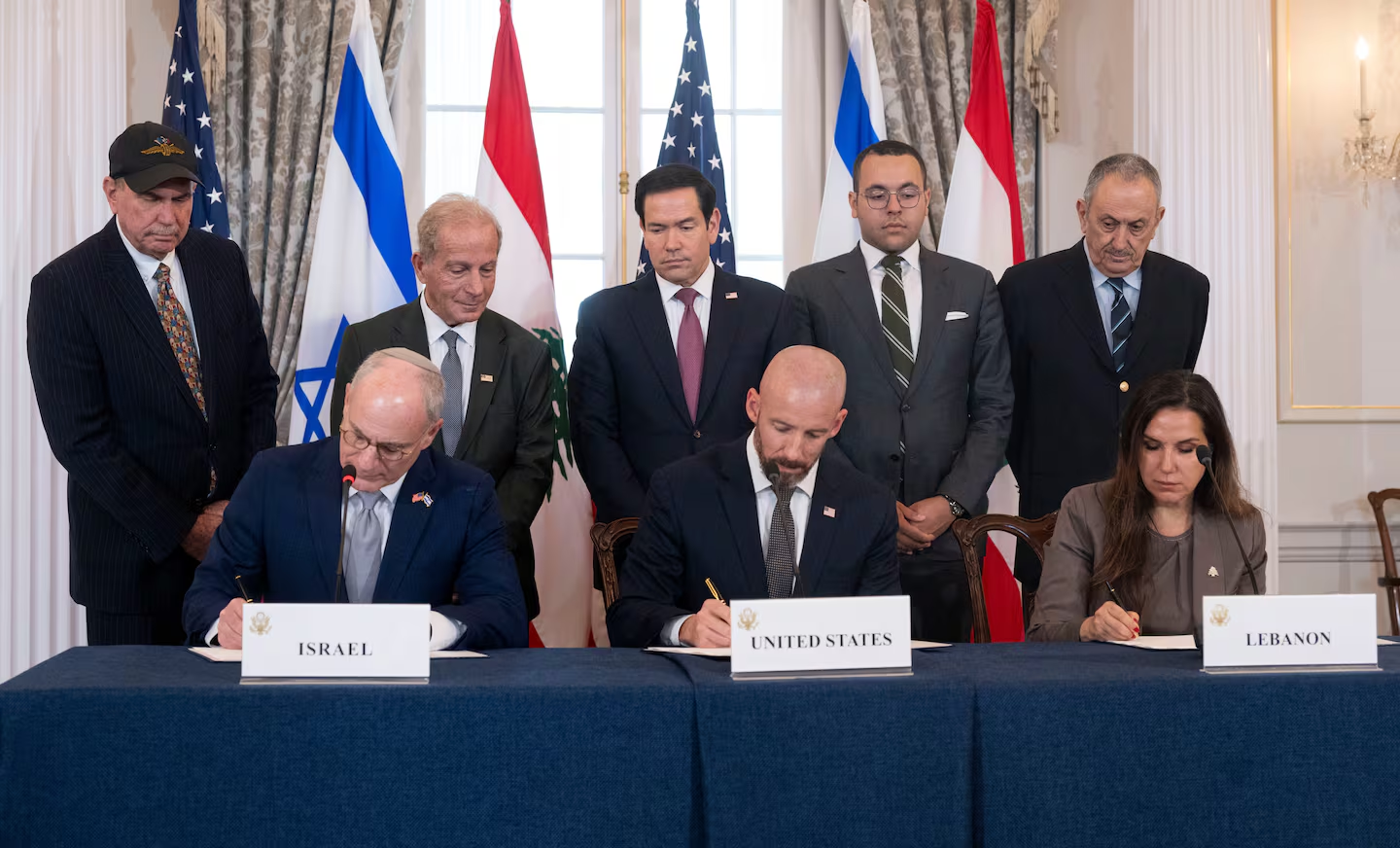


The framework agreement signed between Israel and Lebanon in Washington represents one of the most structured diplomatic attempts in years to stabilize a border that has remained in a permanent state of low-intensity war. Yet despite the language of coordination and sovereignty restoration, the deal is best understood not as a peace agreement, but as a sequenced security arrangement built on conditional withdrawal and contested enforcement authority.
- A “sequenced process” rather than a peace settlement
- The Israeli position: security-first, withdrawal-last
- The Lebanese position: sovereignty as restoration, not conditionality
- The missing actor: Hezbollah outside the negotiating table
- Military realities on the ground: fragmented control and continued strikes
- The “pilot zones” model: experimental sovereignty
- Strategic implications: institutionalizing managed instability
- A framework built on unresolved contradictions
Brokered by the United States and signed alongside Washington as a trilateral party, the agreement establishes what Secretary of State Marco Rubio called “the beginning of the beginning”—a formulation that reflects both ambition and uncertainty. The framework does not resolve the core strategic contradiction on the ground: Israel’s continued military presence in southern Lebanon and Hezbollah’s continued armed status inside the Lebanese state system.
A “sequenced process” rather than a peace settlement
At the heart of the agreement is a step-by-step mechanism linking two politically incompatible objectives:
- The disarmament of non-state armed groups, explicitly targeting Hezbollah
- The progressive redeployment of Israeli forces from Lebanese territory
The sequencing is deliberate and consequential. Under the framework, Lebanese state authority—primarily through the Lebanese Armed Forces—is expected to establish “effective sovereign control” over all Lebanese territory before Israel undertakes full withdrawal steps.
In practical terms, this creates a conditional sovereignty model, where Lebanon’s territorial integrity is restored only after the neutralization of internal armed actors that the agreement defines as illegitimate.
This structure is not neutral. It embeds a political hierarchy: security consolidation inside Lebanon is treated as a precondition for external military disengagement.
The Israeli position: security-first, withdrawal-last
For Israel, the framework formalizes a long-standing strategic doctrine: territorial presence is retained until the elimination of perceived security threats.
Israeli officials have consistently framed the agreement as contingent on Hezbollah’s disarmament, with indications that even full compliance may not guarantee immediate withdrawal. This position introduces ambiguity into the end-state of the agreement, particularly given statements suggesting Israel could maintain positions “beyond” disarmament requirements if security conditions are deemed unstable.
This creates a structural asymmetry:
- Lebanon is required to demonstrate territorial control and internal disarmament progress
- Israel retains operational flexibility over timing and scope of withdrawal
In effect, withdrawal becomes a discretionary outcome rather than an automatic phase transition.
In the meantime, Lebanese Prime Minister Nawaf Salam said in a statement that the agreement “aims to achieve an Israeli withdrawal from all Lebanese territory, restore state sovereignty over it, and facilitate the return of its citizens” and that under it Lebanon is obligated to “extend the authority of the Lebanese state, through its armed forces, over all its territory.”
Lebanese President Joseph Aoun had told a visiting British parliamentary delegation on Wednesday that a proposal for “pilot zones” where the Lebanese army is supposed to take exclusive control of the territory as Israeli troops will withdraw was “under discussion pending approval from the Israeli side.”
Israel’s direct negotiations with Lebanon include discussions about the redeployment of Israeli forces after southern Lebanon is cleared of Hezbollah infrastructure and Hezbollah has disarmed, said an Israeli official who spoke on the condition of anonymity because they were not authorized to speak to the media.
Israeli Prime Minister Benjamin Netanyahu said in a video on Friday that the framework is a “great achievement” for Israel.
“The most important thing, first and foremost, is that Israel will remain in the security zone in southern Lebanon,” he said. “This is a major achievement, and we will maintain it as long as Hezbollah has not been disarmed and as long as it continues to pose a threat to the State of Israel.”
Netanyahu said that Israel is allowing the Lebanese army to begin preparing to take control of territory, while the Israeli military is establishing two pilot zones.
“A small part of it is within the expanded security zone that we secured over the past two weeks and which, the IDF has made absolutely clear, it does not need,” Netanyahu said. “In other words, we are maintaining the original security zone at all times, outside the range of anti-tank missiles.”
The Lebanese position: sovereignty as restoration, not conditionality
Lebanese officials have presented a fundamentally different interpretation. Prime Minister Nawaf Salam has emphasized that the agreement aligns with existing UN frameworks affirming Lebanese sovereignty over all territory.
From Beirut’s perspective, the deal is framed less as a new political settlement and more as a reactivation of long-standing international resolutions that Israel has never fully implemented.
However, Lebanon’s position is constrained by internal fragmentation. Hezbollah remains both:
- A dominant military actor outside state command structures
- A political force embedded within Lebanon’s parliamentary system
This duality makes the Lebanese state simultaneously a party to the agreement and partially unable to enforce its central condition.
The missing actor: Hezbollah outside the negotiating table
A defining feature of the framework is the absence of Hezbollah from formal negotiations, despite being the central variable in the agreement’s logic.
Hezbollah’s stated position rejects:
- Any phased disarmament sequence
- Any normalization with Israel
- Any arrangement perceived as imposed through external mediation
The group’s leadership has explicitly argued that disarmament without Israeli withdrawal reverses the logic of sovereignty restoration, while warning that attempts to enforce such provisions could trigger internal conflict dynamics within Lebanon.
This creates a core enforcement paradox:
the agreement depends on compliance from an actor that rejects both its legitimacy and its sequencing logic.
However, Hezbollah is unlikely to agree to any plan that would include its disarmament throughout the country. The group has maintained that it is only required by previous agreements and U.N. resolutions to disarm in the area south of the Litani River, near Lebanon’s border with Israel.
Hassan Fadlallah, a member of Hezbollah’s parliamentary bloc, reiterated the group’s stance on Beirut-based pan-Arab Al-Mayadeen TV that it rejects Lebanon’s direct negotiations with Israel and that it will not give up its weapons.
Fadlallah said Lebanese authorities “will not be able to enforce the agreement signed in Washington unless they go, with American support, to civil war.” He also called the agreement in Washington “an attempt to derail the Islamabad process,” referring to the U.S.-Iran negotiations.
Military realities on the ground: fragmented control and continued strikes
The operational environment in southern Lebanon remains inconsistent with any stable ceasefire model.
Despite periodic de-escalation arrangements, Israel continues to conduct airstrikes across southern Lebanon and the Bekaa Valley, targeting what it describes as Hezbollah infrastructure. At the same time, Israeli forces maintain a presence in parts of southern Lebanon, with estimates suggesting control over a significant portion of territory near the border zone.
This has produced a hybrid conflict environment characterized by:
- Partial de-escalation frameworks
- Ongoing kinetic operations
- Localized displacement and infrastructure destruction
- Absence of a fully enforceable ceasefire regime
The result is not post-conflict stabilization, but managed confrontation under diplomatic supervision.
The “pilot zones” model: experimental sovereignty
One of the most significant innovations in the framework is the creation of “pilot zones” for phased Israeli withdrawal. In these areas:
- Lebanese forces are expected to assume security control gradually
- Reconstruction efforts would begin after verified disarmament
- Civilian return would be permitted under state authority
This introduces an experimental governance model where sovereignty is tested incrementally rather than restored uniformly.
However, this approach carries inherent risks:
- It fragments territorial recovery into conditional micro-processes
- It ties humanitarian reconstruction to security compliance benchmarks
- It risks creating uneven sovereignty zones within a single state
In effect, Lebanon’s territorial restoration becomes modular and conditional rather than absolute and immediate.
Strategic implications: institutionalizing managed instability
While presented as a pathway toward stabilization, the framework may instead institutionalize a long-term equilibrium of controlled insecurity.
Three structural dynamics stand out:
1. Conditional sovereignty becomes normalized
Lebanon’s full territorial authority is postponed until internal armed actors are neutralized—a condition that may be politically unattainable in the short term.
2. Withdrawal is decoupled from fixed timelines
Israel’s redeployment is tied to security verification rather than calendrical commitments, allowing flexibility but reducing predictability.
3. External mediation becomes permanent infrastructure
The trilateral coordination mechanism embeds the United States as an ongoing manager of implementation rather than a one-time broker.
A framework built on unresolved contradictions
The Israel–Lebanon framework agreement represents a significant diplomatic effort to structure disengagement from an entrenched conflict. Yet its architecture reflects not resolution, but sequenced management of irreconcilable positions.
It assumes that:
- Hezbollah can be disarmed through state-led pressure
- Israel will withdraw in stages once security benchmarks are met
- External coordination can substitute for internal consensus
Each assumption is contested by at least one principal actor. As a result, the agreement is less a peace blueprint than a governance framework for a conflict that remains unresolved at its core. Whether it evolves into a pathway toward sovereignty restoration or a durable mechanism for managed confrontation will depend less on the text signed in Washington than on developments in southern Lebanon itself where the balance between military force, political authority, and external mediation remains deeply unsettled.