


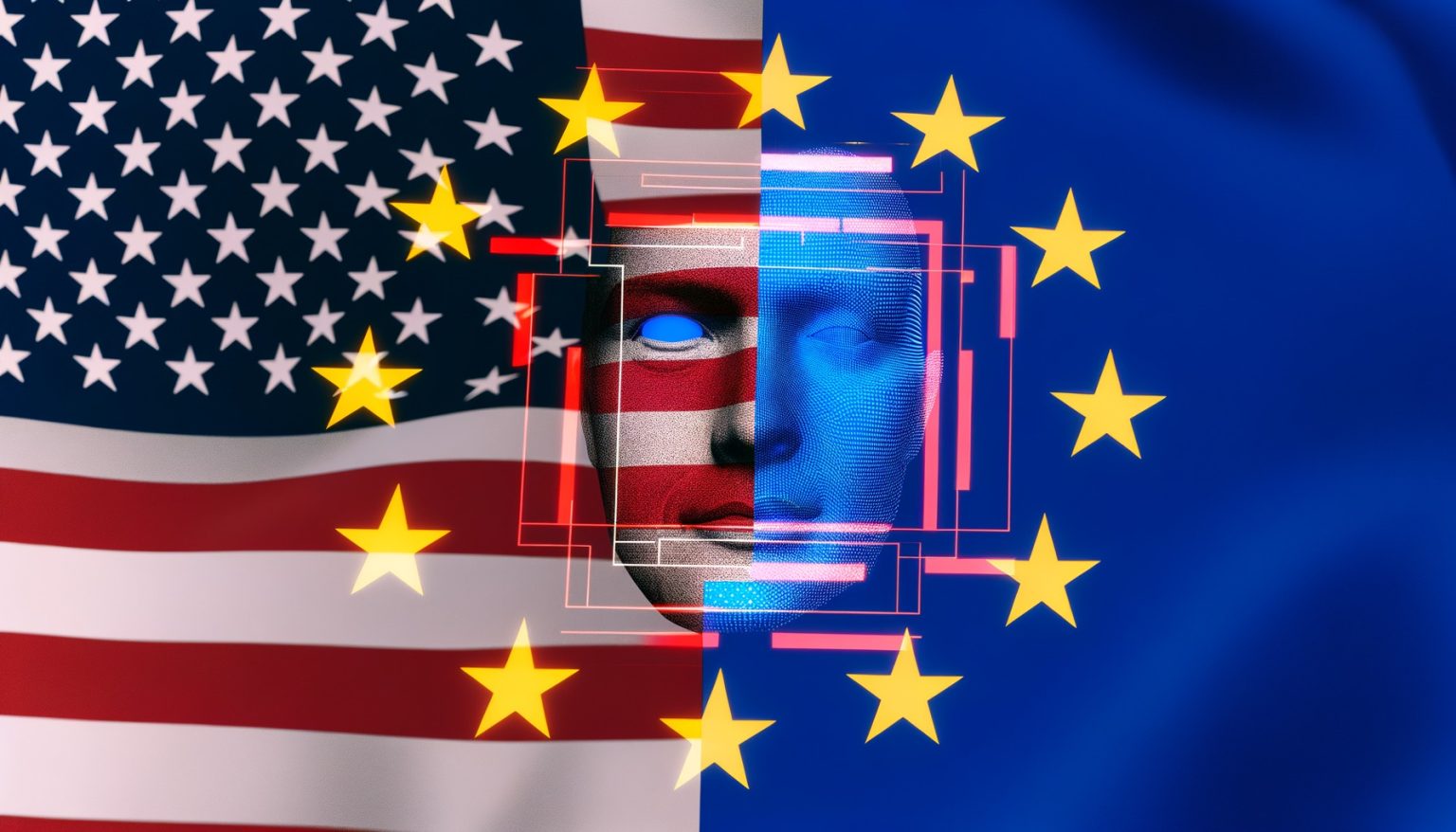


The transatlantic technology relationship long considered one of the stabilising pillars of the Western economic order is approaching a new stress point. A July deadline to de-escalate rising tensions between Washington and Brussels has sharpened what was already an increasingly adversarial policy environment.
At issue is not a single dispute but a widening collision of regulatory philosophies. The European Union’s Digital Services Act (DSA), Digital Markets Act (DMA), and emerging artificial intelligence rules reflect a conviction in Brussels that digital markets must be tightly governed to prevent systemic concentration of power. In Washington, these same frameworks are increasingly interpreted as extraterritorial regulation that disproportionately constrains American firms while exporting European legal norms beyond its borders.
What makes the current moment different is not the existence of friction, but its accumulation across multiple domains—antitrust enforcement, content moderation, data governance, and AI regulation—at a time when both sides are simultaneously weaponising technology policy as an instrument of industrial strategy. The July deadline, therefore, functions less as a diplomatic milestone than as a warning threshold: either the relationship stabilises through tactical compromise, or it enters a phase of managed confrontation with global consequences.
From Regulatory Divergence to Strategic Competition
At the core of the dispute lies a fundamental divergence in how the two sides conceptualise digital power.
For the European Union, the digital economy is now treated as critical infrastructure. Large platforms are not simply market participants but systemic actors whose scale requires pre-emptive regulation. The DSA imposes obligations on content moderation and transparency, while the DMA seeks to limit the market dominance of so-called “gatekeeper” platforms, many of which are American. The logic is preventive: regulate before market failure becomes irreversible.
The United States, by contrast, has historically relied on ex-post enforcement and innovation-led competition. Its technology sector—particularly in cloud computing, AI, and platform services—operates at global scale with relatively light federal regulation compared to Europe’s rulebook-heavy approach. From this perspective, EU regulation is increasingly seen in Washington not as neutral governance but as structural constraint on American industrial leadership.
This divergence has now hardened into a strategic contest over rule-setting authority. The question is no longer simply how digital markets should be regulated, but who gets to define the rules of the global digital economy.
The Political Economy of Digital Power
Behind the regulatory language lies a more material struggle over economic rents and industrial positioning.
European enforcement of digital rules has already produced significant financial penalties and compliance costs for major U.S. technology companies. Beyond fines, the more consequential impact lies in structural adaptation: product redesigns, delayed market rollouts, and legal uncertainty affecting AI deployment and platform services across the continent.
For Brussels, this is a feature rather than a bug. The EU has long sought to convert regulatory authority into geopolitical influence—the so-called “Brussels effect”—where European standards become global defaults through market size and legal complexity.
For Washington, however, this dynamic is increasingly interpreted through the lens of economic statecraft. Digital regulation is no longer viewed as neutral consumer protection but as a form of industrial policy with protectionist effects. The result is a growing willingness in U.S. policy circles to link technology disputes with broader trade instruments, including tariffs and investment restrictions.
What was once a regulatory disagreement has therefore become a distributive conflict: who captures value in the global digital economy, and under whose legal framework that value is governed.
Artificial Intelligence as the Accelerant
If earlier phases of the transatlantic tech dispute centred on search engines, social media platforms, and data privacy, the arrival of frontier artificial intelligence has significantly raised the stakes.
AI systems introduce two additional layers of contention. First is regulatory timing: the United States favours rapid deployment and iterative safety frameworks, while the EU’s emerging AI Act prioritises classification-based risk regulation and pre-market compliance. Second is industrial concentration: the most advanced AI models are overwhelmingly developed by U.S.-based firms, intensifying European concerns about technological dependency.
This asymmetry creates a paradox. Europe is attempting to regulate a sector in which it has limited foundational capacity, while the United States is seeking to preserve innovation speed in a field where regulatory fragmentation is growing. The result is mutual strategic discomfort: Europe fears dependency, while the United States fears regulatory capture of a globally dominant sector.
AI is therefore not just another file in the transatlantic dispute; it is the accelerant that transforms regulatory disagreement into structural competition.
Security and Infrastructure: The Underestimated Dimension
Beneath the visible trade and regulatory tensions lies a quieter but increasingly significant security dimension.
European policymakers are growing more attentive to the geopolitical risks of digital dependency on U.S.-controlled infrastructure. Cloud computing platforms, cybersecurity ecosystems, and enterprise software architectures are deeply embedded in European public and private systems. While this interdependence has historically been treated as benign, the broader climate of geopolitical fragmentation has altered perceptions.
Concerns—sometimes exaggerated but politically potent—revolve around continuity of access, jurisdictional control, and the theoretical ability of sovereign governments to restrict or disrupt services under crisis conditions. These anxieties feed into Europe’s broader “digital sovereignty” agenda, which seeks to diversify infrastructure providers and reduce single-point dependencies.
In Washington, by contrast, there is growing concern that European regulatory fragmentation could complicate intelligence cooperation, cross-border data flows, and joint technology development—particularly in AI-enabled defence systems.
The result is a subtle but important shift: technology infrastructure is no longer seen as merely commercial or regulatory terrain, but as part of the strategic trust architecture of the alliance itself.
Regional and Global Consequences
The implications of a prolonged transatlantic tech confrontation extend well beyond Europe and the United States.
For third countries, particularly in Asia, Latin America, and the Middle East, the fragmentation of digital governance frameworks introduces new compliance complexity. Firms operating globally may increasingly face incompatible regulatory regimes, forcing them to adapt products and services to diverging standards across major markets.
China stands to benefit most directly from this fragmentation. A divided Western regulatory environment weakens the possibility of unified democratic standards in AI governance and digital trade, creating space for alternative normative frameworks to gain traction in parts of the Global South.
At the institutional level, the breakdown of transatlantic coherence undermines efforts to build multilateral governance frameworks for emerging technologies. Institutions attempting to coordinate AI safety standards, data governance norms, or platform accountability rules face a more fragmented negotiating environment precisely when technological acceleration demands convergence.
Policy Outlook: Between Truce and Fragmentation
The next six to twelve months will likely determine whether the current dispute stabilises or escalates into a more structural rupture. Three broad trajectories are emerging.
1. Tactical De-escalation:
The most likely outcome is a narrow compromise. This would involve adjustments in enforcement practices, regulatory sequencing, or mutual understandings on compliance burdens, without altering the underlying legal frameworks. It would stabilise markets but leave core disagreements unresolved.
2. Managed Economic Retaliation:
A more confrontational scenario would see both sides increasingly deploy trade instruments, including targeted tariffs, digital services taxes, or restrictions on sensitive technology exports. This would not constitute a full trade war, but rather a persistent state of calibrated economic friction.
3. Structural Decoupling of Digital Governance:
In a more severe trajectory, the transatlantic space could gradually bifurcate into distinct regulatory and technological ecosystems. Divergent standards in AI governance, cloud infrastructure, and platform regulation would become entrenched, reducing interoperability and increasing long-term compliance costs.
The critical variable is not technical disagreement but political tolerance. As regulatory tools become embedded in broader industrial and geopolitical strategies, the space for technocratic compromise narrows.
The approaching July deadline is less a diplomatic countdown than a signal of systemic strain. The U.S.–EU technology relationship is no longer defined by coordination within a shared framework, but by increasingly incompatible visions of how digital power should be organised and controlled.
Both sides remain deeply interdependent economically, technologically, and strategically. Yet interdependence alone is no longer sufficient to guarantee alignment. As regulation becomes an instrument of sovereignty and technology becomes an instrument of power, the transatlantic alliance finds itself managing not convergence, but structured divergence.
The central question is no longer whether the relationship will fracture, but how much friction it can absorb before fragmentation becomes the default condition of the global digital order.