


Türkiye’s Pentagon Ay Yildiz Was Supposed to Speed Up Militery Decisions. First, It Has to Finish Being Built
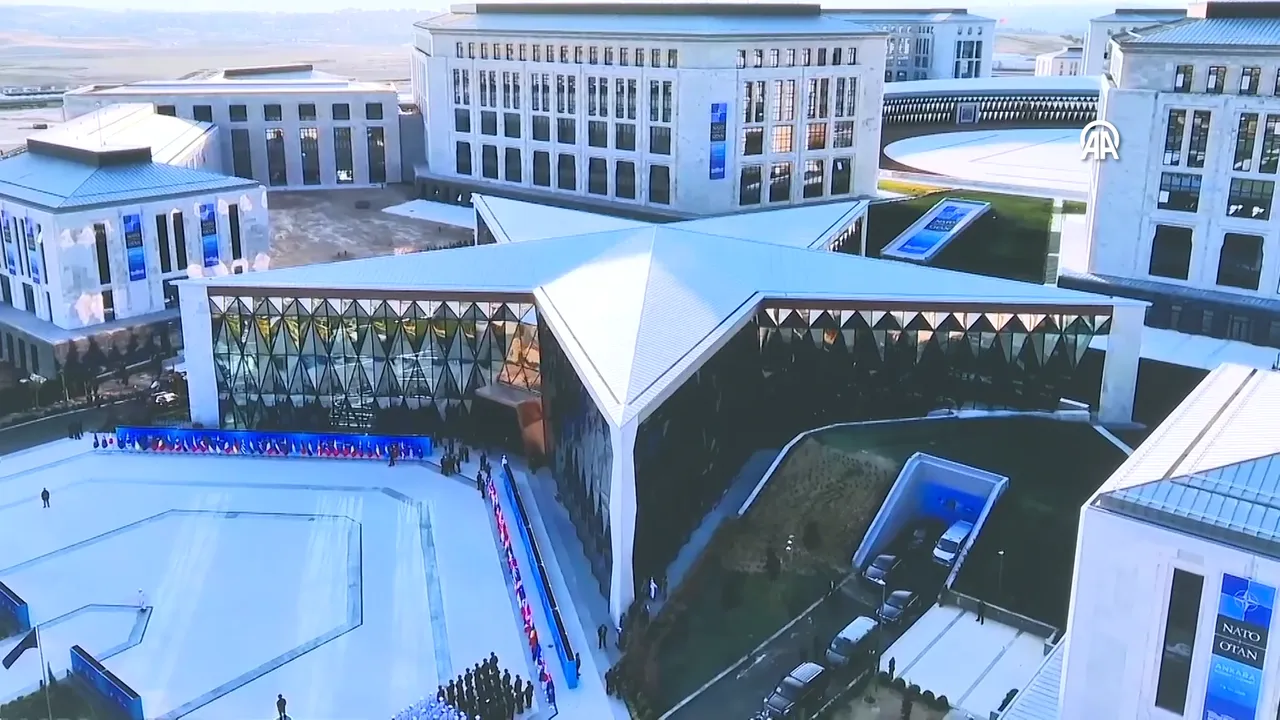
Turkey used the NATO summit it hosted this month to open the doors, still unfinished, of the largest military headquarters project the country has ever attempted. Named Ay Yildiz, meaning crescent and star after the symbol on the Turkish flag, the complex hosted its first official event on July 7, a reception for visiting NATO defense ministers held inside the facility’s Star wing even as construction crews continue finishing the campus around them.
The numbers released alongside the reveal are meant to make an impression on their own. The complex covers twelve million square meters, an area described as equivalent to roughly sixteen hundred eighty football fields, though only about a million square meters have actually been completed so far out of a planned two million. A six and a half kilometer wall encloses the site, and reports describing the structure put its scale at three times the size of the Pentagon and four times larger than NATO’s own headquarters in Brussels.
Roughly nineteen million cubic meters of excavation have been carried out to date, and the finished project is expected to use about two million cubic meters of concrete, a volume reports compare to the size of the Great Pyramid of Giza. The steel alone will total one hundred twenty five thousand tons, described as roughly twenty two times the amount used to build the Eiffel Tower. Beneath all of it runs forty four thousand eight hundred kilometers of cabling, a length that reports note actually exceeds the circumference of the Earth, alongside capacity for twenty five thousand fiber optic lines meant to carry the facility’s communication and command systems.
One building was finished in a single year, and a lot still to come
The ten thousand square meter Yildiz building, one of the campus’s signature structures, was completed in just twelve months, according to figures cited in the reveal. The finished complex is designed to include five conference halls each holding thirty two hundred people, a multi story parking garage built to handle sixty four hundred vehicles at once, a twenty five kilometer internal road network, and one hundred sixty eight thousand lighting fixtures, enough, by one comparison, to illuminate roughly three thousand football fields. Planners have also committed to two million square meters of green space and a million new plants and trees, an area reports describe as one and a half times the size of London’s Hyde Park.
The purpose behind the project is more mundane than its scale suggests. Turkey’s Ministry of National Defense has said for years that consolidating the ministry, the General Staff, and the Land, Naval, and Air Force commands under a single roof would speed up coordination and decision making during a crisis, replacing a setup that had scattered these institutions across separate, often older buildings in different parts of Ankara.
Turkish officials describe the complex as incorporating cybersecurity protections, ballistic defenses, and safeguards against chemical, biological, radiological, and nuclear threats, alongside what they call a smart building system built with environmental efficiency in mind, though the government has kept many of the more sensitive technical details, communication systems and bunker specifications among them, undisclosed.
Construction actually began well before this year’s summit gave it a global audience. President Recep Tayyip Erdogan laid the foundation stone on August 30, 2021, and Defense Minister Yasar Guler told parliament last year that the first structural phase was expected to wrap up by August 2025, with interior finishing to follow.
The government’s current target for full operational readiness is 2028, meaning the complex that hosted NATO’s defense ministers this month remains, by Ankara’s own account, a work in progress rather than a finished command center.
Timing that turned an unfinished building into a message
Turkey’s decision to showcase Ay Yildiz specifically during this year’s NATO summit, the alliance’s first heads of state gathering hosted in the country since the 2004 Istanbul summit, was widely read by regional commentary as a deliberate signal. Analysts covering the reveal note that Ankara is using the building’s scale to argue for a more centralized, technologically capable, and cross service ready military, at the same moment Turkey is separately negotiating with Washington over lifting sanctions and reopening a path back into the F-35 fighter jet program.
The reception itself was held only in the completed Star wing, with the summit’s actual proceedings taking place at the separate Beştepe presidential complex.
Turkish outlets covering the project have repeatedly nicknamed it the country’s own Pentagon, a comparison officials have not discouraged. Commentary on the branding notes it captures the underlying goal reasonably well even if the analogy is imprecise, Ankara is trying to gather its most senior military decision makers into one physical space to cut down the friction that comes from running a modern armed forces command out of buildings scattered across a capital city.
Strip away the comparisons to pyramids and the Eiffel Tower, and the settled facts are narrower than the headline figures suggest. Roughly half of the total planned construction has been completed, the government’s own timeline places full completion in 2028, and the July reception marked the facility’s first official use rather than its formal opening.
Whether Ay Yildiz ultimately delivers the faster, more centralised decision-making Ankara has promised will not be something this month’s photographs can answer. That verdict waits for the day the rest of the twelve million square meters is actually finished.