


Europe wants to punish China’s dominance in green technology, but a trade war may be a fight it cannot afford to win
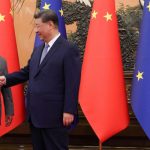
European leaders are growing increasingly alarmed by China’s grip on green technology and its state-backed industrial model, and Brussels is now searching for ways to protect Europe’s industrial base. The debate is unfolding across EU institutions, most visibly at the European Council summit in June, where leaders voiced concern about what they called global macroeconomic imbalances, but stopped short of endorsing a more confrontational approach toward Beijing, according to a media report. The hesitation matters because China is the EU’s second-largest trading partner, and a more aggressive European response risks triggering exactly the kind of retaliation Brussels can least afford.
The temptation to strike hard is understandable. China’s dominance across solar panels, electric vehicles, and a growing list of clean technology sectors has left European industry increasingly anxious about its long-term competitiveness. Some officials have pushed for an expanded trade defence and industrial policy toolbox, aimed squarely at reducing that dominance. But the same reporting notes a sobering complication: Europe’s dependence on China is not a passing inconvenience. It is a structural reality that will take decades, not years, to unwind.
A trillion dollar dependency problem
The scale of that dependency is difficult to overstate. According to estimates from EY Parthenon, Ernst and Young’s global strategy consulting arm, replacing the infrastructure, research, software, manufacturing capacity and supply chains the eurozone currently relies on China for would cost roughly 9.1 trillion dollars, or about 7.95 trillion euros, by 2050. That figure would require an annual investment equivalent to almost double the EU’s entire current annual budget, according to the same report.
This is the number that should temper any appetite in Brussels for a swift, confrontational break with Beijing. Untangling decades of industrial interdependence is not something that can be achieved through tariffs alone, and any strategy that assumes otherwise risks badly underestimating both the cost and the timeline involved.
China, for its part, has already demonstrated both the willingness and the ability to hit back hard when challenged. In the aftermath of tariffs imposed by the Trump administration in 2025, Beijing restricted exports of key rare earth materials, disrupting global industrial supply chains and catching European manufacturers directly in the crossfire, according to the report. The move forced Washington itself to de-escalate, a clear demonstration of what analysts describe as Chinese escalation dominance.
That same leverage applies just as forcefully to Europe. Brussels does hold some chokepoints of its own, most notably through companies like ASML, which produces advanced semiconductor manufacturing equipment that China still cannot easily replace. But those restrictions would take considerably longer to meaningfully affect China than Chinese export controls would take to disrupt the flow of critical inputs into European industry. In a straight escalation contest, Europe is the more exposed party.
Defensive measures instead of a fight, Europe cannot win
Given this imbalance, the more useful question for European policymakers may not be how to directly strike back at China, but what kind of measures genuinely serve Europe’s long-term interests without inviting disproportionate retaliation.
One useful framework distinguishes between defensive and offensive measures. Defensive measures aim to reduce future dependencies and support industries where Europe remains competitive and where China has not yet established dominance. Offensive measures, by contrast, directly challenge sectors China already controls, and are far more likely to be read in Beijing as a hostile provocation.
By this measure, the EU has likely already missed its window to impose trade measures against solar panels or electric vehicles without China treating them as a direct offensive act. China has already retaliated against EU member states that supported tariffs on Chinese electric vehicles, reportedly instructing its automakers to pause investment in those markets, according to the report. Italy, which had been actively courting Chinese automotive investment, has already missed out on recent electric vehicle projects as a direct consequence.
That outcome offers a clear warning about the cost of offensive measures taken too late. But it is not, according to the analysis, too late for Europe to take a more defensive posture in other clean technology sectors. European companies remain significant players in producing electrolysers, wind turbine equipment, heat pumps, and next-generation battery technology, areas where China has not yet secured the kind of dominant position it holds in solar and electric vehicles.
Learning from Beijing’s own long game
Acting early in these sectors, through both supply-side support and measures designed to stimulate consumer demand, would give European firms the reassurance and scale needed to remain competitive before Chinese manufacturers establish a commanding market position. Supporting demand for products like heat pumps, for instance, signals to European firms that continued investment in these technologies is genuinely worthwhile.
This approach carries a further strategic advantage. Such measures can be framed publicly as strengthening economic resilience and supporting decarbonisation goals, rather than as a deliberate attempt to exclude Chinese competitors. That framing matters, since it significantly reduces the risk of triggering the kind of retaliatory response that direct trade barriers on Chinese solar panels or vehicles have already produced.
Critics of a more active industrial policy warn that European governments risk backing the wrong sectors or technologies entirely. That is a legitimate concern. But the greater danger, according to the analysis, may be failing to act with any real conviction at all.
There is an instructive parallel in China’s own approach. Beijing identified electric vehicles as a strategic priority in the early 2000s and sustained consistent support for the sector across two full decades, laying the groundwork for the dominance it now enjoys.
Replicating that kind of patient, long-term commitment is inherently more difficult across a 27-member state bloc, where competing national priorities and shifting political coalitions routinely undermine policy continuity. The EU has already shown a willingness to delay or dilute policy under sustained pressure, evident in the flexibility introduced into its 2035 phase-out of internal combustion engine vehicles.
Yet that kind of policy stability is precisely what European firms need if they are to commit serious investment to clean technologies, trusting that the demand Brussels promises will actually materialise years down the line.
The broader lesson is that Europe’s leverage over China is far more limited than many policymakers would like to admit. Choosing defensive measures that build long-term resilience, rather than offensive ones that risk retaliation from a trading partner with considerably more room to escalate, may be the more difficult path politically. But it may also be the only realistic route for Europe to strengthen its industrial base without entering a trade conflict it is simply not equipped to win.