


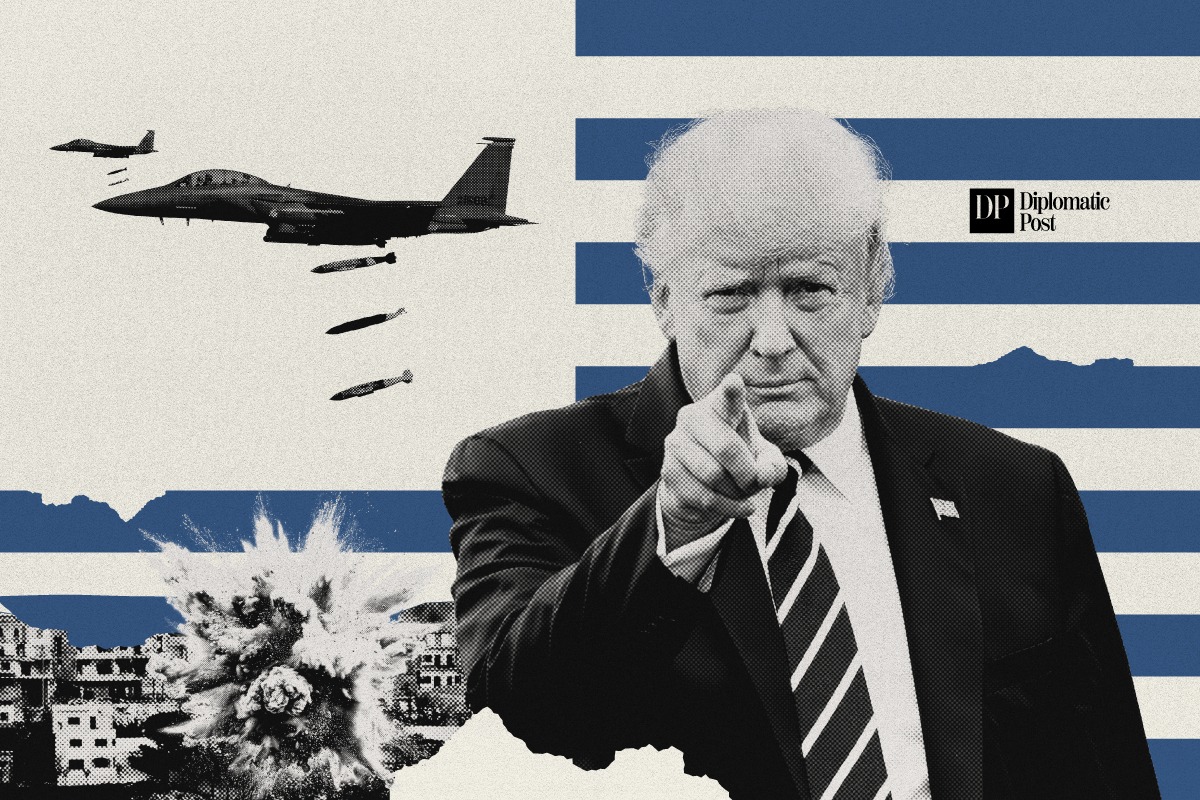

A few hours after US President Donald Trump declared that, as far as he was concerned, the ceasefire with Tehran was “over”, American forces launched a new wave of strikes against Iran.
The United States Central Command (CENTCOM) said the overnight bombardment from Wednesday to Thursday was aimed at further degrading the Islamic Republic’s ability to threaten shipping in the Strait of Hormuz, the vital corridor for global oil and gas exports. More than 90 targets were reportedly hit, including air defence systems, missile bases and logistical infrastructure, particularly along Iran’s southern coastline.
Iran’s Ministry of Health said that 14 people had been killed and 78 wounded in the strikes over the past two days, with around 50 requiring hospital treatment. Iranian media reported explosions in several cities, including the strategic port of Bandar Abbas, Qeshm Island the largest island in the Strait of Hormuz and Bushehr, home to the country’s only nuclear power plant, which local authorities said had not been damaged.
The familiar cycle of action and reaction has once again taken hold. Every move by one side becomes justification for retaliation by the other, creating a vicious spiral of escalation in which both Washington and Tehran deny being the first to strike. Iran’s Islamic Revolutionary Guard Corps responded by launching missiles at several US military bases in Bahrain, Qatar and Kuwait, repeating the pattern established after previous American attacks.
This time, however, air raid sirens also sounded in Jordan. “These threats were neutralised and intercepted,” Jordanian Communications Minister and government spokesman Mohammad Al Momani wrote on X. Jordan’s armed forces told the state news agency Petra that air defence systems had intercepted and destroyed eight missiles launched from Iran on Thursday afternoon. Although several pieces of shrapnel fell to the ground, there were no casualties or material damage.
Kuwait’s Foreign Ministry reported that its airspace detected three ballistic missiles, one cruise missile and ten drones at dawn on Thursday. All were successfully intercepted, although falling debris injured one person.
The renewed confrontation between the two long-time adversaries has once again raised doubts over the future of the memorandum of understanding a document of barely a page and a half that serves as a roadmap towards a final peace agreement and the resolution of two of the most sensitive issues: Iran’s nuclear programme and the future status of the Strait of Hormuz.
Signed on 17 June, the memorandum gave both sides 60 days—until 21 August—to reach a comprehensive agreement. Even when it was signed, the deadline appeared ambitious. Now it looks more distant than ever.
Yet while Trump told reporters ahead of Wednesday’s NATO summit that Iran’s leadership was “a cancer that needs to be removed as quickly as possible”, his later remarks that same day offered a degree of hope for diplomacy. Speaking at the press conference concluding his visit to Turkey, the US president softened his tone, explaining that he wanted to send Tehran a warning it would understand rather than permanently end all dialogue. He stressed that the latest military operation would “be over very quickly” and insisted he was not seeking “a prolonged conflict.”
“When they hit us, we hit back even harder… we speak their language,” Trump said, adding that he still did not believe the war would resume.
Later, aboard Air Force One while returning from the NATO summit, he claimed that the Islamic Republic remained interested in reaching an agreement despite the renewed and intensified hostilities.
“They called me recently. They want a deal so badly. I just don’t know whether they deserve one. I don’t know whether they’ll honour it,” Trump said.
The US president has, however, proved so unpredictable throughout the crisis that it is impossible to know whether he will change his position again tomorrow. Even so, he may be correct in arguing that Iran’s leadership is merely buying time. Twenty days into the two-month negotiating period, substantive talks on Iran’s nuclear programme and the Strait of Hormuz have barely begun.
Negotiations between Iran and the United States have been postponed until the conclusion of the multi-day funeral ceremonies for Supreme Leader Ayatollah Ali Khamenei, who was killed on the first day of the war. The talks are expected to resume tomorrow in Islamabad.
Although Washington and Tehran have agreed in principle to restore freedom of navigation through the Strait of Hormuz—with Trump declaring the waterway open to unrestricted international shipping—the preliminary agreement does not specify how that objective is to be implemented.
At the same time, the Islamic Republic has been tasked with ensuring the passage of vessels that had long been blocked. Iran insists that ships should sail through the channel along its own coastline, which it controls, while many commercial vessels, escorted by the US Navy, continue to use the route closer to the coast of Oman.
“What we’re seeing now is Iran trying to establish control over the entire strait and present that as its sovereign right,” Kevin Donegan, a retired US Navy vice admiral and former commander of American naval forces in the Middle East, told The New York Times.
Other analysts likewise argue that Iranian diplomats and military commanders are approaching the forthcoming negotiations from precisely that position, believing they possess two critical strategic advantages to bring to the negotiating table in Pakistan: the Strait of Hormuz and the Bab el-Mandeb, the second major maritime chokepoint linking the Red Sea with the Gulf of Aden.