




Starmerism, as a political project, suffered from a fundamental incoherence. It was defined largely by what it was not. Not Corbynism on the left, not Johnsonian populism on the right, but struggled to articulate a compelling positive vision. The attempt to govern as a fiscally responsible centre-left administration, appealing to both traditional working-class Labour voters and suburban centrists, satisfied neither. Working-class voters found the government insufficiently radical on redistribution; centrists found it insufficiently competent on delivery.
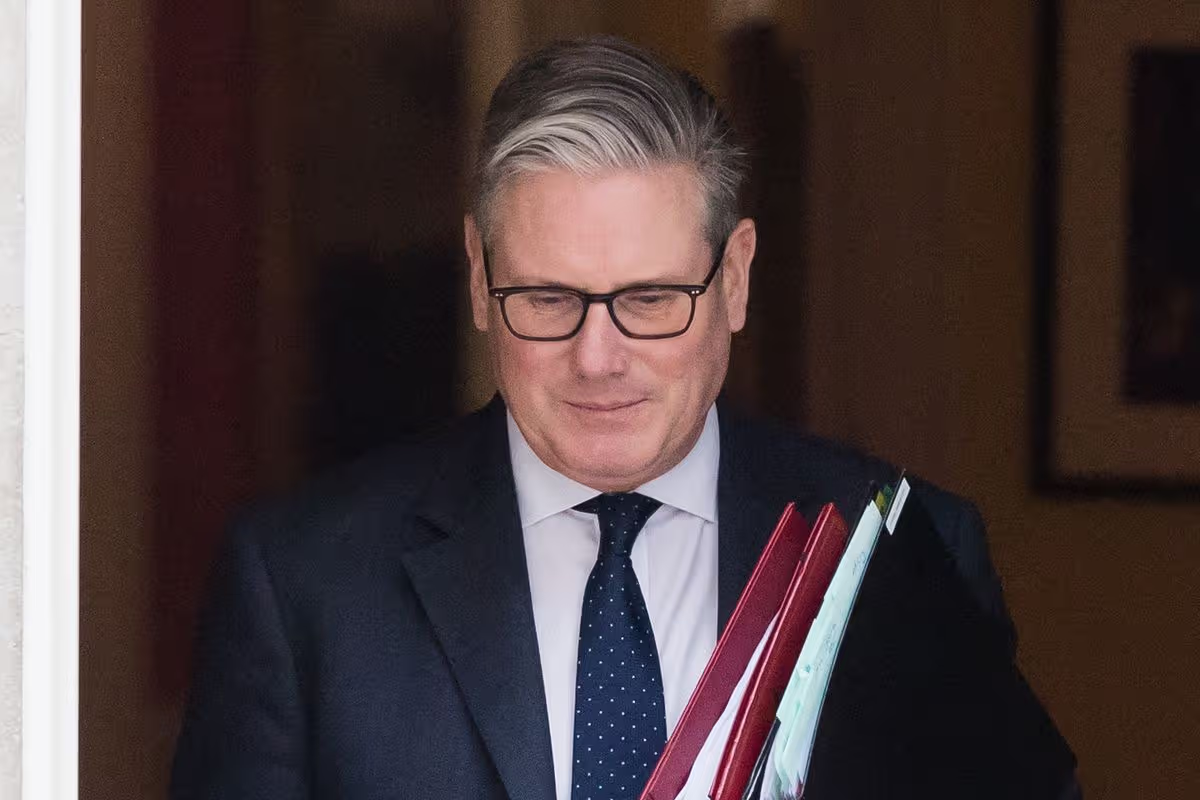
On the morning of 22 June 2026, Keir Starmer announced his resignation as Prime Minister and leader of the Labour Party, concluding he could no longer unite his party. The announcement made him Britain’s seventh prime minister in just over a decade a statistic that speaks not merely to the volatility of individual careers, but to a structural crisis of governance at the heart of one of the world’s oldest parliamentary democracies.
Starmer came to power in July 2024 with a landslide majority, promising stability after the chaos of the Conservative years. That promise lasted barely two years. His departure was neither sudden nor shocking, it was the culmination of a slow-motion collapse driven by economic discontent, internal party fracture, catastrophic electoral results, and a fatal inability to navigate the competing demands of fiscal austerity and social solidarity. Yet the consequences extend far beyond the internal machinations of Westminster. At a moment of profound geopolitical uncertainty, with NATO under strain, Europe rearming, and Donald Trump reshaping the global order – Britain is once again leaderless and directionless.
Electoral Catastrophe
The clearest signal of Starmer’s terminal decline came with the May 2026 local elections, a rout of historic proportions. Labour lost control of 35 councils and nearly 1,500 councillors, representing roughly 60% of all seats up for election. The BBC’s projected national vote share translated Labour’s performance to a mere 17% of the national vote, a figure not seen since the darkest days of post-Blair reconstruction. For context, Labour had won its 2024 landslide with over 33% of the popular vote.
The beneficiaries were diffuse. Reform UK continued to hoover up disaffected working-class voters in the Midlands and North, the Greens gained ground among urban progressives alienated by Labour’s centrist drift and the Liberal Democrats consolidated their hold on southern England. Labour, squeezed from all flanks, found itself without a clear electoral coalition.
The Polling Collapse
The polling numbers tell a story of almost unrelenting public rejection. By September 2025, barely 14 months into government, only 14% of respondents approved of the government’s record, against 69% who disapproved. That figure worsened through the winter. By January 2026, YouGov recorded 75% of the public holding an unfavourable opinion of Starmer, producing a net favourability rating of −57, a number matched only by the brief and chaotic premiership of Liz Truss in 2022. Within his own party, a poll of Labour members found 45% wanting Starmer to step down, up sharply from 28% in October 2025.
The Welfare Rebellion
The proximate trigger for the parliamentary uprising against Starmer was his government’s welfare reform agenda, specifically, planned cuts to disability benefits. In an attempt to reduce the ballooning welfare budget and free up fiscal space for defence, the government proposed reductions to Personal Independence Payments (PIP) and related disability support programmes.
The response from within Labour’s own parliamentary party was seismic. Over 80 Labour MPs signed letters opposing the cuts, representing one of the largest internal rebellions in modern Labour history. The optics were brutal too. A Labour government, founded on the principle of protecting the vulnerable, cutting support for disabled people while simultaneously struggling to justify modest tax raises on the wealthy. It crystallised the central contradiction of Starmer’s project.
But, Starmer’s downfall cannot be fully understood without grasping the specific geopolitical context in which it occurred.Britain finds itself in an increasingly uncomfortable position within the Western alliance. Having been the third-largest spender in NATO, overtaken by Germany in 2024, the UK is under intense pressure from Washington to increase its defence contribution. The Trump administration, pursuing its “America pays less, allies pay more” doctrine, has repeatedly signalled that NATO members spending below 3% of GDP on defence will find American security guarantees increasingly conditional.
For Starmer, this created an impossible fiscal triangle: balance the books, protect social spending, and rearm simultaneously. Something had to give.
The Healey Resignation
The fault line became visible when Defence Secretary John Healey resigned in June, accompanied by junior minister Al Carns and ministerial aide Pamela Nash. Healey’s resignation letter was scathing. He accused Starmer of “failing to commit the resources needed to keep the country safe from mounting threats” and revealed that the government’s Defence Investment Plan, already delayed by over a year, had been indefinitely postponed due to Treasury resistance.
The consequences were immediate and damaging. With a NATO summit less than a month away, Britain’s chief military advocate had publicly quit, declaring that the Plan’s mismanagement would have consequences “of a magnitude far beyond our worst fears.” Kevin Craven, head of Britain’s defence industry lobby ADS, said the situation was “seismic.”
This was a signal to allies and adversaries that Britain’s commitment to the post-Ukraine security architecture was uncertain. At a moment when European NATO members are engaged in the most serious rearmament since the Cold War, a British government in internal free fall is a liability to the entire Western alliance.
Beyond Starmer’s Personal Failures
It would be a mistake to reduce this crisis to the personal shortcomings of one man. Starmer was, in many respects, a symptom of deeper structural pathologies in British politics.
Labour inherited an economy in deep structural difficulty, high inflation, low productivity growth, a public sector hollowed out by 14 years of austerity, and a national debt at post-war highs. Chancellor Rachel Reeves’s attempts to stabilise the public finances through a combination of targeted tax rises and spending restraint were economically defensible but politically combustible. The October 2024 Budget raising employers’ National Insurance contributions, damaged business confidence and fuelled a narrative that Labour was anti-growth, even as it cut public services.
The prolonged cost-of-living crisis, rooted in the inflationary shock of 2021-23, continued to bite into living standards throughout 2025-26. Real wages stagnated for large segments of the workforce, energy bills remained elevated, and housing affordability reached crisis levels in most major cities. The public mood was one of exhausted anger directed at whoever happened to be in power.
What Comes Next: The Leadership Contest and Its Implications
Andy Burnham enters the race as the overwhelming favourite. Two polls from the 2025 Labour Conference already showed 62% of Labour members backing Burnham over Starmer, with Burnham holding 43% first-choice support among prospective leaders compared to 9% for his nearest rival, former Health Secretary Wes Streeting. Even Streeting has since endorsed Burnham’s candidacy.
The timetable is compressed, leadership nominations open 9 July and close when Parliament breaks for summer recess on 16 July. If Burnham faces no serious challenge, he could be Prime Minister within weeks. A contested race would produce a result by 1 September.
Burnham is a fundamentally different political animal to Starmer. Where Starmer is legalistic, cautious, and technocratic, Burnham is instinctively political, emotionally intelligent, and ideologically rooted in a Labour tradition that speaks directly to post-industrial communities in the English North and Midlands, the so-called “Red Wall” that Starmer never convincingly recaptured.
His record in Greater Manchester pioneering integrated health and social care, confronting the Conservatives over lockdown funding, championing transport and housing investment gives him a credible governing narrative. He is also untainted by the divisive welfare cut debates, having been outside Westminster during that crisis.
The Reform UK Threat
The transition period carries real risks. With Labour’s poll ratings at historic lows, Reform UK led by Nigel Farage has established a consistent lead in national polls. A prolonged period of Labour internal turmoil could entrench Reform’s position, particularly in Northern and Midlands constituencies. Burnham’s pitch is, in part, a direct answer to Reform, a Labour leader who speaks the language of patriotism, community, and economic security without the nativist edge.
Britain’s moment of domestic turbulence coincides with an extraordinarily demanding geopolitical calendar. A NATO summit is imminent, at which allies will assess whether Britain can be relied upon as a serious security partner. Ukraine’s war continues to demand sustained Western commitment. The Trump administration’s transactional approach to alliances means that British political instability has direct strategic costs, it reduces London’s leverage in Washington and its credibility in Brussels.
Burnham, if he becomes PM rapidly, will face immediate pressure to finalise the Defence Investment Plan, recommit to NATO spending targets, and articulate a credible foreign policy distinct from both Starmerian managerialism and Corbynite scepticism. His instincts are not those of a foreign policy specialist, and he will need to build a credible team quickly.