





The voters who put Donald Trump back in the White House came because he promised to stop sending Americans to die in other countries’ conflicts. He has since launched a war, deployed troops to the Middle East and requested a record defence budget. Young Republicans have begun drawing conclusions.
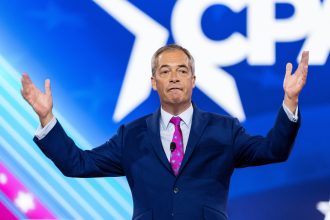
At this year’s Conservative Political Action Conference in Grapevine, Texas, the generational fault line running through the Republican Party became visible in a way that party leadership preferred to ignore. Older attendees, many of whom had supported military interventionism through the Bush years, described Trump’s Iran strikes as a pragmatic and necessary response to a decades-long threat. Younger conservatives used a different word. They used “betrayal.”
Sean O’Brien, a sophomore at Auburn University, told reporters that his support for Trump had slipped, particularly after talk of deploying US troops to the Middle East. “I’m not happy,” he said. Sending troops into Iran, he added, “would be full betrayal.”
His sentiment was not isolated. Tucker Carlson, one of the most influential voices in the conservative media ecosystem, opposed the war from the first strikes. Joe Kent, the director of the Centre for Counterterrorism at the Department of Homeland Security, resigned his position, stating publicly that he could not in good conscience support the ongoing war and that Iran had posed no imminent threat to the United States. Steve Bannon warned aloud that a protracted Middle Eastern engagement would drive conservative voters to stay home in November.
What is emerging inside the Republican coalition is not a rebellion. It is something more electorally dangerous: a quiet withdrawal. Polling conducted by Pew Research found that only 49 per cent of Americans under the age of 30 approved of Trump’s handling of the Iran war.
An NBC News poll found that almost two-thirds of Americans aged 18 to 34 held a negative view of Israel, a figure that had stood at 37 per cent just three years earlier. Among young Republicans specifically, Israel now registers roughly as favourably as Saudi Arabia. A CNN survey found that just 33 per cent of Republican and Republican-leaning voters under the age of 45 describe themselves as extremely motivated to vote in the midterms. Among older Republicans, that figure was a majority.
The Promise That Generated the Problem
The particular sting of the Iran war for young conservatives is that Trump’s anti-interventionism was not an incidental feature of his appeal to them. It was the point. A generation that grew up with the wars in Iraq and Afghanistan, that watched more than 7,000 American service members die and trillions of dollars spent without a coherent outcome, was drawn to a politician who said, explicitly and repeatedly, that this kind of adventurism was over.
“America First” meant, in the understanding of this cohort, that America would not fight other countries’ wars, would not send its young men to places their families could not find on a map, and would not subordinate domestic priorities to foreign policy ambitions that benefited elites rather than working people.
Stryder Bigler, a 21-year-old student at Arizona State University who co-founded a young conservative media company, put the feeling plainly. “When I see our politicians advocating for other countries,” he said, “all of these people focused on all these conflicts, when we have conflicts that are killing people here in our own country.”
His co-founder, Jake Carpenter, described the war as evoking the post-9/11 era of foreign military commitment that the MAGA movement had explicitly defined itself against. “It’s going to be a long-term struggle if we continue to drag out this conflict, and we don’t know what the end goal is,” he said. “You’re just seeing a lot of hypocrisy with a lot of these older conservatives compared to the younger conservatives.”
The political mathematics of this disillusionment is pointed. Republican pollster Alex Tarascio has noted that young male voters were crucial to Trump’s 2024 victory, with men between 18 and 49 favouring Trump over Kamala Harris by only one point, down from a ten-point margin for Biden four years earlier.
That margin was razor thin. Young men delivered it. The same demographic is now showing far less motivation to vote in the midterms, and the Iran war is among the principal reasons cited in every survey of conservative youth opinion conducted since February.
The Iran war has not broken the Republican coalition. But it has exposed the internal contradiction that was always present within it.
A party that ran on ending foreign wars and won narrowly on that promise launched a major Middle Eastern military campaign within its first two months in office. The voters who were the most ideologically committed to the original promise are the voters most likely to register that contradiction in November. Not by switching parties. By staying home. In an election where margins are measured in single digits across competitive districts, that is the outcome that Republican strategists are least able to afford and least willing to discuss.