


The Trump administration wants Iraq to disarm Iran-backed militias, reduce its dependence on Iranian energy, and expand opportunities for US businesses.
Ali al-Zaidi has spent his career persuading bankers, traders and businessmen to place their trust in him. This week, in the Oval Office, he must convince a far harder audience, an American president who backs him for now but whose patience has limits, that Iraq is still worth the investment. The stakes could hardly be higher for a country still absorbing the shockwaves of a regional war, a fractured parliament and years of quiet Iranian encroachment into nearly every corner of its state.
Al-Zaidi, a forty year old businessman and lawyer from Dhi Qar province who had never held political office, was sworn in on 14 May after nearly six months of deadlock following Iraq’s November 2025 elections. He emerged not as the strongest candidate but as the only one nearly every faction could tolerate, according to analysis in the international media, after the Shia dominated Coordination Framework failed to agree on a nominee and Washington effectively vetoed the return of former prime minister Nouri al-Maliki. President Donald Trump had warned that the United States would step back from Iraq altogether if Maliki, seen in Washington as too closely tied to Tehran, took the post again. Al-Zaidi’s lack of a party base and his limited political footprint made him acceptable to rival blocs precisely because he seemed unlikely to challenge any of them, according to researchers who track Iraqi politics closely.
That same quality now defines the central dilemma of his premiership. Al-Zaidi owes his position to a political system built on compromise and patronage, yet Washington is asking him to confront the very forces that sustain that system, chiefly the network of Iran backed militias that operate with considerable autonomy from the Iraqi state. His inaugural programme promised to restrict weapons to state control and strengthen official security forces, a pledge that sounded reassuring in Washington but that few analysts believe can be delivered quickly, given how deeply some of these armed groups are embedded in Iraq’s economy, security apparatus and even parliament itself.
A premiership born from three competing agendas
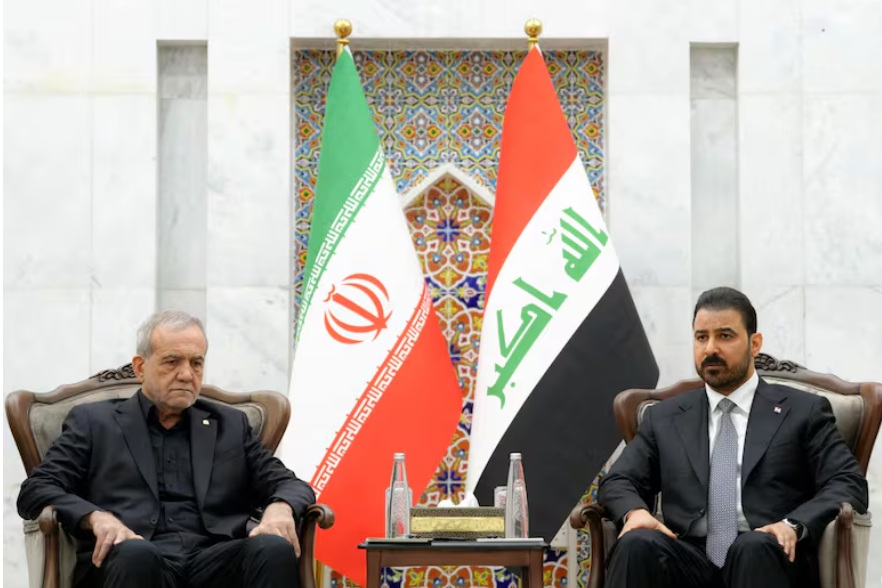
Al-Zaidi’s difficulty lies in the fact that he must satisfy three audiences whose goals do not align. Washington wants the militias dismantled or brought firmly under state authority, viewing them as armed extensions of Iranian power that must eventually be stripped of their independence. Tehran, by contrast, wants those same groups elevated and preserved as a strategic counterweight to American influence in the region, and senior Iranian officials, including President Masoud Pezeshkian, publicly welcomed al-Zaidi’s government and expressed hope for deeper cooperation with Baghdad. Iraq’s own political establishment wants the militias accommodated rather than confronted, mindful of their legitimacy among many ordinary Iraqis who credit them with helping prevent the state’s collapse during the fight against the Islamic State group. Satisfying all three simultaneously is, in the words of security analysts who follow the country closely, close to impossible, and every concession al-Zaidi makes to one side risks alienating another.
The backdrop to this balancing act is a country still reeling from this year’s Iran war, whose economic and security fallout has hit Iraq particularly hard given its deep entanglement with both Washington and Tehran. During the prolonged political deadlock earlier this year, the United States suspended cash shipments tied to Iraq’s oil revenues and paused security cooperation with Baghdad, a pressure tactic that underscored how quickly Washington is willing to use its financial leverage when it senses Iraq drifting too far towards Iranian influence. Even after al-Zaidi’s confirmation, tensions have not eased. Days after he took office, elements linked to Iran backed militias launched drone strikes against Saudi Arabia and the United Arab Emirates, with one strike reportedly hitting the Barakah nuclear power site in the UAE, an incident that starkly illustrated how little control Baghdad’s new government yet exercises over armed groups nominally under state authority. Some senior figures within those groups have made their position clear, with one parliamentary bloc leader linked to the powerful Kataeb Hezbollah faction publicly denouncing what he called direct American interference in shaping Iraq’s political scene, insisting that disarmament cannot be achieved through pressure alone.
Iraq’s economic vulnerabilities compound the political strain. The country remains heavily dependent on oil revenue at a moment when the war’s fallout has disrupted production and strained government spending, while its historic reliance on Iranian electricity and gas imports, both of which were formally halted earlier this year, leaves Baghdad searching for alternative energy sources it does not yet fully possess. This is precisely where al-Zaidi hopes his business background can prove useful. He is expected to travel with a delegation of Iraqi business leaders and sign a series of memorandums of understanding with major American energy firms, deals intended to demonstrate that Iraq can offer Washington tangible economic returns rather than simply asking for security guarantees. Decision makers in Washington have signalled they want to see business friendly reforms that would make it easier for both foreign and domestic investors to operate inside Iraq, viewing economic partnership as a more sustainable foundation for the relationship than security cooperation alone.
Why this meeting matters far beyond Baghdad
The Washington meeting therefore carries weight well beyond a routine diplomatic courtesy call. For Trump, who has taken the unusual step of speaking directly with al-Zaidi by phone and publicly declaring strong support for his candidacy, the visit is an opportunity to showcase a friendlier and more cooperative Iraqi government after years of frustration with Tehran’s entrenched influence in Baghdad. For al-Zaidi, deliberately choosing Washington as his first foreign trip as prime minister, the visit is a calculated signal both to his American counterparts and to domestic audiences that he intends to anchor Iraq’s foreign policy more firmly around the United States, even as he insists Iraq cannot simply sever its ties with Iran any more than Washington could sever its ties with a neighbouring country of its own. Analysts following the visit closely note that form may matter as much as substance in this particular encounter, given how central personal rapport with Trump has become to securing continued American engagement with any foreign government.
What happens after the cameras leave the Oval Office will matter far more than the visit itself. Washington’s support for al-Zaidi has always been described by officials and analysts alike as conditional rather than enthusiastic, and the coming months will test whether he can translate warm words into concrete steps against militia financing networks and armed groups that show no genuine willingness to disarm. Should progress stall, and history suggests Iraqi governments rarely move quickly on this issue, Washington has already shown through this year’s suspension of cash transfers and security cooperation that it is prepared to apply real economic pressure again. Should al-Zaidi instead deliver visible movement on state control of weapons and a steady stream of energy deals for American firms, he could secure the sustained backing that would allow his fragile, consensus built government to survive longer than many of Iraq’s recent short lived premierships. Either way, the coming months will reveal whether Iraq’s newest and least political prime minister can do what none of his immediate predecessors managed, satisfy Washington’s demands without breaking the delicate coalition of Iranian aligned factions that put him in office in the first place.