




A serious attempt to end the war means shifting focus from territory, making realistic promises, and bringing all parties to the table
Eighteen months into President Donald Trump’s renewed diplomatic push to end the war in Ukraine, the trajectory of negotiations is moving in the wrong direction. What was initially framed in Washington as a high-tempo effort to secure a rapid ceasefire has instead hardened into a fragmented, stalled and increasingly mistrustful diplomatic process. Despite early engagement with both Kyiv and Moscow, the war has not de-escalated; in several sectors, it has intensified.
The problem is no longer simply one of timing or external distraction, including shifting U.S. attention toward the Middle East. Rather, the structure of the negotiations themselves has begun to constrain the possibility of agreement. By placing territorial questions at the centre of diplomacy, offering security commitments that neither side believes are credible, and operating through segmented, siloed talks, Washington has inadvertently deepened the very divisions it sought to bridge.
For European capitals and NATO planners, this matters beyond Ukraine. It raises broader questions about U.S. diplomatic reliability, the future architecture of European security, and whether war termination strategies premised on transactional bargaining can succeed in a conflict shaped by existential security concerns on both sides.
A Negotiating Framework Out of Sync With the War
At the heart of the current impasse is a mismatch between diplomatic design and battlefield logic. Early in the conflict, Russia’s objectives were primarily political: limiting Ukraine’s integration into Western security structures and reversing its strategic drift toward NATO. But as the war evolved into a prolonged attritional struggle, territorial control hardened into a substitute objective, embedded further by constitutional and administrative measures in Moscow.
This shift has fundamentally altered the bargaining landscape. What might once have been a flexible political negotiation has become a zero-sum dispute over land that neither side can simultaneously concede without domestic and strategic costs that would be politically unsustainable.
U.S. negotiators, however, have effectively elevated territory to the central currency of a settlement. By signalling that Ukrainian withdrawal from remaining contested areas could be exchanged for “security guarantees,” Washington has reinforced a logic that is increasingly disconnected from feasibility. The result is a paradox: the more territory becomes central to talks, the less room there is for compromise.
This reflects a broader tendency in recent U.S. diplomacy to compress complex wars into transactional frameworks—territory for guarantees, concessions for ceasefires—without fully accounting for the structural incompatibility of the positions involved.
The Credibility Gap in Security Guarantees
The second structural problem lies in the credibility of U.S. commitments. The notion of “Article 5-like” assurances for Ukraine has circulated in various forms, yet it sits uneasily with longstanding American strategic doctrine. Successive administrations have been explicit that direct military confrontation with Russia over Ukraine is not a plausible or desirable commitment.
This creates a widening credibility gap. For Kyiv, security assurances short of NATO membership are increasingly viewed as insufficient unless backed by concrete enforcement mechanisms. For Moscow, even loosely defined Western guarantees are interpreted as latent NATO expansion by another means.
In attempting to bridge these positions, Washington has arguably satisfied neither side. Instead, it has created incentives for both to hold out for better terms: Ukraine, hoping for stronger commitments; Russia, expecting future concessions on territory or sanctions relief.
This dynamic is not unique to the Ukraine conflict. It reflects a recurring pattern in modern mediation efforts where external guarantors overpromise leverage they do not possess. In this case, the gap between diplomatic language and strategic capability has become a central obstacle to progress.
Siloed Diplomacy and the Absence of a Unified Format
Equally significant is the architecture of the negotiation process itself. The United States has oscillated between bilateral engagement with Russia, consultations with Ukraine, and separate coordination with European allies. Occasional trilateral formats have not evolved into a sustained, inclusive negotiation platform involving all key stakeholders simultaneously.
This fragmentation has produced three unintended consequences.
First, it has slowed decision-making by multiplying parallel conversations that often fail to converge. Second, it has fuelled suspicion among participants. Europeans fear marginalisation in decisions affecting continental security; Ukraine worries about potential external pressure to accept unfavourable terms; and Russia remains alert to what it perceives as Western coordination aimed at strategic containment.
Third, it has reduced transparency in the negotiation process itself, allowing worst-case assumptions to fill the information vacuum. In high-stakes conflicts, perception is often as decisive as policy. The current structure has amplified mistrust rather than reducing it.
From a diplomatic perspective, the absence of a single coherent negotiating table has made convergence more difficult at precisely the moment when incentives for compromise are already weak.
Limits of External Mediation
The deeper issue is that the United States is attempting to mediate a war where it is simultaneously a key military supporter of one party and a strategic adversary—by proxy—of the other. This dual role limits its ability to function as a neutral arbiter and complicates its leverage over outcomes.
Russia retains battlefield agency and therefore a de facto veto over any settlement it finds unacceptable. Ukraine, meanwhile, depends heavily on external military and financial support but retains domestic political constraints that sharply limit territorial concessions.
In such conditions, external mediation cannot manufacture agreement; it can only shape the conditions under which agreement becomes marginally more or less likely. The Trump administration’s current approach has not yet recalibrated expectations to this reality.
Regional and International Implications
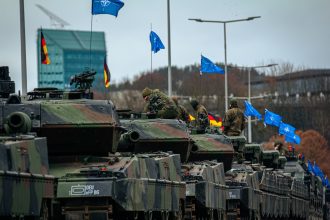
For Europe, the stagnation of talks carries immediate security implications. The continuation of the war sustains pressure on NATO’s eastern flank, reinforces defence spending trajectories, and prolongs uncertainty over energy and defence industrial planning.
For the EU, the diplomatic consequences are equally significant. A prolonged stalemate undermines confidence in Western conflict-resolution capacity and reinforces the perception that European security outcomes are ultimately determined outside European institutions.
At the global level, the Ukraine war has become a reference point for other contested regions, shaping perceptions of deterrence, alliance credibility, and the limits of Western diplomatic influence. A failed or stalled peace process under U.S. leadership would therefore reverberate beyond Europe, affecting strategic calculations in multiple theatres.
At the same time, there remains a narrow window for diplomacy. Neither side has achieved decisive military dominance, and both face escalating economic and manpower constraints. This creates a latent, if fragile, incentive structure for eventual negotiation—provided the framework is adjusted.
Three Possible Trajectories
Over the next 6–12 months, three broad scenarios are plausible.
The first is continued managed stalemate, with periodic diplomatic engagement but no substantive breakthrough. This remains the default trajectory if current negotiating structures persist.
The second is incremental de-escalation leading to a frozen conflict. This would involve informal understandings around front lines without a comprehensive political settlement, effectively institutionalising division.
The third—currently least likely but not impossible—is a restructured negotiation process that abandons maximalist territorial sequencing in favour of a phased approach to security arrangements, political guarantees, and ceasefire stabilisation mechanisms.
Avoiding drift toward the second scenario will require three policy adjustments: deprioritising territorial sequencing, recalibrating security commitments to align with actual enforcement capacity, and constructing an inclusive negotiation format that reduces parallel channels and information asymmetry
Conclusion
The failure of the current U.S.-led diplomatic effort in Ukraine is not primarily a function of insufficient engagement or political will. It reflects a deeper misreading of how wars of this nature end. Conflicts driven by overlapping security fears and identity-based strategic narratives rarely yield to transactional diplomacy alone.
The Trump administration’s approach has exposed the limits of sequencing peace through territorial bargaining while simultaneously offering security assurances that lack credible enforcement mechanisms. It has also demonstrated the costs of fragmented diplomacy in high-intensity geopolitical crises.
Ultimately, the Ukraine war is testing not only military endurance but diplomatic architecture. Whether the next phase of negotiations produces escalation, stagnation, or settlement will depend less on rhetoric than on whether Washington and its partners are willing to redesign the process itself to match the realities on the ground.