


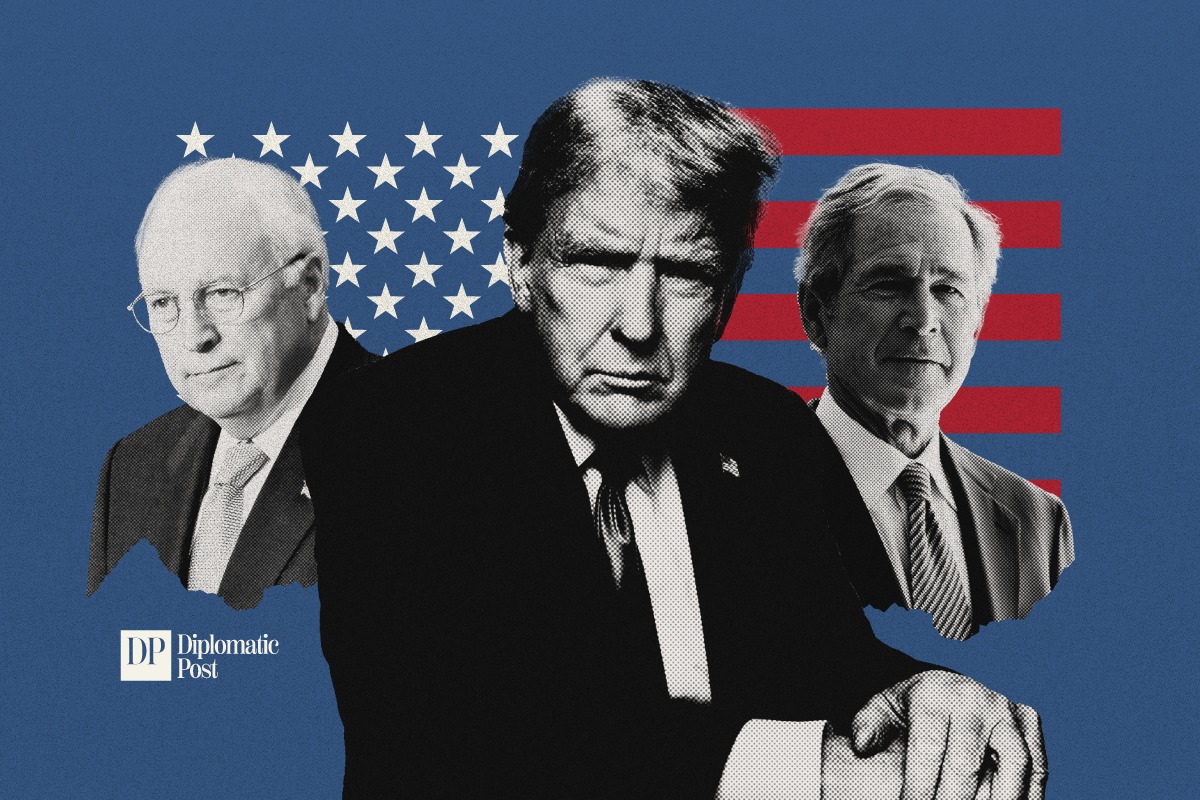
A leading global democracy tracker says the US has fallen further and faster than Hungary or Turkey ever did, and critics argue the runway was built two decades ago, in the name of fighting terrorism
The world’s most closely watched democracy monitor has reached a stark conclusion: the United States is no longer functioning as a liberal democracy, and it got there faster than any comparable case on record. The Varieties of Democracy Institute at Sweden’s University of Gothenburg, in its annual report, found that the US is autocratizing at a pace that outstrips Hungary, Turkey, Serbia and India, all countries widely studied for their own democratic backsliding, according to a media report on the findings. Why this matters extends well beyond a single index number; the researchers argue the mechanisms driving this collapse were not invented recently, but were normalised two decades earlier, during the war on terror, and are now simply being used at home rather than abroad.
“For Orbán in Hungary, it took about four years, for Vučić in Serbia, it took eight years, and for Erdoğan in Turkey and Modi in India, it took about 10 years to accomplish the suppression of democratic institutions that Trump has achieved in only one year,” said Staffan Lindberg, the institute’s founder, according to the report. US democracy has fallen to its worst recorded level since 1965, the year civil rights legislation first introduced de facto universal suffrage, erasing, in the report’s assessment, all progress made in the six decades since.
A concentration of power the researchers call unprecedented
The V-Dem Institute has tracked global democracy since 1789 using 48 separate metrics, covering freedom of expression, media freedom, election quality and rule of law, drawing on a team of 4,200 researchers across 180 countries and more than 32 million data points. Lindberg said the resulting liberal democracy index shows the speed of US democratic dismantlement is unprecedented in modern history, driven primarily by what he called “a rapid and aggressive concentration of powers in the presidency.”
Congress, in the institute’s assessment, has been effectively marginalised. “We’ve seen a very fast concentration of power in the executive wing. The legislative branch has practically abdicated its powers to the president. It no longer functions as a check on executive power,” Lindberg said. He pointed to a striking imbalance in Trump’s first year back in office: 225 executive orders signed, compared with just 49 new laws passed by a Republican controlled Congress. “Most of Trump’s executive orders were significant. He shut down entire departments of the government, firing hundreds of thousands of employees. The bills passed by Congress were mostly insignificant modifications to existing laws,” Lindberg said. “So, we no longer have a meaningful division between the legislative and executive branches.”
The Supreme Court, Lindberg added, has also largely ceded ground, and even when it does strike down an executive order, the administration finds ways around the ruling, with more than 600 ongoing judicial proceedings against the administration currently working through the courts. The report also highlighted Trump’s pardon of 1,500 people convicted over the January 6, 2021 Capitol assault, which the researchers say undermines the legitimacy of the courts themselves.
Lindberg pointed to a further parallel with other autocratizing states: the removal of internal safeguards meant to prevent abuse of power. “Trump has fired inspectors general and higher levels of civil servants across departments, and replaced them with loyalists. This is exactly what Orbán and Erdoğan did. They remove the constraints on power. It should be obvious by now that Trump is aiming for dictatorship,” Lindberg said.
The institute itself has a track record worth noting here. Founded in 2012, when global democracy sat near a historic peak, V-Dem’s researchers originally set out simply to build better metrics for studying democratisation. Within five years, they found the data moving sharply in the opposite direction. “Now, all of us researching democratisation have become researchers on autocratisation,” Lindberg said, adding that the institute’s earlier warnings were once dismissed as alarmist. “We were called alarmists. But now our warnings seem justified.”
A former CIA officer says the groundwork was laid twenty years ago
If the V-Dem report measures how fast this collapse is happening, a separate argument, made by a former CIA counterterrorism official, addresses a different question: why American institutions proved so vulnerable to it in the first place. John Kiriakou, a CIA whistleblower who served as chief of counterterrorism operations in Pakistan after September 11 and later as executive assistant to the agency’s deputy director for operations during Iraq War planning, argues the war on terror is where the real damage began, according to an analysis he authored.
Kiriakou writes that he had a front row seat to what he calls the CIA’s dismantling of constitutional constraints in the years following 9/11. “It was clear even then that the United States was moving to embrace what Vice President Dick Cheney called the ‘dark side,’ torture, assassinations, secret prisons, and extrajudicial renditions,” he writes. “It was equally clear that the Justice Department would sit idly by while the federal judiciary looked the other way.” In his account, this early dismantling of checks and balances, and the normalisation of extrajudicial executive power, directly laid the groundwork for the later rise of Trump and the broader MAGA movement.
Kiriakou notes the Bush administration moved quickly after 9/11, launching the war on terror with overwhelming bipartisan support, framed at the time as an urgent necessity to prevent another attack, a justification that redrew the boundaries of what was considered acceptable government conduct, according to his analysis. His broader argument is that once a president secures the practical, unchallenged authority to declare war, detain people indefinitely, and conduct lethal operations without meaningful congressional or judicial check, that authority does not simply disappear when the original justification fades. It becomes a permanent feature of the presidency, available to any successor willing to use it, for any purpose they choose.
A historian traces a third thread: guns and the psychology of fear
A third strand of this argument comes from historian Ruth Ben-Ghiat, author of “Strongmen: From Mussolini to the Present,” who has argued separately that America’s relationship with lethal weapons has created its own psychological conditions favourable to authoritarian politics, according to a media report carrying her analysis.
Ben-Ghiat’s argument centres on scale: more than 1.5 million Americans have died from gunshots over the past 50 years, she notes, more than the 1.2 million killed across the entirety of the nation’s wars combined. That volume of death, she argues, doesn’t just desensitise the public to violence; it actively cheapens the perceived value of life, fostering exactly the kind of political and psychological conditions autocracy tends to exploit. She points to armed militia members storming the Michigan Capitol in 2020, and later joining the broader coalition present at the January 6 insurrection, alongside retired and active duty law enforcement and military personnel, as evidence of how armed extremism and political destabilisation reinforce each other.
Her argument extends into a feedback loop she considers particularly dangerous, fear of violence driving more gun purchases, which in turn produces more accidental deaths, suicides, and hate crimes, deepening the very climate of fear that fuels further armed radicalisation. “The terror-filled psychological climate created by mass death only encourages the embrace of fundamentalist and cult ideologies that promise to bring order to chaos,” Ben-Ghiat writes, arguing that a healthy democracy depends on social trust and civic culture, conditions she says fear and suspicion actively erode.
Three arguments, one shared warning
Taken together, these three strands, an institutional index tracking executive overreach in real time, a former intelligence officer tracing that overreach back to specific war on terror policies, and a historian linking armed violence to authoritarian psychology, converge on a single broader claim, that American democratic backsliding did not emerge suddenly under one administration, but built cumulatively over two decades, through mechanisms established well before the current political moment.
This argument is not without pushback, and it is worth stating plainly that it remains genuinely contested. Supporters of the current administration would argue that expansive executive action, including the pace of executive orders cited in the V-Dem report, reflects legitimate use of presidential authority to address gridlock in a divided Congress, rather than an attempt to dismantle constitutional government. They would note that federal courts continue to hear and rule against the administration in hundreds of ongoing cases, itself evidence that judicial checks remain functional rather than abandoned, and that comparisons to Hungary, Turkey or Serbia risk flattening meaningful differences between those political systems and America’s own, considerably more decentralised and legally contested one. Critics of the V-Dem methodology have also long argued that quantifying something as complex as democratic health into a single index number necessarily involves subjective judgment calls that can be disputed on their merits.
What is not in dispute is that a research institute built specifically to study global democratisation now spends most of its time studying the opposite process, and that its founder, once accused of exaggerating the risks facing global democratic stability, says those earlier warnings now look understated rather than overstated. Whether that verdict holds up to further scrutiny, or whether America’s institutions prove more resilient than the index suggests, is likely to become one of the defining political arguments of the years immediately ahead.