



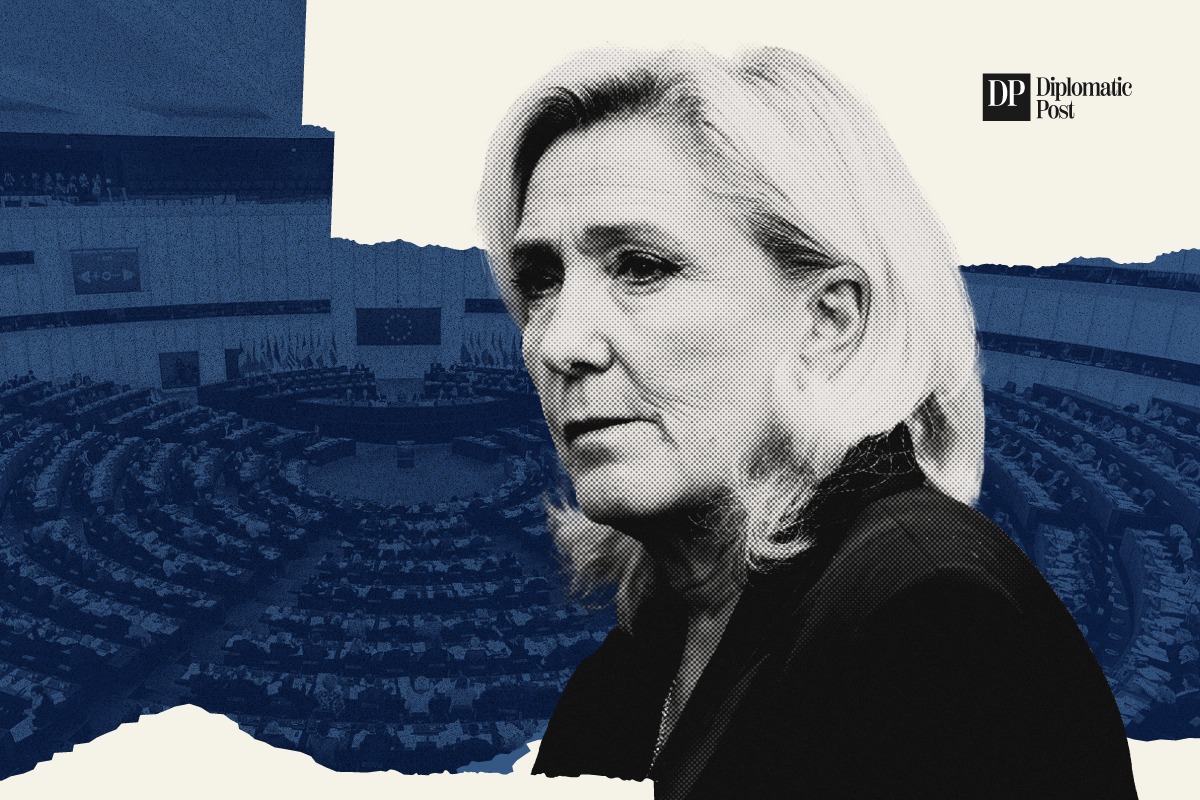


Few court rulings have carried such profound political consequences for modern France as the judgment expected in Paris today. For more than a decade, Marine Le Pen has transformed herself from the heir to a fringe nationalist movement into the leading figure of a party that many voters now see as a credible alternative to government. Whether she will be allowed to contest the 2027 presidential election now rests not with voters but with judges.
The Paris Court of Appeal is due to decide whether to uphold or overturn Le Pen’s conviction for misusing European Parliament funds, a ruling that also imposed a five year ban on holding elected office. The decision could determine not only the future of France’s most successful far right politician but also reshape European politics at a moment when nationalist parties continue to gain influence across the continent.
The case stems from allegations that members of what is now the National Rally used European Parliament money intended for parliamentary assistants to finance party activities inside France between 2004 and 2016. Prosecutors argued that public funds were diverted through an organised system benefiting the party rather than parliamentary work. Le Pen has consistently denied wrongdoing, insisting the prosecution represents a politically motivated effort to prevent her reaching the Élysée Palace.
When the lower court delivered its verdict in March 2025, the consequences extended far beyond criminal penalties. Alongside a prison sentence, partly suspended and partly to be served under electronic monitoring, Le Pen received an immediate five year ban from public office. That sanction instantly cast doubt over her long planned fourth presidential campaign. The appeal court now has several options. It may uphold the conviction and electoral ban, reduce or remove the ban, or overturn the conviction entirely, although legal specialists generally regard a full acquittal as unlikely.
The importance of the ruling reflects Le Pen’s extraordinary political journey. When she inherited leadership of the party founded by her father, Jean Marie Le Pen, it remained associated with political extremism, antisemitism and open hostility towards the European project. Over fifteen years she systematically softened its public image, expelled controversial figures including her own father, broadened its appeal beyond traditional nationalist voters and shifted attention towards immigration, purchasing power, security and national sovereignty.
Her strategy steadily paid dividends. After reaching the presidential runoff in both 2017 and 2022, Le Pen secured the strongest result ever achieved by the French far right. The National Rally subsequently became the largest single parliamentary force, cementing its position at the centre of French political life rather than its margins. According to recent polling cited in several analyses, Le Pen or her designated successor would begin the next presidential contest as one of the leading contenders.
More Than One Politician Faces Judgment
The appeal therefore concerns far more than one individual’s political survival. France is approaching a rare presidential election without an incumbent. Under the constitution, Emmanuel Macron cannot seek a third consecutive term, leaving the political field unusually open. Unlike previous elections dominated by familiar personalities, the next contest offers an opportunity for a complete reshaping of French politics.
If Le Pen remains barred from standing, attention immediately shifts to Jordan Bardella, the thirty year old National Rally president widely viewed as her political heir. Bardella has risen rapidly through the party ranks, presenting a younger and less controversial face while maintaining the movement’s core message on immigration, law and order and French sovereignty. Opinion surveys suggest he could also reach the presidential runoff, although questions remain about his governing experience and ability to withstand the pressures of a national campaign.
The possibility of a Bardella candidacy illustrates how thoroughly Le Pen has reshaped her party. Unlike earlier generations of European nationalist movements that often revolved around a single charismatic leader, today’s National Rally has invested heavily in institutional continuity. Senior party figures have repeatedly stated that whichever way the court rules, the political programme will remain unchanged.
Yet replacing Le Pen would not be straightforward. She remains the party’s dominant strategist, most experienced campaigner and strongest connection to millions of voters who have supported her across three presidential elections. Bardella may inherit the party organisation, but he cannot instantly replace the political authority accumulated through years of national campaigning.
The legal battle also raises wider questions about democratic accountability. Critics argue that preventing leading politicians from standing risks fuelling public distrust and strengthening claims that established institutions manipulate elections. Supporters of the prosecution counter that democracy depends equally upon the principle that elected politicians remain subject to the rule of law. From that perspective, exempting powerful candidates from legal consequences would undermine public confidence far more severely than enforcing judicial decisions.
That debate extends well beyond France. Across Europe, nationalist parties increasingly portray legal investigations as evidence of establishment attempts to silence political opposition. Similar arguments have appeared in several European countries whenever prominent populist leaders have faced corruption investigations or criminal charges. The French ruling therefore carries symbolic significance for political movements across the continent regardless of its legal outcome.
Europe Watches Closely
International attention reflects France’s central role within Europe. As one of the European Union’s largest economies, a permanent member of the United Nations Security Council and a leading military power, French presidential elections influence decisions reaching far beyond domestic politics.
Le Pen has consistently advocated a different approach towards European integration from successive French governments. Although she no longer proposes leaving the European Union or abandoning the euro, she has argued for returning greater authority to national governments, tightening border controls and reducing the influence of European institutions over domestic policy. She has also questioned aspects of France’s relationship with the Atlantic alliance while maintaining support for national defence capabilities.
On Russia and Ukraine, her positions have evolved significantly since the full scale invasion began. While condemning the invasion, she has remained more cautious than many mainstream European leaders regarding long term military support for Kyiv. Any future Le Pen presidency would therefore be watched closely by governments seeking continued European unity on sanctions, defence spending and support for Ukraine.
Markets are equally attentive. Political uncertainty in France has repeatedly affected investor confidence, government borrowing costs and broader discussions about fiscal policy inside the euro area. Although today’s judgment concerns criminal law rather than economic policy, it could influence expectations surrounding the next presidential campaign and France’s future direction.
For Le Pen personally, the ruling represents the culmination of years spent attempting to convert electoral momentum into presidential power. Few politicians have come so close while carrying such substantial political baggage. If the court removes the legal obstacle, she will almost certainly enter the presidential race as one of its strongest candidates. If the judges uphold the ban, her own ambitions may effectively end, but the movement she spent years normalising is unlikely to disappear.
Indeed, that may prove the most significant consequence of today’s decision. Whether represented by Le Pen or Bardella, the National Rally now occupies a permanent place at the heart of French politics. The court can determine who appears on the ballot paper, but it cannot resolve the economic anxieties, immigration concerns and growing distrust of established political parties that have fuelled the movement’s rise. Over the coming months those underlying forces are likely to matter every bit as much as the legal judgment itself, shaping not only France’s next election but also the wider balance of political power across Europe.