




Efforts to end the war in Ukraine have stalled due to increasingly intense exchanges of drone and missile strikes and a deadlock in EU mediation initiatives. At the diplomatic level, both sides claim they remain open to negotiations. However, on the military level, the conflict is further escalating through mutual drone and missile attacks, making such negotiations almost impossible.
Negotiations remain at a standstill. Russian President Vladimir Putin once again stated during a regional visit that he “remains open to talks,” but only “under the same conditions we have already outlined.” In other words, he continues to insist that Kyiv give up control over parts of Donbas that the Armed Forces of the Russian Federation (AFRF) have not yet occupied.
The two sides remain deeply divided, as detailed in a text by long-time Russian Foreign Minister Sergey Lavrov. The article was supposed to be published in Politico this week but was withdrawn at the last moment.
In the text however, published on the website of the Russian Ministry of Foreign Affairs, Lavrov reiterated that the Kremlin is ready to negotiate, even with the EU, but only if Kyiv is prepared to address the so-called “root causes” of the war. This term, translated, refers to several demands: guarantees that Ukraine will not join NATO, security guarantees for Russia, protection of the religious and linguistic rights of Russians and Russian-speaking populations, and territorial concessions in Donbas. Zelensky has made it equally clear that these are red lines Kyiv will not cross. He has also explicitly rejected a ceasefire, arguing that freezing the conflict would only postpone another war.
“Russia Is Not Losing the War,” As Some Media Claim
Meanwhile, Kyiv highlights the slow progress of Russian forces, while international media often support the Ukrainian narrative, claiming the war has reached a “turning point” and that Russia is once again “losing the war.”
As noted in his weekly column by BneIntelliNews commentator Leonid Ragozin, along with several other military and political analysts and the editor of this portal, this is an illusion. Such assessments have been seen before. Every Russian setback is interpreted as a sign of collapse. However, reports from the battlefield paint a far more somber picture than charts showing territorial gains or casualty numbers.
Russian forces have infiltrated the strategically important city of Kostiantynivka in eastern Ukraine and are now attempting to encircle it, according to the BBC. Kostiantynivka serves as a gateway to the rest of Donbas and poses a threat to remaining Ukrainian strongholds in the east, Kramatorsk and Sloviansk. It is a heavily fortified defensive line in Donbas. If all three cities fall under Russian control, Donbas would effectively be lost for Ukraine.
Ukrainian mid-range attack drones are swarming the Russian-occupied Chonhar area, a key Russian supply line between southern Ukraine and Crimea.
— OSINTtechnical (@Osinttechnical) June 23, 2026
Seen here, a compilation of recent GUR strikes targeting Russian logistics in the area: pic.twitter.com/MKIBSxzqKo
Although the Kremlin is clearly under pressure, both militarily and economically, it is far from collapse, as shown by the latest May report from the Kyiv School of Economics (KSE).
Putin’s strategy appears clear: to wait for Ukraine to accept Kremlin terms while continuing military pressure in Donbas. He seems convinced that Russian forces can seize the remainder of the region and is prepared to commit the necessary financial and human resources to achieve that goal. However, it is also true that the Russian army is advancing extremely slowly. Over the past year and a half, it has captured around 1% of Ukrainian territory, and a war that was expected to last weeks or months—according to Russian military planners—has entered its fifth year. From the idea of capturing Kyiv and Odesa, Russia has apparently even abandoned full control over territories it has already incorporated into its constitution (the remaining parts of Kherson and Zaporizhzhia regions, as well as their regional capitals).
It seems that “pro-war” commentators struggle to hold multiple truths at once: that the Russian army is still advancing, but also that the course of the war is far from what Moscow originally planned or considered a successful outcome of the “special military operation” four and a half years ago.
The war has thus remained in a kind of stalemate, marked by contradictory signals. Rhetorically, both leaders claim to be open to negotiations, even a personal meeting. In practice, however, neither side is willing to compromise. Yuri Ushakov, Putin’s chief foreign policy adviser, said this week that the Kremlin is not waiting for negotiations, but for military victory in Donbas.
Zelensky also speaks of peace, but at the same time is conducting the deepest, most frequent, and most serious strikes on Russian territory to date. The list of targets has expanded from military-industrial facilities to symbolic sites, such as the massive drone attack on Moscow last week.
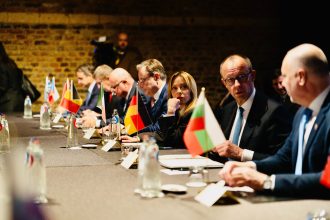
The European Union finds itself in a similar dilemma. At the E3 summit in London on June 8, leaders of France, Germany, and the United Kingdom called for negotiations and presented a five-point plan, but at the same time signed agreements for additional weapons supplies to Ukraine, including long-range missiles capable of striking deep inside Russia. Lavrov therefore rejected the possibility of the E3 acting as a mediator, arguing that they are participants in the conflict rather than neutral actors.
At the end of last year, significant progress toward a ceasefire was achieved, culminating in a meeting in Moscow on December 3. A 27-point peace plan (27PPP) was presented, which Putin described as “largely acceptable” to the Kremlin because it was based on agreements reached with U.S. President Donald Trump at the Alaska summit on August 15. That document has now been effectively abandoned, and the White House has withdrawn from the process.
E3 Leaders in Political Crisis
The initiative was taken over by the E3, but its position was immediately weakened by the resignation of British Prime Minister Keir Starmer on June 22. German Chancellor Friedrich Merz and French President Emmanuel Macron are also facing political difficulties. Merz is currently the least popular German chancellor in modern history and is facing a growing challenge from the far-right AfD (Alternative for Germany), now the most popular party in the country, which could take power in its first federal state in the upcoming autumn local elections.
The long-standing principle of the “Brandmauer” (firewall)—isolating the far right by refusing coalition partnerships—could begin to erode if the economic situation continues to worsen.
Macron’s mandate ends next year, and it is almost certain he will be succeeded by a candidate from the National Rally. Both AfD and the National Rally show some sympathy toward the Kremlin and would likely reduce support for Ukraine. Enthusiasm for supporting Ukraine has already significantly weakened among several new governments in Central Europe. At the same time, divisions within the EU are growing, making it harder to identify a unified European representative for talks with the Kremlin.
Without a clear diplomatic exit from the military stalemate, Kyiv has intensified drone strikes to bring the war closer to everyday life for Russian citizens. This strategy has had partial success. Strikes on refineries have triggered a growing fuel crisis, rising prices, and widespread rationing, even in Moscow.
But time is running out for Ukraine. Putin is likely to wait for winter and continue attempts to weaken Ukraine through attacks on its energy infrastructure. Last year’s campaign targeted Ukraine’s electricity system, reducing generation capacity from nearly 60 GW before the war to about 10 GW today. The shortfall is being covered by planned blackouts and electricity imports from the EU.
Long-Range Drones Are Not Ballistic Missiles
Ukrainian experts are attempting to repair as much damage as possible during the summer, but Russia still holds significant missile superiority. Ukrainian long-range drones are not ballistic or hypersonic missiles.
Western media are increasingly recognizing this military imbalance. For example, the New York Times noted last week that Ukraine has long-range drones, but their explosive payload is too small to cause major damage. Meanwhile, Russia produces dozens of cruise and ballistic missiles daily with far greater destructive power.
In addition, Russia currently uses between 1,400 and 1,750 glide bombs weekly, including cheap but extremely powerful modified FAB bombs. The latest Geran-5 drones and jet-powered glide bombs fly too fast for Ukrainian interceptor drones to effectively shoot them down.
Ukraine also faces a severe shortage of Patriot PAC-3 air defense missiles. After the United States depleted part of its own stockpiles during operations in the Middle East, Ukraine’s reserves have significantly decreased. According to some reports, Ukraine had only sixteen interceptor missiles left at the beginning of the year. As a result, Ukrainian airspace could again become highly vulnerable this winter.
Ukraine is now engaged in a political-psychological war. Drone strikes on Saint Petersburg during the International Economic Forum (SPIEF) and attacks on Moscow during the G20 summit were primarily symbolic—aimed at showing Russia’s vulnerability rather than achieving major military gains.
Russia is using similar methods. One example is the recent bombing of the Kyiv Pechersk Lavra complex, a UNESCO World Heritage site.
Declining Popularity of Both Putin and Zelensky
According to the Kyiv School of Economics (KSE), Kyiv can inflict some economic damage on Russia. However, political analyst Mark Galeotti warns that despite growing tensions between hardliners and pragmatists within the Kremlin, no one believes this will be enough to deter Putin from continuing the war.
On the other hand, Russia still has the ability to seriously damage Ukraine’s economy with its missile arsenal. Zelensky is also under increasing pressure from domestic political problems, corruption scandals, and financial challenges that intensified after the EU reduced funding for Ukraine in the new Multiannual Financial Framework (MFF).
In the short term, a recently approved €90 billion EU loan will finance Ukraine’s armed forces this year and part of next year. However, according to the draft Ukrainian budget, an additional €45 billion will be needed from G7 partners by the end of 2027. Even that may not be enough, as Ukraine already faces a budget deficit of around €20 billion this year.
Putin’s popularity has declined, but Zelensky’s has fallen even more. According to recent polls, corruption has become a more important issue for Ukrainian citizens than the war itself. The Russian economy is suffering from the conflict, but so is the European Union’s economy.
Ukraine Facing a Severe Demographic Crisis
As noted by Yulia Mendel, former spokesperson for Volodymyr Zelensky, continuing the conflict without clearly defined war goals is becoming increasingly meaningless and threatens to worsen Ukraine’s already severe demographic situation. The country already faces one of the worst demographic profiles in the world. The population has nearly halved, and roughly half of the remaining population consists of pensioners.
Rising costs of the military and economic war have revived discussions about the possible use of tactical nuclear weapons. Putin himself has taken a more restrained public stance. Following recent attacks, he rejected calls for direct retaliation beyond conventional warfare and avoided the nuclear rhetoric that many had feared.
At the same time, he emphasized that such attacks are incompatible with Zelensky’s calls for direct negotiations, once again highlighting the deep deadlock in the peace process.
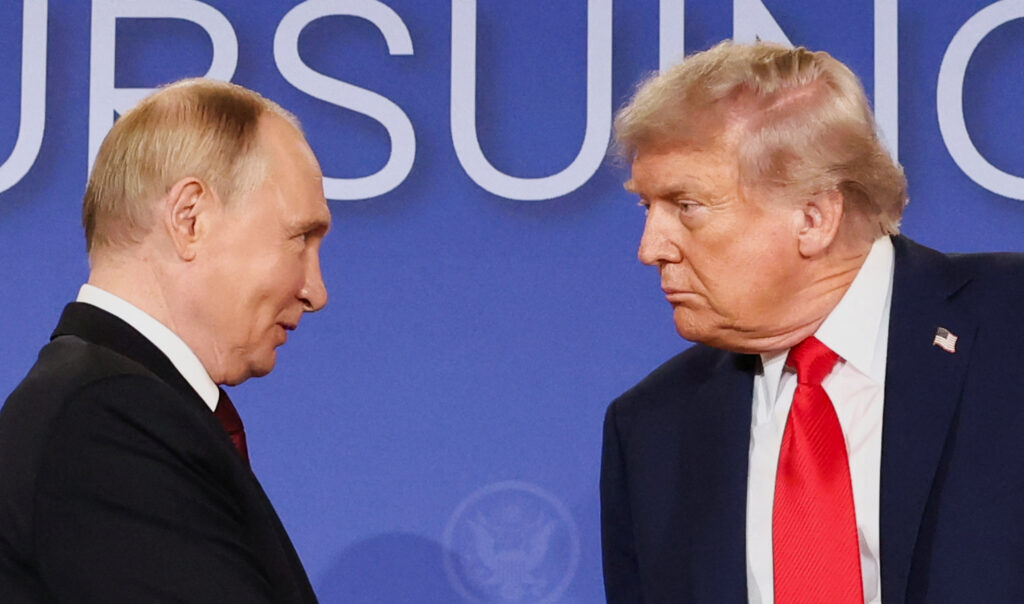
“People keep saying: ‘We want personal meetings, we want a personal meeting.’ And then, three days later, there is an attack on Starobilsk. How are we supposed to interpret that?” Putin asked reporters.
The Russian president reiterated that Moscow remains ready to continue negotiations, as neither side wants to be seen as the one prolonging the war, even though the full-scale conflict began when Russian forces entered Ukraine in late February 2022. “Russia is ready to continue negotiations,” he said, adding that the conditions have not significantly changed from his earlier demands.
There are growing signs that both sides understand the war will eventually have to end through negotiations. However, neither is currently willing to take steps that would create conditions for a serious peace process.
While political leaders speak of dialogue, the war continues with undiminished intensity. Drone strikes, missile attacks, and attrition remain the main instruments of policy on both sides. Under these conditions, the possibility of a sustainable peace agreement appears further away than official rhetoric suggests. As a result, the war in Ukraine remains trapped between declarative willingness to negotiate and a reality in which both sides act as though they believe they can achieve a more favorable outcome on the battlefield than at the negotiating table.