


The unravelling of unanimity over the EU’s 21st sanctions package is less a diplomatic hiccup than a warning sign about the durability of Europe’s four-year confrontation with Moscow.
For three and a half years, the European Union’s sanctions machine ran on a simple political fuel: solidarity with Ukraine was non-negotiable, and the economic cost of proving it was someone else’s problem. That fuel is running low. Negotiations over the bloc’s 21st sanctions package against Russia have dragged for days without resolution, as Greece, France, Italy, Germany, Austria and Portugal have all sought carve-outs to protect domestic industries from Greek shipping to Portuguese and German fish processing to French and Italian tourism revenue tied to Russian visa policy. One diplomat involved in the talks told the Financial Times that “the moral imperative is losing its force” around the negotiating table. The European Commission is now reportedly reworking parts of the package, including provisions on Russian oil and Austria’s Raiffeisen Bank, before a decisive ambassadors’ meeting.
This matters well beyond the technicalities of package number 21. Because EU sanctions require unanimity among 27 governments, the bloc’s Russia policy has always been hostage to its most reluctant member. What is new is that the resistance is no longer confined to the usual suspects, Hungary and Slovakia. It now includes core EU states whose objections are economic rather than ideological a shift that changes the character of the debate entirely.
What is actually happening
The 21st package targets areas where Russia has adapted its economy fastest: shadow-fleet energy exports, financial workarounds to the oil price cap, and remaining trade channels that sanctions have not yet closed. Precisely because these measures bite where evasion has been most lucrative, they also bite European commercial interests that have quietly continued profiting from residual Russia-linked trade. Greece’s shipping sector, led by companies such as Dynagas, has opposed a ban on transporting Russian liquefied natural gas, arguing according to Politico’s reporting on internal EU deliberations that it would hand market share to non-EU competitors while inflicting disproportionate damage on Greek firms rather than on Moscow. Germany and Portugal want exemptions preserved for Russian fish imports to protect processing industries. France and Italy, whose tourism sectors depend partly on Russian visitors, are pushing back on tighter visa restrictions. Austria continues to press for leniency toward Raiffeisen Bank, still one of the few major Western lenders operating at scale inside Russia.
None of this amounts to a rupture in the EU’s declared support for Ukraine. Every government involved continues to affirm, publicly, that Russia’s aggression must be met with pressure. But the pattern — repeated across successive sanctions rounds since 2022 — points to a structural problem: the easy sanctions were adopted early, and each subsequent package increasingly forces a choice between symbolic toughness and tangible domestic cost. The Commission is said to be preparing an economic-impact assessment ahead of a July 22 ambassadors’ meeting, an unusual step that itself signals how seriously Brussels is treating the risk of outright failure to agree a package at all.
Why now
Timing explains much of the erosion. Three forces are converging. First, the war has settled into a grinding phase in which decisive battlefield breakthroughs look less likely than a negotiated freeze, and several capitals are positioning themselves for a diplomatic endgame rather than open-ended confrontation — reducing the political premium on demonstrating maximal toughness now. Second, European economies are still absorbing the compounding costs of energy-price disruption, reduced Russian trade, and retaliatory measures, at a moment when several major EU states, including Germany and France, are dealing with sluggish growth and tight fiscal space. Third, and less discussed, is the sheer cumulative reach of twenty prior packages: the EU has already sanctioned the largest and most obvious targets, so each new round increasingly touches smaller but politically concentrated domestic interests shipping fleets, regional fishing industries, specific banks that lobby hard and visibly against their own exposure.
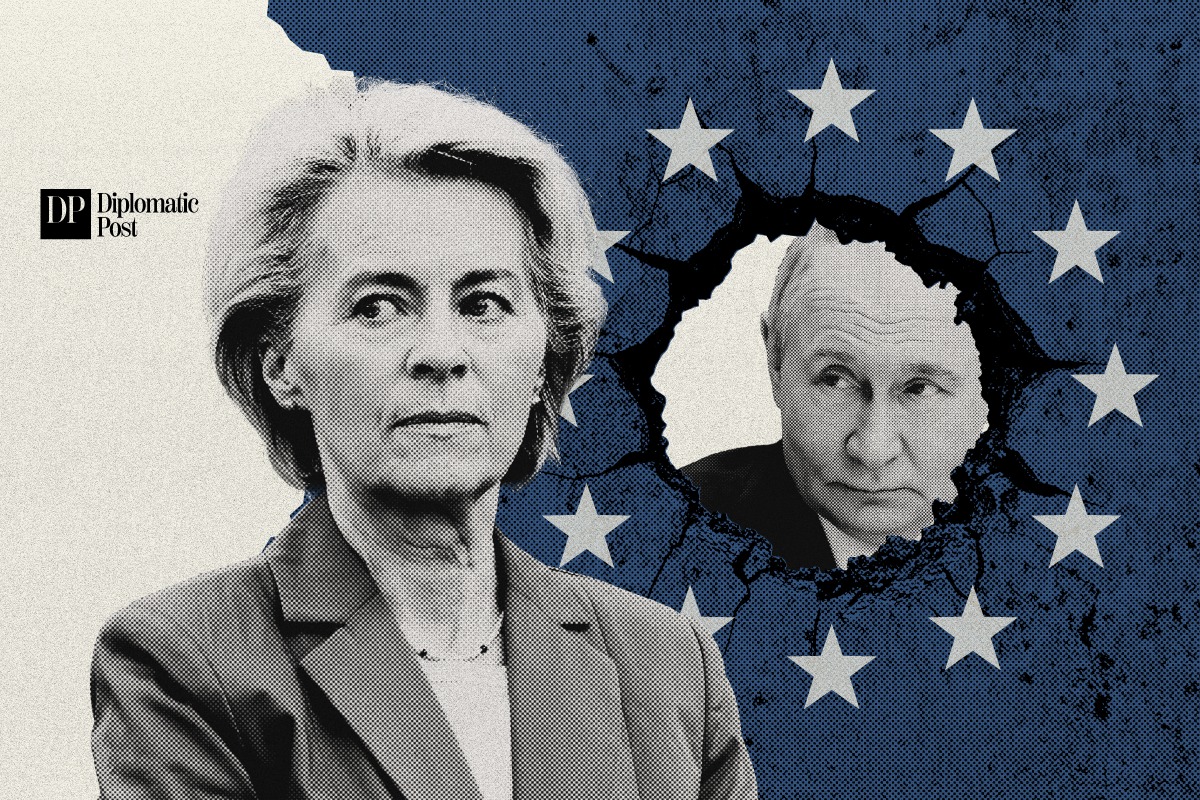
This is compounded by a parallel and unresolved fight over the EU’s “reparations loan,” the plan championed by Commission President Ursula von der Leyen and German Chancellor Friedrich Merz to advance Ukraine roughly €90–140 billion drawn against frozen Russian central bank assets held mainly at Euroclear in Belgium. Belgium has resisted the scheme for months, citing legal exposure to Russian litigation and the risk of confiscation of European corporate assets inside Russia, and Washington has reportedly signalled discomfort with the idea as it explores using the same frozen assets as leverage in any eventual peace settlement. The sanctions fight and the reparations-loan fight are not the same dispute, but they share a common root: European governments are increasingly unwilling to absorb open-ended financial risk on Ukraine’s behalf without ironclad guarantees that costs will be shared, not concentrated.
Who gains, who loses
Russia is the most obvious beneficiary of a slower, more contested sanctions process, even short of any package collapsing outright. Delay itself has value: it buys the Kremlin time to further adapt trade routes, and it feeds a Russian narrative — amplified energetically in Moscow-aligned media — that Western unity is dissolving under the weight of self-interest. That narrative has clear utility in any negotiation, since Russia’s leverage in peace talks partly depends on convincing Ukraine and Washington that European resolve has a shelf life.
Ukraine loses the most from any perception of drift, not because the 21st package by itself is decisive, but because Kyiv’s negotiating position depends on Moscow believing that Western pressure will keep intensifying rather than plateauing. A stalled or watered-down package, following on from the unresolved reparations-loan fight, would reinforce doubts in Kyiv about the durability of European commitment just as any ceasefire negotiations gain momentum.
Within the EU, the states seeking carve-outs are pursuing entirely rational, narrow interests — Greek shipowners, German fish processors, Austrian bank shareholders, French and Italian tourism operators — but collectively they weaken the Commission’s hand and invite exactly the kind of horse-trading unanimity rules were designed to allow. The European Commission and the more hawkish member states — the Baltics, Poland, the Nordics — stand to lose institutional credibility if sanctions rounds increasingly resemble negotiated exemptions rather than coordinated pressure.
Regional and international stakes
For NATO’s eastern flank, a visibly fraying sanctions consensus reinforces long-standing anxieties that Western Europe’s appetite for confrontation is more conditional than its rhetoric suggests. For Washington, now managing its own recalibrated approach to the war, European disunity complicates any effort to present a coordinated transatlantic position in ceasefire diplomacy — Russia has every incentive to exploit gaps between US and EU red lines. For international institutions, particularly the G7’s coordinated sanctions architecture built since 2022, a European retreat into carve-out politics threatens to unpick the uniformity that has made sanctions enforcement harder for Moscow to circumvent through jurisdiction-shopping.
There is a genuine diplomatic opportunity buried in this friction, however. The Commission’s economic-impact review, however unwelcome to hawks, could produce a more sustainable sanctions architecture — one calibrated to actual enforcement capacity and shared burden rather than symbolic breadth. A narrower but genuinely enforced package may do more damage to Russian revenue than a broader one riddled with informal exemptions and evasion.
Policy outlook: the next six to twelve months
Watch three things. First, whether the July 22 ambassadors’ meeting produces a genuine compromise or merely defers the fight — a repeated pattern of last-minute, watered-down deals would itself become a strategic signal to Moscow. Second, whether the reparations-loan impasse with Belgium is resolved with credible member-state guarantees; failure here would compound the sanctions story into a broader narrative of European financial hesitancy on Ukraine. Third, the trajectory of any US-brokered ceasefire framework: if Washington pushes a settlement that implicitly deprioritizes further sanctions escalation, EU hawks will lose significant leverage to hold the line against carve-out demands, accelerating the very fragmentation now visible in Brussels.
Policymakers in Kyiv, Washington and allied capitals should treat the 21st package not as an isolated procedural spat but as a leading indicator of how much further, and how fast, European sanctions policy can realistically go.
The bottom line
The unanimity rule was always Europe’s structural vulnerability on Russia policy, tolerable so long as political will outran economic pain. That balance is shifting. What is emerging is not a collapse of the sanctions regime but its maturation into something more contested, transactional and vulnerable to erosion by attrition — a slower unwinding that may prove more consequential, over time, than any single dramatic veto. For Moscow, patience is starting to look like a strategy that is working.