



The next generation of weapons may not roll off Lockheed’s assembly lines, but out of the same labs building your phone’s AI, and that shift is quietly rewriting the rules of modern war
For generations, the world’s most powerful weapons carried the names of a small handful of giants: Lockheed Martin, Northrop Grumman, Boeing, and Raytheon. That era is not over, but it is no longer the whole story. Technology companies that were never built to make weapons at all are now pushing deep into defence, betting that software and machine intelligence can produce cheaper, faster and more adaptable systems than the traditional defence industry ever could, according to a media report on the shift. Why this matters goes well beyond who wins new Pentagon contracts. It signals a genuine change in what decides military power, not simply who owns the most expensive aircraft or the largest fleet, but who can field thousands of intelligent machines fast enough to outpace an adversary.
Artificial intelligence firms, robotics companies and technology startups are now actively competing for a role in next-generation military systems. Their pitch is straightforward, use automation and machine intelligence to build weapons systems that traditional manufacturers, with their years long design and production cycles, simply cannot match for speed or cost.
Ukraine turned theory into proof
The war in Ukraine has done more than any Pentagon white paper to accelerate this shift. The conflict has become a live laboratory for autonomous warfare, demonstrating that relatively inexpensive unmanned systems can genuinely challenge assumptions that shaped military planning for decades. Drones have destroyed tanks, disrupted supply lines, and forced entire armies to rethink how they defend themselves.
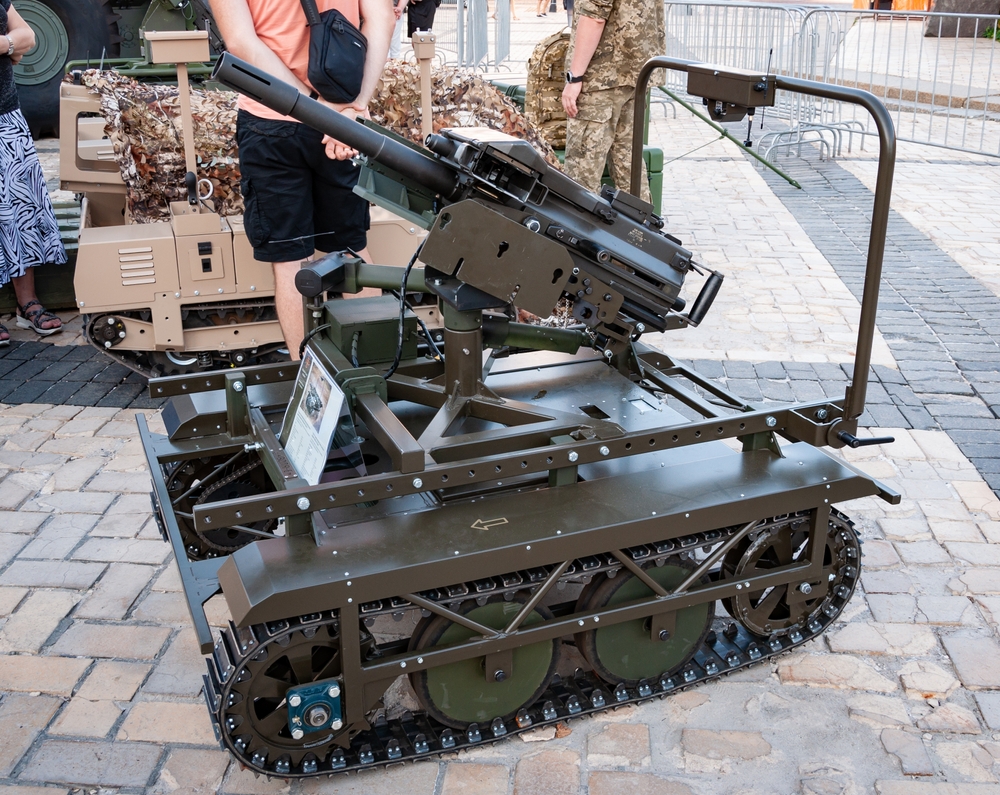
But the next stage of this shift goes well beyond flying drones. It extends to ground robots, autonomous vehicles, AI-powered targeting systems, and machines built specifically to operate in environments too dangerous for human soldiers. According to the same reporting, defence planners increasingly view armed robotic systems as a potential future standard rather than a specialised niche. The appeal is obvious on its face, machines can absorb the risk of dangerous missions instead of soldiers, and improvements in artificial intelligence are steadily making those machines more capable and more affordable at the same time.
Why Silicon Valley finally wants in
For decades, major technology companies kept their distance from the defence sector, focusing instead on consumer products, enterprise software and internet services. That posture has shifted dramatically. The Pentagon’s search for artificial intelligence capability has opened a door for companies whose real expertise lies not in building missiles or aircraft, but in processing enormous volumes of data and building intelligent software systems.
Palantir Technologies has already become a major defence technology player in its own right, supplying battlefield intelligence and data analysis platforms to military customers. Other technology firms are now developing autonomous systems, computer vision tools and AI capabilities explicitly adaptable for military use, a trend an analysis from the Centre for Strategic and International Studies has examined in detail as part of broader research on artificial intelligence and the future of warfare.
The message increasingly coming out of the Pentagon is clear: future wars will be won not solely through industrial capacity, but through technological speed. Traditional defence firms remain essential, since they still build the platforms that dominate modern warfare, such as aircraft carriers, fighter jets, and missile systems. But Silicon Valley brings something different to the table, the ability to rapidly develop, update and scale software-driven systems. On a battlefield where technology can shift meaningfully within a single month, that speed advantage may prove decisive.
This is precisely why armed robots have captured so much attention. They represent the merging of two worlds that historically operated on entirely separate tracks: military hardware and commercial technology. A tank takes years to design and manufacture from scratch. Software, by contrast, can be updated overnight. A fighter jet represents a multi-billion-dollar investment locked in for decades. A network of autonomous systems can potentially expand at a fraction of that cost and adapt far faster once deployed.
Robots as partners, not replacements
None of this means soldiers are about to be replaced. According to research from the RAND Corporation examining artificial intelligence and the future of defence, the more realistic near-term outcome is not a fully autonomous army operating without human involvement, but a new kind of partnership between humans and machines. Under that model, robots would handle reconnaissance, logistics, surveillance and the most dangerous missions, while human commanders retain responsibility for strategic decisions.
That transition, however, opens up genuinely difficult questions that have not been fully answered. The central debate concerns control. As artificial intelligence systems grow more capable, governments face a real decision about how much independence to grant military machines operating in the field. Critics warn that allowing algorithms to make decisions in lethal situations risks creating serious legal and ethical problems, particularly around accountability when something goes wrong.
Supporters of the technology counter that properly designed autonomous systems could actually make warfare more controlled rather than less, by reducing human error, improving targeting accuracy, and giving commanders significantly better real-time information. The genuine debate, in other words, is not really about whether autonomous weapons will exist. It is about how they will ultimately be governed, and by whom.
A race measured in code, not just steel
This technological shift is unfolding against a much larger geopolitical competition. The United States, China and other major military powers are racing to establish dominance in military artificial intelligence. Beijing has invested heavily in autonomous systems as part of a broader military modernisation strategy, while Washington is attempting to combine its long-standing traditional defence advantages with the innovation coming out of Silicon Valley.
NATO itself has flagged emerging and disruptive technologies as a strategic priority, according to the alliance’s own assessment of the field, reflecting how seriously member states now take the risk of falling behind in this particular technological race. The countries that ultimately succeed in this competition may not be the ones fielding the largest standing armies. They may instead be the ones capable of producing the smartest, fastest and most adaptable machines, regardless of overall military size.
The rise of armed robots marks a genuine shift in what military power actually means. The factories shaping tomorrow’s battlefield will not only be filled with engineers building aircraft carriers and fighter jets. Increasingly, they will also house programmers writing the algorithms that determine how those weapons perceive their environment, move through it, and respond to threats within it.
The next arms race, in other words, is not simply about steel and tonnage the way past ones were. It is increasingly about software, about who can write, test and deploy intelligent systems faster than their rivals. And Silicon Valley, a corner of the American economy that spent decades staying deliberately clear of military work, now clearly wants a seat close to the centre of it.