


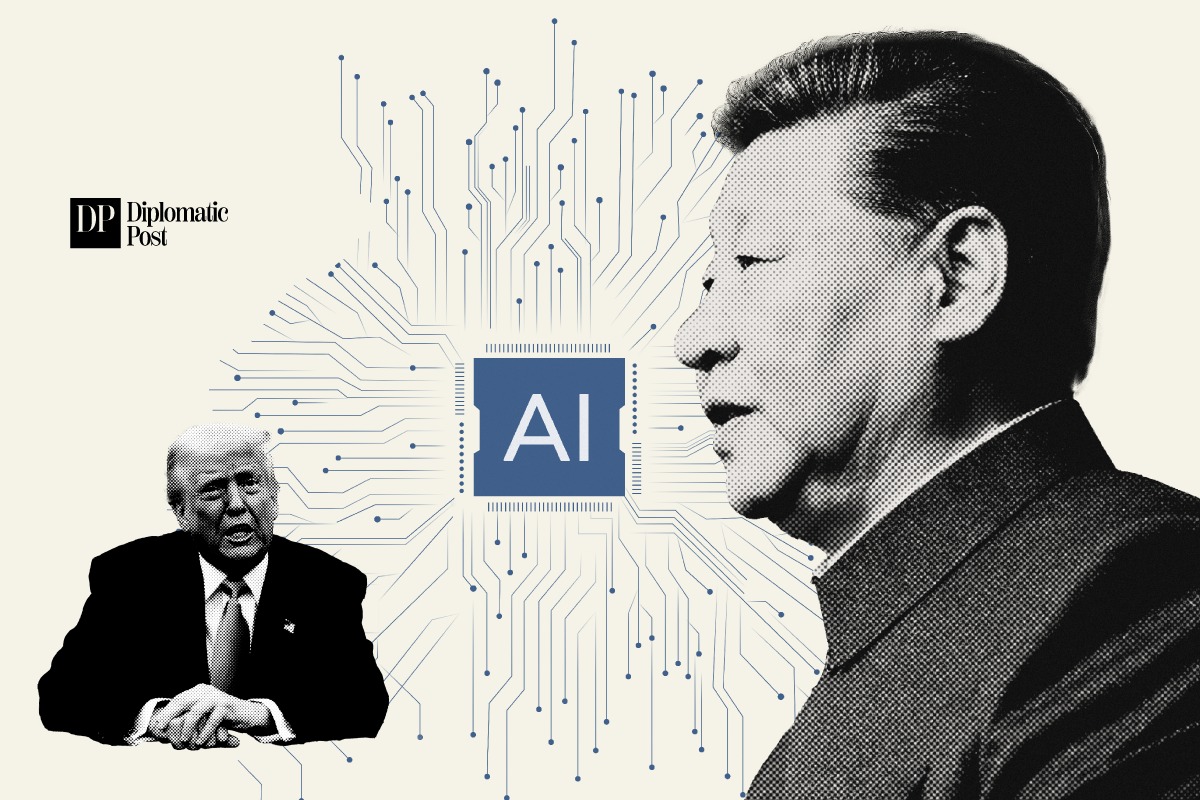
Locked out of America’s chip supply chains, China is answering with something Washington can’t easily match, a coalition of nations it says Washington left behind
Here is the strategic logic driving events in Shanghai this week. Washington has spent two years choking off China’s access to the world’s most advanced chips, and Beijing has spent that same stretch of time deciding that if it cannot out-compute America, it can out-recruit it.
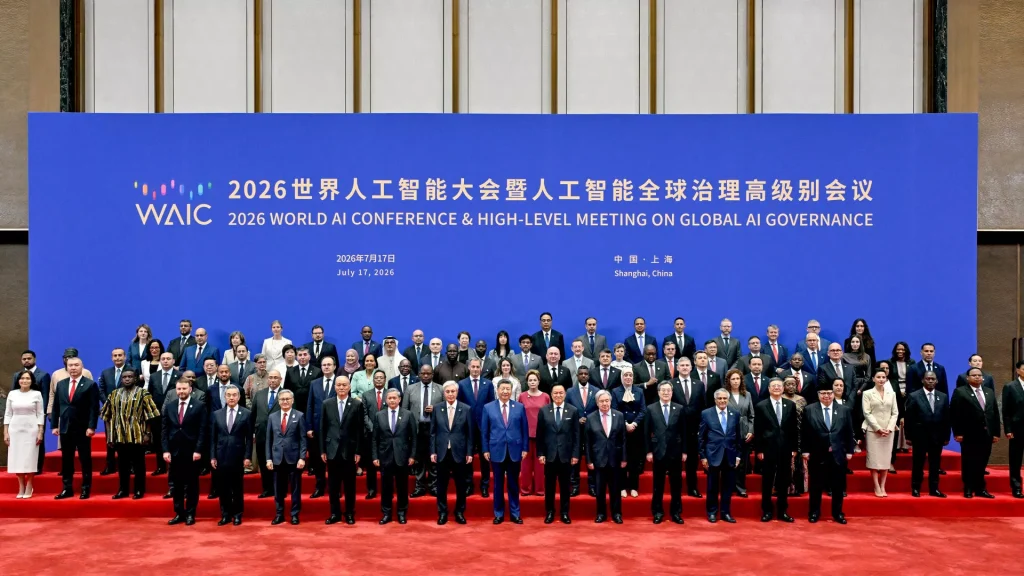
That calculation is what brought 29 countries to Shanghai on July 16 to found a new World AI Cooperation Organisation, and what put Xi Jinping on stage the next day, promising a symphony of global cooperation, according to a media report. This is not really a conference about algorithms. It is a bid for diplomatic mass, an attempt to turn a technology fight China cannot yet win on hardware into a coalition fight it believes it can win on numbers.
The chip restrictions are the whole backstory here, even though Xi never named them directly. American export controls have cut China off from some of the most advanced semiconductor technology in the world, forcing Beijing to accelerate its own chip development while simultaneously searching for a different kind of advantage, one measured in allies rather than transistors.
Xi’s answer, delivered at the World Artificial Intelligence Conference, was to declare that AI “should not be a solo performance by any single country but rather a symphony of global cooperation,” a line aimed less at reassuring the world than at recasting American restrictions as selfishness dressed up as security policy. He repeated a familiar Chinese grievance almost word for word, warning against “overstretching the concept of national security” and “placing one’s own security above that of other countries,” according to the same report.
Why the Global South is the real prize
Xi did not stop at rhetoric. China pledged to deepen AI cooperation with the Association of Southeast Asian Nations, the League of Arab States, the African Union, the Community of Latin American and Caribbean States, the Shanghai Cooperation Organisation and the BRICS bloc. It promised 30 countries free access to a Chinese-built AI weather forecasting tool and 5,000 AI training slots for developing nations over the next five years.
None of this is charity. It is market building. Countries that train their engineers on Chinese systems, run their forecasting on Chinese tools, and plug their institutions into Chinese AI infrastructure are countries that will find it structurally harder to walk away from Chinese technology later, whatever Washington offers them instead.
George Chen of the Washington-based consultancy The Asia Group, who attended the conference, put the goal plainly: China wants to be seen as the reliable partner for the Global South, and as he said, “China will not let America be the monopoly of AI technology,” according to the report. That is a geopolitical statement wearing a technology conference badge.
The organization built specifically to rival Washington’s club
The new World AI Cooperation Organisation was signed into existence a day before Xi spoke, by representatives of Russia, Belarus, Serbia, Cuba, Brazil, Venezuela, and 22 African and Asian states, headquartered in Shanghai, according to a media report. Look at that roster, and the strategic pattern is obvious. These are, almost without exception, countries either sanctioned by Washington, wary of Washington, or actively courted by both Washington and Beijing simultaneously. This is not a neutral scientific body. It is a block.
Chen was blunt about what it answers: the American-led Pax Silica framework, launched last year to bind US allies together on AI supply chains, whose signatories, Japan, the UK, Australia, the Philippines, Israel and India, read almost like a mirror opposite of the Shanghai roster, according to the report. Two blocs, two membership lists with almost no overlap, built around the same technology. That is the real map of this rivalry, and it was drawn well before anyone in Shanghai picked up a signing pen.
A companion account from the Shanghai Cooperation Organisation’s own secretariat filled in the institutional scaffolding. The new body will operate under the UN Charter, rely on consultation rather than binding authority, and lean on what it calls a human-centred approach, according to the organisation’s own report.
Eleven of the 29 founding members are already SCO states: Belarus, Cambodia, Kazakhstan, China, Kyrgyzstan, Laos, Myanmar, Pakistan, Russia, Tajikistan and Uzbekistan, meaning China is largely building this new AI body directly on top of an alliance architecture it already controls. Premier Li Qiang floated the idea back in 2025. It took a year and mounting American export pressure to turn that proposal into signatures.
Rivals at the podium, partners in private
What complicates any simple picture of two hardening camps is that Washington and Beijing are still talking to each other directly, even as they build opposing coalitions. Following a May visit by President Trump to Beijing, the two countries separately agreed to hold their own bilateral dialogue on AI governance, according to the report. That is the paradox of this moment. China is assembling a rival bloc in public while keeping a private channel open to the very power that bloc is designed to counterbalance.
The reason China can make this pitch credibly at all is that its technology has stopped lagging far enough behind to make the sales pitch embarrassing. Huawei is showing off its Atlas 950 SuperPoD computing system at the same conference. Chinese startup Moonshot timed the release of its Kimi K3 model, which it claims carries 2.8 trillion parameters, to land during the event, overtaking DeepSeek’s own 1.6 trillion-parameter V4 Pro. Another firm, Zhipu, put out its GLM-5.2 model last month, aimed squarely at Anthropic. American companies, Anthropic among them, have accused Chinese firms of illicitly distilling their models to extract the underlying technology, an accusation Beijing calls groundless, while US policymakers separately warn that Chinese AI now poses a genuine economic threat rather than a developmental curiosity.
That combination, real technical progress plus a credible export controls grievance plus a genuine financing offer to the developing world, is what makes this Shanghai push different from previous Chinese diplomatic charm offensives. It gives Beijing something to sell beyond goodwill. The open question is whether 29 signatures in Shanghai translate into lasting technological dependence on Chinese systems across Africa, Latin America and Southeast Asia, or whether it ends up as one more institution competing for relevance alongside Pax Silica, bilateral US-China talks, and whatever comes next in a rivalry that is now being fought as much in conference halls as in chip fabrication plants.