




A month of protests in Albania has moved far beyond tourism. It has become a test of whether Brussels holds candidate countries to European values, not only technical checklists. Belgian lawmaker Michel De Maegd tells EU Perspectives that Tirana’s EU path cannot come at the expense of the rule of law.
A flamingo is not an animal usually associated with geopolitical crisis, yet for six weeks it has become the unlikely emblem of a standoff that stretches from a wetland on the Albanian coast to the corridors of the European Commission. What began as a local dispute over a luxury resort has grown into the largest protest movement Albania has seen in more than three decades, and into a genuine test of whether Brussels means what it says when it insists that European Union membership is about values, not just paperwork. The answer to that question will shape not only Albania’s future but the credibility of an enlargement process the EU has spent years promising to take seriously again.
The dispute centres on a coastal development plan worth, according to differing estimates, somewhere between one and a half and five billion dollars, spanning the uninhabited island of Sazan and the protected Vjosa-Narta lagoon on Albania’s Adriatic coast. Sazan, a former communist-era military base sealed off from the public for decades, and the wetlands around Narta and Zvernec are home to more than two hundred species of migratory birds, along with endangered Mediterranean monk seals and sea turtles. The land sits on the Adriatic Flyway, a crucial corridor for birds crossing between Europe and Africa, and both sites enjoyed strict legal protection until a parliamentary amendment passed in February 2024 opened the door to five-star resort construction inside protected areas. Shortly afterwards, a company linked to Affinity Partners, the investment fund run by Jared Kushner, the son-in-law of US President Donald Trump, was granted so-called strategic investor status over the land. Ivanka Trump has since described the island in glowing terms on a podcast, calling it an extraordinary opportunity, while Kushner has spoken of building the kind of resort he would want to holiday at with his own family.
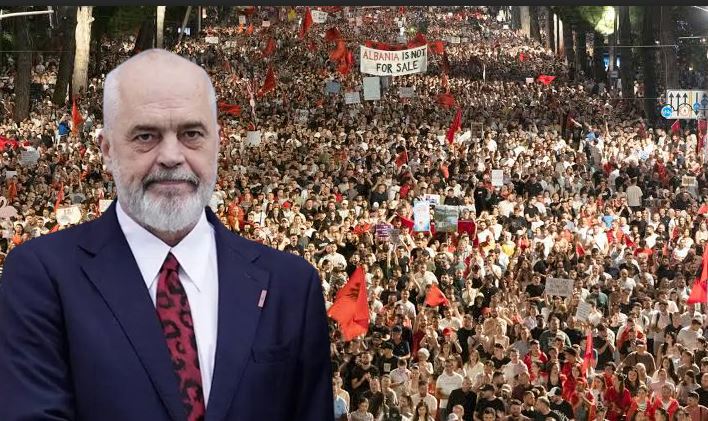
It was that connection, more than the development itself, which turned a local planning dispute into an international story. Protesters have gathered daily in Tirana’s Skanderbeg Square and near the construction site itself since late May, with Albanian media estimating that more than a quarter of a million people joined the largest demonstration in the capital in late June, making it, by most measures, the biggest protest movement since the fall of the country’s communist regime in the early 1990s. Demonstrators have carried inflatable flamingos and cutouts of the bird, lending the movement its now-familiar nickname, and some have reworked the Albanian flag itself, replacing its black eagle with a flamingo silhouette against a blue background. Crucially, organisers and independent observers describe the movement as decentralised, driven largely by younger Albanians and civil society groups rather than opposition parties, several of which have struggled to convert public anger into political capital of their own.
A test case Brussels cannot avoid
Albania’s timing could hardly be more delicate. The country applied for EU membership back in 2009 and has held official candidate status since 2014, but progress had, for years, moved at a frustratingly slow pace typical of Western Balkan accession bids. That changed markedly over the past year. Albania opened all thirty three of its accession negotiating chapters in little more than a year, and shortly before the protests erupted it became only the second candidate country, after Montenegro, to meet interim benchmarks on the rule of law. Officials in both Tirana and Brussels had begun speaking, with some confidence, of full membership arriving as early as 2028 or 2030, a milestone that would make Albania one of the enlargement process’s clearest success stories. It is precisely because that momentum had become so valuable that the resort dispute now carries such weight. Environmental compliance and judicial independence are not peripheral conditions bolted onto the accession process. They sit at its core, alongside anti-corruption safeguards and public procurement standards, and a government seen to be bending those rules for a politically connected investor undermines the very case for its own readiness to join.
The European Parliament has already called for an immediate pause in construction, and the European Commission issued a warning in June that Tirana’s handling of the affair could have consequences for its EU path, urging Albanian authorities to refrain from actions that might undermine their own bid. Michel De Maegd, a Belgian member of parliament who has pressed the issue with his own country’s foreign minister, argues that geopolitical convenience must never be allowed to excuse weak governance. His warning, delivered directly to this newspaper, is unambiguous: Albania’s accession must be judged on its commitment to European values, not solely on reforms achieved on paper, and any credibility Brussels has built through its enlargement process will erode quickly if citizens conclude that European institutions stay silent whenever those values come under real pressure. He wants a complete, independently conducted environmental impact assessment before any irreversible construction proceeds, full transparency over the investors, land titles and permits involved, and clear signals that certain accession chapters simply cannot close while serious concerns remain unresolved.
Prime Minister Edi Rama, for his part, has shown little appetite for retreat. He has dismissed the scale of the protests, insisted the investment will proceed regardless of opposition, and at one point accused unnamed foreign actors of waging a campaign of disinformation against the project, a claim Iran’s foreign ministry publicly and pointedly rejected. He has also sought to reframe the development in environmental terms, promising that the finished resort will ultimately increase green space on the site rather than diminish it. Albania’s own anti-corruption and anti-mafia prosecution service, an institution whose independence is itself often cited by Brussels as evidence of judicial reform, has opened an investigation into how the 2024 legal changes were passed and whether standard public tender procedures were bypassed in awarding the land. That an Albanian state body is now scrutinising the government’s own flagship investment project says as much about the country’s evolving institutions as any statement from Brussels could.
What happens next will say a great deal about whether the EU’s enlargement pledges carry real weight or remain, as sceptics in the Western Balkans have long suspected, conditional on politics rather than principle. Should the Commission allow the Sazan and Vjosa-Narta project to proceed largely unchanged while continuing to praise Albania’s overall progress, it risks confirming, in the clearest possible terms, that geopolitical convenience and a desire to keep the enlargement process moving still outweigh the environmental and rule of law standards it insists candidate countries must meet. Should it instead press Tirana toward a genuine independent assessment and hold back progress on the relevant chapters, it would send a signal, rare in recent years, that the EU is prepared to slow its own flagship foreign policy project rather than compromise on the standards that project claims to embody. Either way, the protesters gathering with their flamingos in Skanderbeg Square have already achieved something significant: they have forced a question onto Brussels’ desk that the Commission would clearly have preferred to avoid, at the exact moment its enlargement ambitions in the Western Balkans were beginning to look like a genuine success story rather than another exercise in patient, indefinite waiting.