


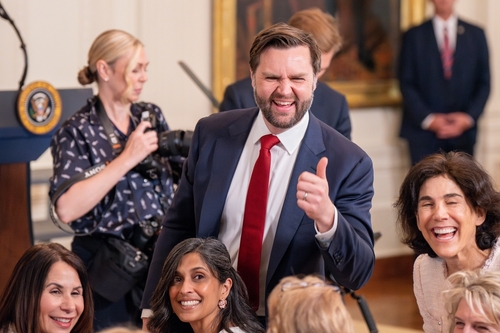


JD Vance stood at the Nixon Library and told the room that Watergate would barely make the news today. He was probably right. And that is the most alarming thing any sitting American vice president has said in decades.
Half a century after Richard Nixon left the White House under the weight of Watergate, his presidential library became the setting for an extraordinary reflection on how far American politics has changed. Speaking on 25 June at the Richard Nixon Presidential Library in Yorba Linda, California, Vice President JD Vance was ostensibly there to discuss his new book. Instead, he delivered a striking reassessment of the scandal that reshaped modern American politics and, in doing so, offered an equally revealing commentary on the political culture of today.
“If Watergate happened tomorrow,” Vance told the audience, “it would be like a 12-hour news story. The idea that it would have taken down a presidency is crazy.”
He went further, portraying Nixon as a casualty of what he described as the “deep state” and drawing deliberate parallels with Donald Trump. Then came the remark that blurred history with autobiography.
“Young senator, vice president, writes some bestselling books, is hated by the media. It kind of sounds like JD Vance. I’ve always liked Richard Nixon.”
The significance of those words lies not in their provocation but in what they assume. Watergate has long stood as the defining test of American constitutional accountability. It exposed a criminal break-in ordered by political operatives, an extensive campaign to conceal the truth, the abuse of federal institutions against perceived enemies, the dismissal of the special prosecutor during the Saturday Night Massacre, the resignations of the attorney general and deputy attorney general, and, ultimately, a unanimous Supreme Court decision compelling Nixon to surrender the White House tapes that sealed his political fate. For decades, it represented the moment when the American system demonstrated that no president stood above the law.
Vance’s argument was not that those events had been misunderstood. It was that they no longer mattered in the same way. He claimed that, in today’s America, a scandal that once brought down a president would barely survive a single news cycle before being overtaken by the next political crisis. It was delivered with humour and greeted by many as another provocative soundbite. Yet beneath the laughter was a remarkably candid observation about the transformation of American politics: not simply that scandals have become more frequent, but that the country’s capacity to be shocked by them has steadily eroded.
What Vance Was Actually Saying
The most honest interpretation of Vance’s Watergate comment is that he was not wrong about the media environment but was deeply wrong about what that says. A former CIA analyst who responded publicly to the remarks put it plainly: Vance is correct that a Watergate-scale scandal would not register in the same way today, but not for the reasons he imagines.
The reason, this observer argued, is that the current administration has a Watergate-scale scandal roughly every month, that media ownership has consolidated to the point where owners who are simultaneously government contractors or dependent on federal goodwill have powerful incentives to suppress rather than investigate, and that the constant velocity of provocations has numbed the public to the significance of any individual one.
Democratic congresswoman Jaime Raskin framed the implication with equal directness, writing in response that Vance was essentially acknowledging that his own administration has so normalised corruption and lawlessness that past crimes now appear minor by comparison. This is not a partisan overreaction. It is a precise description of the political logic embedded in Vance’s words. If a cover-up of criminal conduct, a deliberate obstruction of federal investigation and the firing of prosecutors who came too close to the truth would all amount to a 12-hour news story today, the explanation is not that Watergate was minor. The explanation is that the bar has moved so far that even Watergate would no longer clear it.
Vance went further than the Watergate comment alone. He described the chain of events that undid Nixon as the work of “the same groups of people, the same institutions” that tried to bring down Trump in his first administration.
The deep state framing is not new. But its application to Watergate is significant. What Vance was describing, in effect, is a world in which the Senate select committee, the special prosecutor, the FBI, the Supreme Court and the journalists who reported on the scandal were not democratic institutions performing their constitutional functions. They were a coordinated conspiracy operating against a legitimate president. This is not a reinterpretation of Watergate. It is a systematic delegitimisation of the checks on executive power that Watergate actually forced into the open.
A former Justice Department attorney who worked on the original Watergate case responded publicly to the characterisation with visible frustration. The scandal, he noted, was not limited to the break-in at Democratic National Committee headquarters. It encompassed the burglary of a private citizen’s psychiatrist’s office, a plot to assassinate a political opponent who had leaked the Pentagon Papers, illegal campaign contributions, the misuse of the IRS to target political enemies and a scheme to commit tax fraud.
None of this drip of almost daily revelations over two years amounted to a 12-hour news story, he wrote. It was sustained, multi-institutional, democratic accountability in action. The fact that Vance finds this accountability unimaginable in today’s environment is not a comment on the 1970s. It is a comment on 2026.
Why This Matters Beyond the Headlines
The significance of Vance’s remarks extends well beyond a political vice president saying something provocative to score points with a sympathetic audience. Vance is the most likely Republican presidential nominee for 2028. He is not a peripheral figure positioning himself on the fringe. He is a heartbeat from the presidency, shaping the ideological direction of a governing party, and he has now publicly stated, at the institutional home of the Nixon legacy, that the most consequential act of executive accountability in modern American history was illegitimate and would, if repeated today, be inconsequential.
This has geopolitical implications that observers outside the United States have been slow to process. American democratic credibility has been one of the primary instruments of Western foreign policy for eight decades: the argument that the model works, that leaders are accountable, that institutions hold even the most powerful to account.
That argument was tested and validated, expensively and painfully, by Watergate. It was the moment that the system proved it could work, that a president could be forced from office not by a coup or a revolution but by the patient, grinding operation of constitutional mechanisms. Allies in Europe, Asia and beyond took note. The world’s confidence in American leadership has rested partly on the belief that when American leaders overreach, the overreach eventually meets a wall.
What Vance is saying, whether he intends it in these terms or not, is that the wall is gone. That the institutions which built it, the independent press, the congressional oversight committees, the special counsel mechanism, the judicial insistence on executive compliance, have either been captured, defanged or rendered politically irrelevant by the pace of the news cycle and the normalisation of conduct that would once have triggered them. This is not merely a domestic political statement. It is a strategic communication to every government in the world that is watching American democracy and calibrating its assumptions about American reliability, American commitment to rules-based international order and American suitability as an anchor for the Western alliance.
The Nixon rehabilitation that Vance is advancing, and that he credits himself with championing, is not really about Nixon. It is about establishing, in advance of 2028, that the standards applied to Nixon were unfair, that similar conduct by a Republican president should not trigger similar consequences, and that the institutional mechanisms which enforced those consequences are themselves suspect.
This is the preparation of a political environment in which executive accountability is treated not as a constitutional guarantee but as a partisan weapon. Vance did not say all of this at the Nixon Library. He said enough of it that the rest follows logically. The 12-hour news story he imagined is, in his vision of American democracy, not a symptom of media failure. It is the desired outcome.