




A stable prime minister, a clear EU path, a decade of growth – and then, in the space of a few weeks, a country turned against its government. But was a luxury resort complex really the cause? Or merely the spark?
Edi Rama was, by the metrics that usually matter to Brussels and Washington, a success story. A former painter turned politician who had governed Albania for over a decade, he had won four consecutive elections, the last of them, in May 2025, a near-landslide, with his Socialist Party claiming 52.1% of the vote and 83 of 140 parliamentary seats. Albania had opened EU accession chapters and the economy had grown. A country once synonymous with pyramid scheme collapse and desperate emigrants clinging to ships was, to all outward appearances, on its way in from the cold.
Then came the flamingos
On 23 May 2026, a handful of protesters gathered in the village of Zvërnec, on Albania’s southern Adriatic coast, not far from the city of Vlorë. They were there because excavators had begun breaking ground near the Vjosa-Narta Protected Landscape, a wetland teeming with over 70 endangered species, more than 200 bird species, Mediterranean monk seals and the flamingos that would give the movement its name. The earthmovers, it turned out, were clearing the path for a €1.4 billion luxury resort backed by Jared Kushner, son-in-law of the sitting United States President, to be built across Sazan Island and the protected lagoon of Zvërnec.
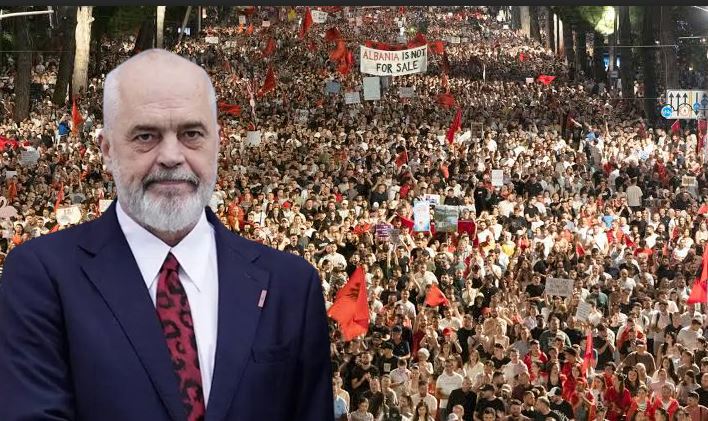
Within days, the protesters numbered in the tens of thousands. Within weeks, the movement had engulfed Tirana, spread to Kosovo, and ignited the Albanian diaspora from London to New York. Crowds stretching half a mile down the capital’s main boulevards chanted something that told you everything about the depth of the discontent: not merely “save the flamingos,” but “Rama in prison, Berisha in prison” — targeting both the prime minister and his main opponent, leader of the Democratic Party. Albania’s street revolt had ceased to be about a resort. It had become something else entirely.
The question that matters not just for Albania but for any ostensibly stable, reform-oriented Balkan government is this: was the Kushner project truly the cause? Or was it, as seems far more likely on examination, merely the match thrown into a room that had been filling with gas for years?
The Project That Crystallised Everything
To understand why this particular development became the trigger, you need to understand what it represents to Albanians beyond its environmental footprint which is, by any measure, severe enough on its own terms.
The Vjosa-Narta Protected Landscape is not some peripheral marshland. It sits at the heart of one of Europe’s most important migratory bird corridors, the Adriatic Flyway. Environmental investigators who visited the site in June described already-irreversible damage: destroyed millennial dunes, severed water exchange in the Narta Lagoon, fragmented migratory habitat.
Albania’s Special Anti-Corruption Prosecutor’s Office (SPAK) opened a formal investigation into how the protected status of the area had been altered and how private entities came to hold land titles within the development zone without a public tender process.
But it is the politics of the project, not just the ecology, that ignited the country. Kushner’s name carries the full weight of Trump-era transactional diplomacy. His company’s involvement, a €1.4 billion deal on protected sovereign land, awarded through what critics describe as a legal instrument called the “strategic investor” framework designed specifically to bypass normal procurement rules — read to many Albanians as the most brazen possible expression of a system they had long suspected: that their country, its land, its coastline and its natural heritage, was for sale to whoever arrived with the right connections and the right cheque.
Rama’s response deepened the wound. Rather than engage with the substance of the concerns, he dismissed the protests as “hysteria,” accused international media of exaggeration, and in a move that strained credulity, blamed Iranian meddling for stirring unrest. When tens of thousands of his own citizens were in the streets, he told a party meeting he would not resign, and that the Kushner project would proceed. “There is absolutely no chance,” he said, “that this development will stop.”
That defiance, in retrospect, was a political miscalculation of the first order. It confirmed, in the minds of many, what they had long believed.
A Decade of Grievances
The Kushner project did not create Albanian discontent. It gave it a name.
To understand the depth of what has erupted, you need to go back to Rama’s first term in 2013, when he swept to power on a wave of genuine optimism, promising to clean up the wreckage of successive corrupt governments and steer Albania toward Europe. For a time, that optimism felt warranted. GDP grew, infrastructure improved and the EU accession talks, long stalled, inched forward.
But alongside these gains, a different story was quietly accumulating. Since 2013, more than 500,000 Albanians have left. They were fleeing a specific kind of poverty, the poverty of a society where economic growth accrues to those with political connections, where young professionals see no path to advancement that does not run through patronage networks, and where the rules apply differently depending on who you know.
Youth unemployment has stubbornly hovered around 22%. The cost of living cited by 58% of emigrants as their primary reason for leaving has climbed while wages in the formal economy stagnate. Albania ranks 91st out of 182 countries on Transparency International’s Corruption Perceptions Index, a ranking that itself fell by eleven places in 2025 alone. The SPAK investigation into former Deputy Prime Minister Belinda Balluku, opened in October 2025, alleged that she had ordered the manipulation of public tenders worth some €210 million, with encrypted messages purportedly showing her directing which contractors would be disqualified and which would succeed.
This is the backdrop against which the Kushner project must be read. The “strategic investor” framework, the legal mechanism through which the resort deal was structured, was not a one-off aberration. It sits within a pattern of governance in which the instruments of the state have been repeatedly bent toward the benefit of those with access to power, whether domestic oligarchs or foreign investors bearing politically useful names.
The most revealing poll to emerge in the months before the protests showed that 26% of Albanians said they would vote for an entirely new political movement, unconnected to any existing party. That is not the sentiment of a population with faith in its institutions. That is the sentiment of a population that has concluded, quietly, that the game is rigged and is waiting for a reason to say so out loud.
The EU Paradox
There is an especially bitter irony at the heart of this crisis, and it concerns the one political asset Rama has most assiduously cultivated: the European Union.
Over 90% of Albanians support EU membership, the highest rate in any Western Balkan country. Rama has made EU accession the centrepiece of his political identity, the organising promise of his fourth term. In May 2026, in what should have been a moment of triumph, the eighth Intergovernmental Conference between Albania and the EU formally opened the final phase of accession negotiations. Rama spoke of concluding by 2027 or 2028.
And then, within days, the European Parliament passed a resolution urging Albania to halt construction in protected areas. The European Commission warned that actions undermining environmental law would affect Albania’s accession path. Brussels, which Rama had presented as the destination that justified every difficult reform, was suddenly questioning whether Albania deserved to arrive.
The EU has always been both Albania’s compass and its constraint. But the Kushner project has exposed the paradox at the core of that bargain. If EU accession requires genuine rule of law, genuine environmental standards, and genuinely transparent procurement, and if those standards are being visibly violated in the service of a deal with Trump’s family, then the EU promise does not strengthen Rama’s hand. It weakens it, because it gives his critics a European vocabulary with which to condemn him.
The protesters are not anti-European. They are, in many ways, the most European constituency in the country — young, educated, demanding accountability and transparency. Their chant is not “Albania out of Europe.” It is “Albania is not for sale.” That is a distinctly European aspiration. And it is being directed squarely at a government that claims to embody it.
What Comes Next
It would be premature to forecast the end of Rama. He has survived political crises before, and his opposition remains, despite the protests, structurally weak. The very fact that protesters are chanting against Berisha as well as Rama reflects a profound absence of alternative leadership: the movement has a target but no obvious beneficiary.
But several things are now true that were not true six weeks ago.
SPAK has formally opened investigations into the Kushner land transfers. The European Parliament and the European Commission have publicly questioned Albania’s commitment to environmental standards. A 26% bloc of the electorate has declared itself ready for a political force that does not yet exist. And tens of thousands of Albanians who had either emigrated or retreated into private fatalism have returned to the streets of Tirana, to rallies in London and New York to say, with unusual unanimity, that enough is enough.
The Flamingo Revolution is not, in the end, about flamingos. It is not even, really, about Jared Kushner. It is about what happens when a government mistakes an absence of alternatives for genuine consent and when the one act that might have seemed, in a purely transactional sense, like good diplomacy turns out to be the act that tears back the curtain on everything that has been quietly, steadily, corroding beneath the surface.
Edi Rama did not lose his country over a resort. He lost over ten years of a promise, the promise of a different Albania, that the resort proved, finally and undeniably, had never quite been kept.