


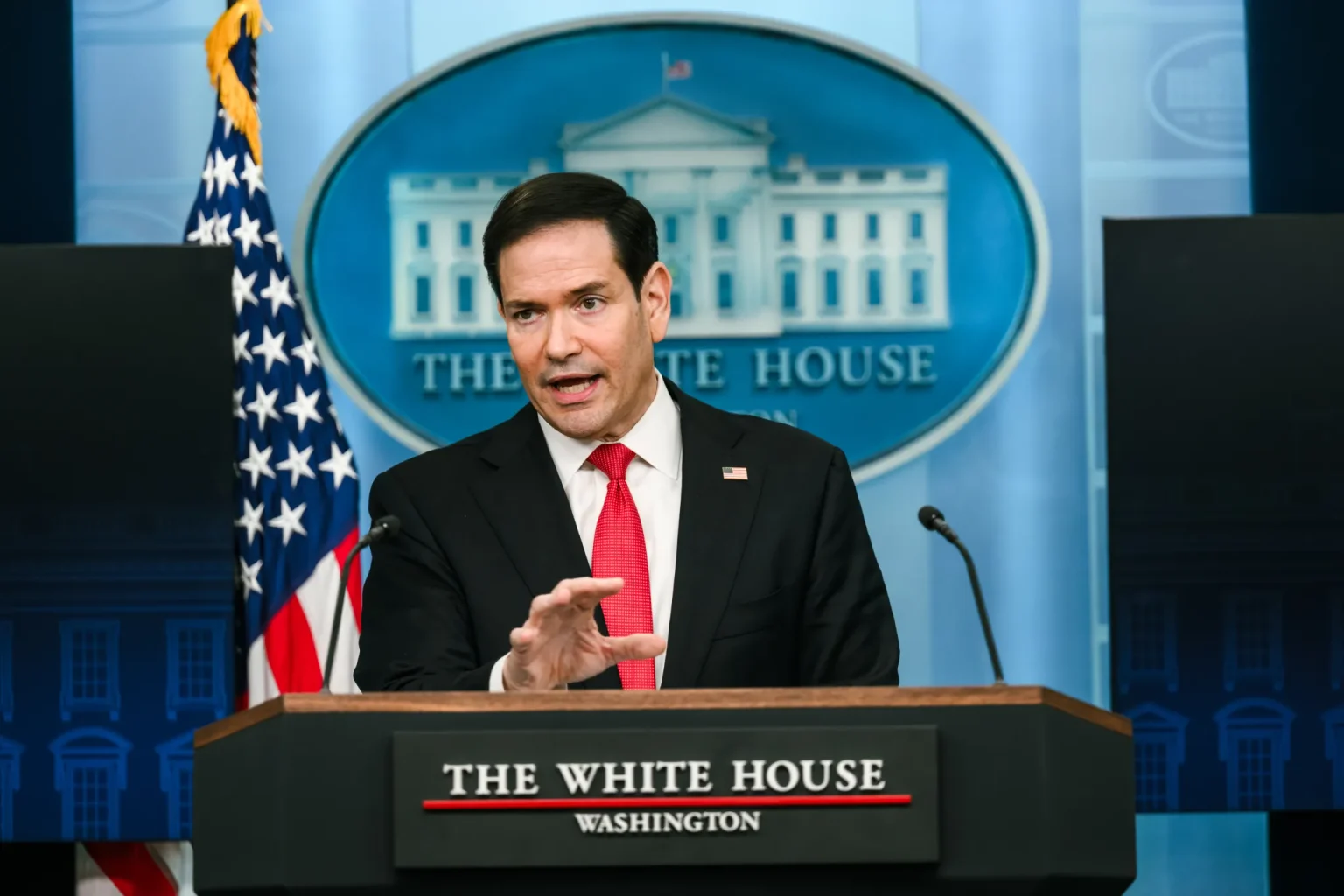


The US Secretary of State Marco Rubio faces one of the most delicate diplomatic missions of his tenure: reassuring America’s closest Arab partners in the Gulf while defending a controversial emerging understanding between Washington and Tehran.
Over the coming days, Rubio is set to visit key Gulf Cooperation Council (GCC) capitals including the United Arab Emirates, Kuwait, and Bahrain to explain the logic behind a tentative US–Iran framework that has already triggered unease across the region. The agreement, recently endorsed by US President Donald Trump and Iranian President Masoud Pezeshkian, has been presented in Washington as a pragmatic de-escalation mechanism after months of confrontation. In Gulf capitals, however, it is increasingly viewed as a potential strategic concession to Tehran.
At the core of the dispute lies a set of politically sensitive provisions: the absence of restrictions on Iran’s ballistic missile programme, a proposed $300 billion reconstruction fund, and provisions that Gulf officials fear could expand Tehran’s regional influence over critical maritime corridors—particularly energy transport routes. For Gulf monarchies that host US military bases and depend on American security guarantees, the deal raises a fundamental question: is Washington recalibrating containment, or quietly exiting it?
Gulf Security Architecture Under Pressure
The six GCC states Saudi Arabia, the UAE, Qatar, Kuwait, Bahrain, and Oman remain the backbone of America’s forward military posture in the Middle East. US bases across the region underpin air, naval, and intelligence operations that define Washington’s deterrence architecture.
Yet this architecture has been repeatedly tested over the past four months. During the recent US–Israel–Iran confrontation, GCC states provided logistical support to US operations but also became exposed to Iranian missile and drone strikes. The attacks reinforced a long-standing vulnerability: Gulf states are simultaneously strategic partners of Washington and potential targets in any US–Iran escalation.
Now, the prospect of a partial US–Iran détente has introduced a new layer of strategic ambiguity. While Washington frames the understanding as stabilisation, Gulf governments fear it may reduce pressure on Tehran without addressing core security concerns.
Analysts at institutions such as the Atlantic Council have long warned that Gulf states interpret US–Iran diplomacy through a regional lens: not as bilateral de-escalation, but as a potential redistribution of power in which Iran gains strategic depth while Gulf deterrence weakens.
Ballistic Missiles, Maritime Routes, and Strategic Leverage
The most contentious element of the emerging framework is the reported omission of limits on Iran’s ballistic missile programme. For Gulf states, missile capabilitiesnnot nuclear enrichment alone represent the most immediate existential threat due to proximity and speed of delivery.
Equally sensitive is the proposed $300 billion reconstruction mechanism linked to sanctions relief. Gulf policymakers fear that such a fund could indirectly strengthen Iranian regional networks across Iraq, Syria, Lebanon, and Yemen, reinforcing what they view as Tehran’s “forward defence” strategy.
Maritime security is another flashpoint. The Strait of Hormuz, through which roughly a fifth of global oil trade flows, remains a critical chokepoint. Any perceived loosening of constraints on Iran’s regional behaviour is seen in Gulf capitals as increasing the risk of strategic coercion in energy markets.
Even minor shifts in Iran’s leverage over shipping lanes could have outsized consequences for global oil prices and insurance costs—an issue closely monitored by international energy agencies and financial institutions.
Diplomatic Reassurance Without Public Reversal
Rubio’s challenge is not to renegotiate the US–Iran understanding, but to contain its geopolitical fallout among allies who feel excluded from its formation.
The diplomatic balancing act is further complicated by domestic US politics. While the Trump administration defends the agreement as a calibrated risk, critics in Congress argue it represents a strategic concession to Tehran. This internal divide limits Washington’s ability to present a unified narrative abroad.
Former US National Security Council official Andrew Peek, now at the Atlantic Council, has argued that reassurance in Gulf capitals will depend less on the details of the agreement and more on reminders of past US policy toward Iran—particularly periods of maximum pressure and military deterrence.
In essence, Washington’s message is expected to be continuity beneath adjustment: that engagement does not replace coercion, and that US military posture in the Gulf remains intact.
Iran’s Calculated Diplomatic Opening
From Tehran’s perspective, the agreement represents both economic relief and strategic recognition. Iranian officials, including chief negotiator Mohammad Baqer Kalibaf, have framed the talks as a step toward de-escalation and controlled normalisation.
Reported provisions include the establishment of communication channels for maritime incidents in the Strait of Hormuz and the partial release of frozen Iranian assets estimated at around $12 billion. These measures suggest a limited but meaningful thaw in US–Iran financial and security engagement.
Iran’s leadership under Masoud Pezeshkian appears to be pursuing a dual strategy: securing economic relief while avoiding major concessions on missile capability or regional influence networks.
For Tehran, this approach preserves strategic ambiguity—reducing immediate pressure while maintaining deterrence against regional rivals.
Regional Power Balance and Strategic Uncertainty
The broader question raised by the emerging US–Iran framework is whether it signals a structural shift in Middle East security architecture.
For decades, US strategy in the Gulf has rested on a dual containment logic: deterrence of Iran and reassurance of Arab monarchies. Any perceived deviation from this equilibrium risks recalibrating alliance expectations.
If Gulf states begin to doubt the durability of US commitments, even subtly, they may pursue parallel hedging strategies—expanding defence partnerships with other global powers or accelerating indigenous military development.
Think tanks such as the Council on Foreign Relations and Chatham House have repeatedly noted that Gulf hedging behaviour is already visible, particularly in diversified energy diplomacy and selective geopolitical autonomy.
Trump’s Gamble: Peace Through Leverage—or Concession?
At the heart of the controversy lies not Marco Rubio’s diplomatic tour, but President Donald Trump himself. The emerging agreement reflects Trump’s long-standing foreign policy instinct: use military pressure to force negotiations, then claim a diplomatic breakthrough that predecessors could not achieve.
The White House argues that the strategy worked. Following months of military confrontation involving the United States, Israel and Iran, Washington has secured direct engagement with Tehran, reopened channels of communication in the Strait of Hormuz and created a pathway toward regional de-escalation. Trump has presented the arrangement as evidence that deterrence and diplomacy are not mutually exclusive, but complementary tools of American power.
Critics, however, see a different picture. They argue that Iran has emerged from the crisis with many of its core strategic assets intact. Tehran has reportedly avoided new restrictions on its ballistic missile programme, preserved much of its regional influence network and secured access to frozen financial assets. From this perspective, the agreement risks creating the perception that Iran can absorb military pressure and still emerge with significant concessions.
The political danger for Trump is that the deal could alienate two constituencies simultaneously. Iran hawks in Washington view the arrangement as an unnecessary concession, while Gulf allies fear it signals a broader American shift from containment toward accommodation. If either perception gains traction, the administration may find itself defending the agreement abroad and at home at the same time.
For Trump, therefore, the challenge extends beyond preventing another regional war. He must convince sceptics that the agreement strengthens American leverage rather than diluting it. The success or failure of that argument may ultimately determine whether the deal is remembered as a strategic breakthrough or as the opening chapter of a new period of uncertainty in the Gulf.