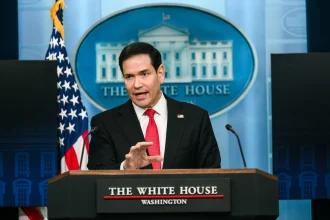



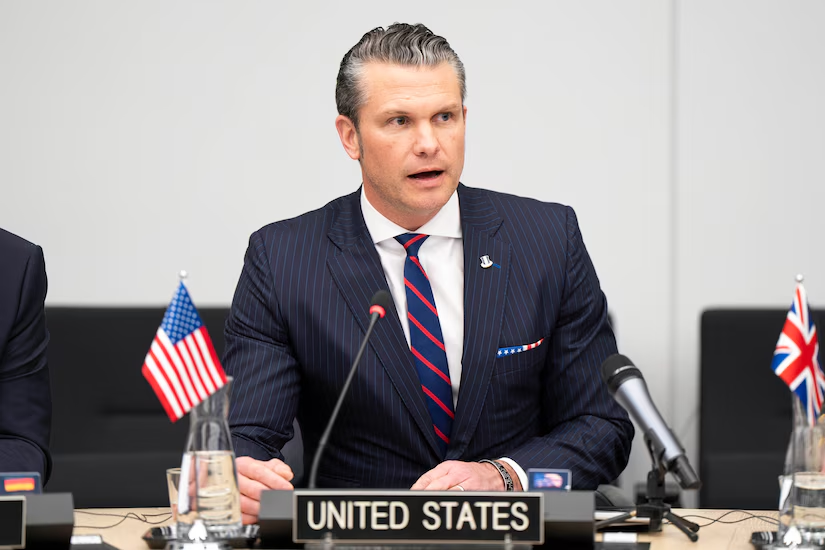

U.S. Secretary of Defense Pete Hegseth today sharply criticized NATO allies, announcing a six-month review of U.S. forces in Europe to be conducted by the Pentagon, which will depend on how quickly Europeans assume responsibility for their own security.
“This will be a real review. It will be designed to ensure that NATO moves quickly and irreversibly toward European leadership, taking primary responsibility for the defense of Europe as well,” he told his NATO counterparts in Brussels.
Withdrawal of U.S. weapons and troops
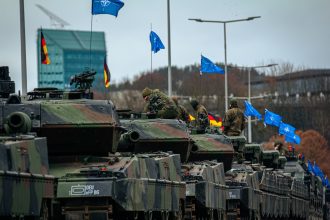
The concrete figures presented by the U.S. delegation in Brussels came as a shock. U.S. fighter aircraft (F-16 and F-15E) assigned to NATO: reduced from 150 to 100. KC-46 aerial refueling tankers: all eight withdrawn. Without aerial refueling, European fighters have dramatically reduced range and endurance. Maritime patrol aircraft: reduced from 26 to 15. One carrier strike group and one cruise-missile submarine are being withdrawn. And 5,000 U.S. troops are packing up in Germany. A NATO rapid-response strategic bomber task force has been removed from the structure. Secretary of Defense Pete Hegseth presented the plan to stunned officials three weeks before the alliance summit in Ankara.
Hegseth: European allies put U.S. “sons and daughters” at risk
Hegseth sharply criticized European allies for not granting U.S. forces access to bases in Europe for launching strikes on Iran, calling it “shameful.”
“These allies are putting American sons and daughters, our sons and daughters, at risk by denying them predictable access, basing, and overflight rights that should never have been in question,” he said.
His remarks came weeks after the United States told allies it would no longer deploy certain warships and aircraft if one of them were attacked. European allies and Canada are now trying to fill the resulting gaps.
“NATO 3.0 is the post–Cold War recognition that NATO must return to being a true hard-power military alliance with real capabilities capable of deterring here on the continent and taking the lead in conventional defense of Europe,” Hegseth said.
“Above all, it protects America and U.S. interests”
As part of this shift, he told reporters, the United States will invest $1.5 trillion in its own defense by 2027, sending a “message to the world” that America is building an “arsenal of freedom.”
Hegseth said this arsenal “first and foremost protects America and American interests, but also supports the strength of NATO and our allies.”
He said he would tell allies that they “must be ready to step up and do something strong” regarding the defense of their own continent.
The NATO Supreme Allied Commander, an American, is working on contingency plans for the defense of Europe after the United States signaled on June 3 that it would no longer provide carrier strike groups, support ships, aerial refueling tankers, and dozens of combat aircraft in the event of a crisis on the European continent.
Preparing for potential conflict with China
The Trump administration insists it must be able to plan for two simultaneous conflicts and wants more military resources available in case a conflict with China breaks out in the Indo-Pacific region.
Under NATO’s collective security guarantee, Article 5 of the founding treaty, the 32 allies commit that an attack on one is considered an attack on all.
Now, the United States is reducing expectations that it would come to the aid of an ally invoking Article 5. The U.S. still has by far the largest armed forces in NATO. However, it has not yet indicated plans to withdraw its nuclear weapons from Europe, which remain central to NATO’s deterrence.