



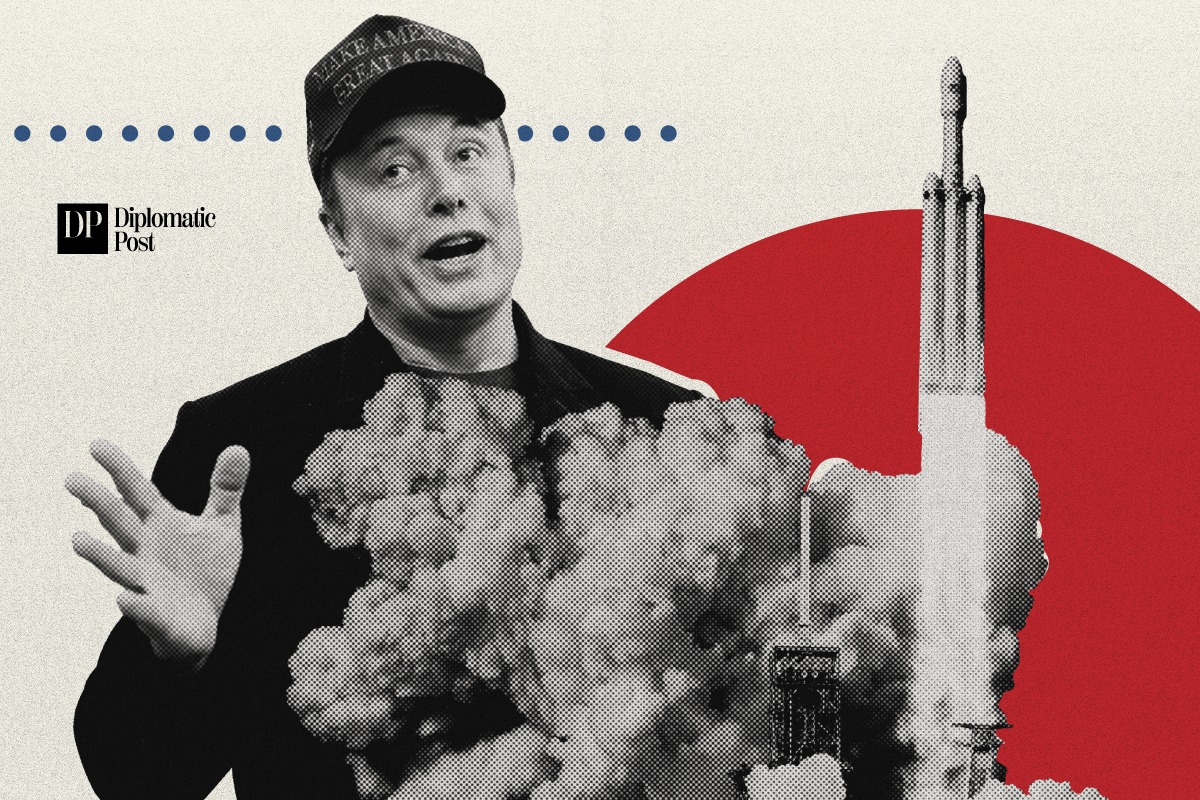
SpaceX just became a two trillion dollar company. It launches half the world’s satellites, runs America’s spy network in orbit, and one man controls 85 per cent of the votes. This isn’t a future risk anymore; it’s already happened
- One company now launches more than most countries combined
- America’s spy satellites now run through a private company
- A private decision once controlled a real war
- Now the same infrastructure is being aimed at AI
- Space is only the most visible piece of a bigger shift
- Three billionaires, but one already owns the sky
Space used to belong to governments. Now it mostly belongs to one company, and one man controls that company almost completely. SpaceX priced what became the largest IPO in history, selling roughly 555.6 million shares at 135 dollars each to raise 75 billion dollars at a valuation of around 1.75 trillion dollars, according to a media report. By the end of its first day of trading, the company’s valuation had climbed past 2 trillion dollars, according to a media report. Elon Musk retained approximately 85 per cent of shareholder voting power even after taking the company public, meaning the largest infusion of outside investor money in stock market history changed almost nothing about who actually controls it. That detail alone should reframe how this story gets told. This is not a warning about space becoming privatised someday. It already has.
One company now launches more than most countries combined
The scale of SpaceX’s dominance over global launches is difficult to overstate. The company completed 165 orbital launches in 2025, representing roughly 51 per cent of every orbital launch on Earth that year, and launched around 85 per cent of all satellites placed into orbit during the same period, according to a media report. A single private company is now performing more launches annually than entire national space programs, a level of concentration that has no real historical precedent in the space age.
Most of that launch activity is building something specific, a private communications network with few real competitors. Of SpaceX’s 165 launches in 2025, 123 were primarily tied to expanding Starlink, adding more than 3,000 spacecraft and bringing the constellation to over 9,300 active satellites by year’s end, according to a media report. By July 2026, that network had grown further still, to roughly 10,000 satellites, with SpaceX simultaneously developing direct-to-phone connectivity and additional satellites intended specifically to support AI computing, according to a media report. This is infrastructure combining communications, computing, and military relevance inside a single privately controlled network, something no government space agency and no rival company currently comes close to matching.
America’s spy satellites now run through a private company
What makes this concentration genuinely alarming is how deeply it now reaches into core government functions that used to be exclusively public. SpaceX’s Starshield division received a classified 1.8 billion dollar contract from the National Reconnaissance Office to build a spy satellite network designed to provide persistent imaging and surveillance coverage using large numbers of satellites, according to a media report. SpaceX is no longer simply transporting government satellites into orbit for a fee. It is helping build and operate core American intelligence infrastructure directly.
A separate 4.16 billion dollar Space Force contract selected SpaceX to develop satellites capable of tracking aircraft and other airborne targets from orbit, intended to support persistent military surveillance in environments too dangerous for conventional aircraft, according to a media report. Combined with Starshield, this represents a genuine transfer of sensitive military space functions away from government agencies and into private hands, a shift that has happened gradually enough that it rarely gets discussed as the structural change it actually is.
A private decision once controlled a real war
Perhaps the clearest illustration of what this concentration of power actually means in practice came from Ukraine’s battlefield itself. A Reuters investigation documented how Starlink service was restricted during Ukrainian military operations, a private company’s internal decision materially affecting communications during an active war, according to the investigation. This is not a hypothetical risk about future corporate overreach. It already happened, and it changed how a real conflict unfolded on the ground. The Pentagon subsequently entered into a major agreement with SpaceX valued at approximately 537 million dollars, according to the same investigation, a sign that Washington understood exactly how much leverage this single company now holds over military communications, and chose to formalise dependency on it rather than build an alternative.
NASA’s own return to the Moon depends on the same company. NASA selected SpaceX to develop the human landing system meant to carry astronauts from lunar orbit down to the Moon’s surface, according to a US Government Accountability Office report. SpaceX is not simply a commercial vendor bidding alongside competitors here. A central piece of America’s entire lunar program now depends on this one company completing both Starship and its lunar lander.
Now the same infrastructure is being aimed at AI
SpaceX’s ambitions extend beyond launches and satellites into computing itself. The company plans to launch orbital data centres capable of performing AI computing tasks, betting that abundant solar energy and its own existing launch infrastructure could make the concept commercially viable, according to a media report. Experts cited in that reporting flag serious unresolved problems: launch cost, radiation exposure, cooling, maintenance, latency and orbital debris, meaning the project remains a plan rather than a working reality for now. Even OpenAI’s own Sam Altman has publicly dismissed the near-term version of this idea, arguing orbital data centres would not provide meaningful computing power for OpenAI anytime soon and questioning whether they could ever compete economically with facilities built on the ground, according to a media report.
That scepticism matters, because it complicates any narrative suggesting a united front of billionaires racing to privatise space together. Altman is investing heavily in infrastructure of his own, just mostly on the ground. OpenAI, alongside SoftBank, Oracle and other partners, has announced plans to invest up to 500 billion dollars in American AI infrastructure over four years through the Stargate Project, according to OpenAI’s own announcement, a project that is overwhelmingly terrestrial rather than space-based, but that still illustrates how privately led corporations are now building the kind of infrastructure once associated squarely with national industrial and security planning. Altman has also backed Helion Energy, which began constructing a fusion facility intended to supply electricity to Microsoft’s data centers, according to a media report, though the underlying fusion technology remains experimental and has not yet demonstrated commercial generation.
Space is only the most visible piece of a bigger shift
Peter Thiel’s Palantir offers a parallel example of private control over strategic infrastructure, just without the rockets. Palantir supplies data integration and decision-support software specifically for air, space and cyber operations, helping governments process information gathered from military sensors and other sources, according to the company’s own description of its offerings. Palantir secured a ten-year, 10 billion dollar agreement consolidating multiple US Army software contracts, alongside major funding for Maven, an AI-enabled military intelligence and targeting platform, according to a media report. Thiel does not own launch vehicles or a satellite constellation comparable to Starlink, but his company demonstrates the same underlying pattern: governments growing increasingly dependent on privately controlled systems for functions that used to sit firmly inside public institutions.
Three billionaires, but one already owns the sky
It would be a mistake to flatten these three figures into a single story of equal, coordinated power. Musk controls rockets, satellites, communications and orbital infrastructure at a scale no government or competitor currently matches. Thiel controls defence software, data analysis and military AI systems, without owning a single satellite. Altman controls AI models, computing infrastructure and energy investment, and has openly pushed back against Musk’s timeline for moving any of it into orbit.
What ties them together is not a shared space program. It is a shared pattern: strategic infrastructure that governments once built, owned and controlled directly is increasingly being built, owned and controlled by private companies instead, with limited democratic oversight over how that infrastructure gets used, who gets access to it, and what happens when a private owner makes a decision that ripples across an active war or a national intelligence program. Space is simply the arena where that shift is furthest along, and the numbers make clear it is no longer a future risk worth debating. A single company already launches half the world’s satellites, runs a growing share of America’s intelligence infrastructure, and answers, in practice, to one person holding 85 per cent of the vote.