


Twenty-seven ships now sit off Iran, and that’s the problem. America’s fleet is so thin it can project power but cannot risk losing a single hull to do it
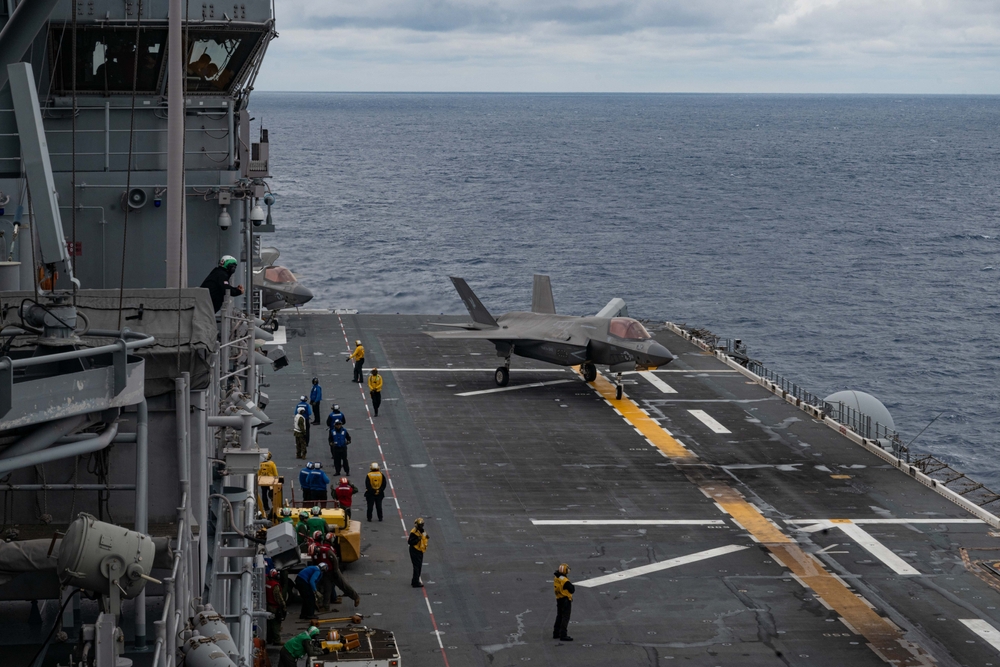
A powerful naval force now sits stretched from the Mediterranean to the Indian Ocean in support of ongoing operations against Iran: two aircraft carriers, six amphibious assault ships, and 19 cruisers and destroyers. President Donald Trump declared this week he would re-impose a blockade on Iranian ports, while American strikes on coastal and island targets continue without pause, according to an analysis of the deployment. The question worth asking is not whether the US Navy can put this force in place. It already has. The real question is how long it can keep it there, and whether America could actually sustain, let alone win, a drawn-out war with Iran. That question exposes just how much American seapower has quietly eroded.
The fact that this question needs asking at all says something. In 1945, the US Navy operated more than 6,000 ships and stood as a truly global seapower. Eighty years later, the fleet has shrunk so severely that Americans are quietly uncertain whether it can sustain renewed operations against Iran at all, the analysis found. A naval blockade, even one built around a distant barrier in the Arabian Sea, means an extended operating tempo for ships and crews. Vessels that have been in theatre since February, some deployed for 10 months or more, need rotation and replacement. Keeping this many ships concentrated in Central Command’s area of responsibility means the Navy can only really focus on one region at a time, effectively giving up its broader global reach in the process.
Three things broke the fleet
The first problem is simply that the fleet lost its ships. The Navy counted 6,768 vessels in 1945, enough to last decades. Even during Vietnam, the fleet still numbered over 900 ships. By the late 1970s, that had collapsed to roughly 450, before rebounding to nearly 600 during the Reagan era. Then came the end of the Cold War, and a long, steady shrinkage that has never really stopped, according to the analysis.
Today, the Navy’s useful order of battle sits at around 180 ships, carriers, large-deck amphibious ships, attack submarines, and guided missile destroyers. China’s navy now fields more battle force ships than the United States does, a milestone that would have seemed unthinkable a generation ago.
What ships remain are big and powerful, but poorly supplemented by the smaller vessels needed for patrol, escort and minesweeping duties. The Littoral Combat Ship was supposed to fill that gap; 35 were built over the past two decades, and they are now being retired, some of them brand new. Representative Adam Smith, the Washington Democrat who chaired the House Armed Services Committee in 2022, summed up the program bluntly at the time: “We can’t use them, number one because they’re not ready to do anything. Number two, when they are, they still break down.” The result is a Navy that is no longer a balanced fleet.
The second problem follows directly from the first: a shrinking fleet means fewer ships actually available at sea. The standard rule of thumb holds that three hulls are needed to keep just one deployed overseas continuously. During periods of high tension, ships get kept at sea as long as possible to satisfy political demands, reassure nervous allies, and project deterrence. The USS Abraham Lincoln, deployed since November 2025, is now in the Arabian Sea more than 210 days without a port visit, a Navy record, according to the analysis. Worn-out ships keep getting sent back out to put out the next fire, until something finally breaks.
And when ships do break, there often isn’t anywhere to fix them properly. Maintenance facilities are so limited that recent submarine overhauls have taken as long as eight years to complete. One nuclear submarine, the USS Boise, was ultimately scrapped after 10 years of repair work, having consumed 800 million dollars while reaching only 25 per cent completion. Roughly 40 per cent of the submarine force cannot currently be deployed because of maintenance bottlenecks and contractor failures, even though submarines receive the Navy’s highest maintenance priority. The surface fleet fares considerably worse.
The quietest crisis is the one wearing out sailors, not ships
The third factor is the easiest to overlook, and may be the most dangerous long-term threat facing the service: the exhaustion and demoralisation of its own sailors. Long overseas deployments that keep getting extended erode morale for both the sailor at sea and the family waiting at home.
Retired Vice Admiral Phil Wisecup understands this problem intimately. As the Navy’s scheduler during the 1990s, he co-authored a study recommending deployments be capped at six months, with exceptions only for genuine emergencies. The Navy adopted that standard, then abandoned it entirely in the crisis atmosphere that followed the September 11 attacks, according to the analysis.
For roughly a quarter century now, the Navy has effectively been operating under wartime deployment conditions, resembling World War II, when ships crossed the Pacific and did not return home until the war ended, or Vietnam, when carriers were kept on station in the Gulf of Tonkin until exhausted, granted a month of rest, and sent straight back to Yankee Station. Those earlier periods of sustained high-intensity combat lasted only a few years each. Sustaining that same pace for 25 straight years risks pushing sailors not just to their limit, but out of the service entirely. Ten-month deployments have become the Navy’s ordinary norm rather than the wartime exception.
The clearest example is the USS Gerald Ford, America’s newest and most advanced nuclear aircraft carrier, which became a case study in crew exhaustion and demoralisation before finishing an 11-month deployment in the Middle East running from June 2025 to May 2026. The three billion dollar carrier is the first of its class, packed with 20 new, largely untested systems, electromagnetic catapults and arrestor gear, new radar arrays, new ordnance elevators, even a new vacuum-based human waste disposal system, each one a fresh potential point of failure. It has been described as a monument to everything wrong with the US Navy. When the toilets failed, the crew’s morale failed alongside them. A major fire broke out in the ship’s laundry on March 12 this year, one many believe was deliberately set, effectively ending the deployment. The Ford limped from the Red Sea, where it had spent months during the Iran and Houthi conflicts, to Crete for repairs, and finally home.
No fix arrives in under thirty years
There is no quick way out of this. No matter how much money gets spent, and a 2017 estimate put the cost of a 355 ship fleet at more than 3 trillion dollars to build and maintain, likely far higher today, there is no realistic path to growing the fleet in less than three decades, the analysis found. The ambitious Golden Fleet modernisation plan, aiming to expand the Navy to 450 ships, is seeking at least 267 billion dollars just to get started, the Navy said in May. A hopeful plan is not the same thing as a solution.
Analysts note that despite the shipbuilding budget doubling over the past two decades, fleet size has not meaningfully grown to match. The Navy’s 2026 Shipbuilding Plan talks ambitiously about changing how the service does business and delivering accountability, but that rhetoric runs up against 50 years of entrenched practice and effectively zero accountability to date. America’s polarised political environment does little to help, offering scant appetite for the kind of sustained, extraordinarily expensive fleet expansion this would require.
The likely outcome is that the Navy simply keeps going, managing its ageing, overstretched fleet as best it can and hoping to avoid further decline in ship numbers, while shipyard modernisation gradually, if slowly, improves maintenance and repair timelines. Eventually, though, the service will have to reckon honestly with the limits of what modern American seapower can actually do.
So can the fleet sustain this posture off Iran, and could it actually win a longer war? The honest answer is yes, but with a significant caveat. The Navy remains fully capable of positioning a powerful group of high-end warships anywhere in the world and keeping it there through rotation for as long as ordered. But that capability now represents the Navy’s practical maximum, not a routine baseline. Much like the 1920s and 1930s, the service has effectively become a single mission force again, one that can go to one place and accomplish one thing at a time, rather than the truly global seapower it represented during World War II and the Cold War.
Even that single mission comes with a hard limit. The 27 large ships currently concentrated in Central Command’s area of operations are in no position to go, in the old naval phrase, in harm’s way. Whatever missions they carry out, the fleet simply cannot afford to lose a ship. There are not enough hulls in reserve, and nowhere near the repair capacity needed to quickly fix one if it takes battle damage.
That is the stark reality of America’s diminished seapower today. It can put a respectable force off a foreign shore and keep it there indefinitely. What it can no longer afford, in a war expected to stretch on for months or years rather than weeks, is to actually get into a real fight.