



Ukraine woke up on Monday to a government that no longer exists in its old form, after President Volodymyr Zelenskyy abruptly announced he would replace his prime minister and overhaul the leadership of the country’s law enforcement agencies, a move that under Ukrainian law automatically forces the entire cabinet to resign. The announcement, delivered through a lengthy social media post on Sunday, caught officials, lawmakers and foreign observers off guard. Yet beneath the surprise lies a story that has been building for months, one in which Ukraine’s largest wartime corruption scandal has crept steadily closer to the president’s own inner circle, forcing him to act before the political damage spreads further.
Prime Minister Yulia Svyrydenko, an economist who took office in July last year after four years as deputy prime minister for economic development, stepped down five days short of completing a full year in the job. Zelenskyy offered no detailed explanation beyond describing the changes as part of an “updated political strategy”, saying that each foreign policy priority, including defence cooperation with the United States and Europe, EU integration and relations with Poland and Hungary, would now be overseen by a dedicated senior figure. He thanked Svyrydenko for her service and said he had offered her a new role handling relations with a key partner country, widely believed to mean Washington, where she could become Ukraine’s next ambassador. According to media reports, the current ambassador to the United States, Olga Stefanishyna, had separately requested to end her diplomatic posting for personal reasons, a development that may have pushed Zelenskyy to accelerate a reshuffle that had reportedly been planned for later in the year.
A scandal that will not stay contained
The timing cannot be separated from the so called Midas case, the corruption investigation that has convulsed Ukrainian politics for the past eight months. The scandal centres on an alleged one hundred million dollar kickback scheme uncovered by Ukraine’s National Anti Corruption Bureau at the state nuclear power company Energoatom, at a moment when Ukraine’s energy infrastructure is already being battered nightly by Russian missiles and drones. Investigators have accused Timur Mindich, a long time business partner of Zelenskyy, of orchestrating the scheme and using his access to manipulate procurement decisions inside the energy and defence ministries during wartime, according to officials familiar with the case. Mindich fled the country shortly before investigators searched his home, having reportedly been tipped off about his impending arrest. The affair reached the heart of the presidential administration in November last year, when Andriy Yermak, Zelenskyy’s powerful chief of staff and one of his closest confidants, resigned after being named a suspect. Yermak was quickly replaced by General Kyrylo Budanov, the respected head of Ukraine’s military intelligence agency, in a move seen as an attempt to restore credibility at the top of the presidential office.
That November upheaval already forced eleven officials to resign in what was, until this weekend, described as the biggest reshuffle since Russia’s full scale invasion began in 2022. Svyrydenko was widely seen as having enjoyed the backing of Yermak during her time in office, according to political analysts, and her position looked increasingly exposed once her patron was gone. She largely avoided direct criticism during her tenure, but critics note she also failed to deliver the sweeping reforms that Western partners have long demanded, focusing instead on smaller social measures such as a modest one off winter payment to households. For a government trying to convince sceptical allies in Washington and Brussels that it can root out graft even as it asks them for billions in continued military and financial support, the optics of a prime minister closely tied to a disgraced chief of staff had become increasingly difficult to sustain.
Lawmakers have floated several names as Svyrydenko’s likely successor, with the strongest contender said to be Sergii Koretskyi, the chief executive of the state energy company Naftogaz, who previously ran the state owned oil producer Ukrnafta. Former prime minister Denys Shmyhal, who currently serves as energy minister and has effectively become Zelenskyy’s troubleshooter for the state’s most distressed sectors, is also mentioned, as is Defence Minister Mykhailo Fedorov. Analysts describe Koretskyi as a politically neutral technocrat with a reputation as a capable manager and no party affiliations or personal ambitions for higher office, qualities that would make him unlikely to build a rival power base, a consideration that matters greatly to a president who has grown wary of any potential challenger ahead of elections that cannot realistically be held while martial law remains in force. Notably, even some opposition figures have welcomed the prospect of Koretskyi’s appointment, a rare moment of cross party consensus in Kyiv’s fractious politics.
Why the reshuffle matters beyond Kyiv
The stakes go well beyond domestic politics. Ukraine enters its fifth winter of full scale war facing a Russian president who has shown no genuine appetite for negotiation and continues to press maximalist demands, according to security analysts monitoring the diplomatic track. Russian strikes on energy infrastructure have already left hundreds of thousands of people without power and heating during cold spells this year, and decision makers in Kyiv are acutely conscious that another winter of blackouts could deepen public exhaustion with the war. Placing an energy sector veteran such as Koretskyi or Shmyhal at the head of government would send a signal that keeping the lights on and the grid functioning has become as urgent a priority as battlefield strategy itself.
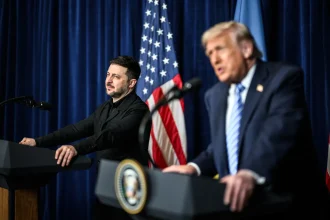
There is also a delicate diplomatic calculation at play. Relations between Kyiv and Washington have shown signs of improvement in recent weeks, with President Donald Trump agreeing to allow Ukraine to produce Patriot air defence missiles domestically, a concession that could meaningfully strengthen Ukraine’s ability to protect its cities and infrastructure. Zelenskyy’s decision to assign named individuals to manage specific foreign policy relationships, including with Washington, Brussels, Warsaw and Budapest, suggests an attempt to professionalise and personalise Ukraine’s diplomacy at a moment when Trump’s unpredictability continues to worry officials across European capitals. Sending a trusted figure to Washington as ambassador, rather than leaving the post in limbo, fits into that same logic.
At home, the government has also been contending with growing war fatigue, including public anger over an explosion at a munitions depot near residential housing and violent confrontations between potential conscripts and military recruitment officers, incidents that have chipped away at confidence in state institutions even as the corruption scandal simmers. Zelenskyy’s reshuffle can therefore be read as an attempt to draw a line under a period of scandal and infighting while repositioning his government for the harder tests still ahead, both on the battlefield and at the negotiating table.
Whether this reshuffle achieves that reset will depend on choices still to be made. If parliament, comfortably controlled by Zelenskyy’s own party, swiftly confirms a credible, corruption free cabinet within the coming weeks, it could help restore some trust among Western backers who have grown increasingly insistent on accountability as a condition for continued aid. But if the new law enforcement appointments are seen as tightening the president’s grip over anti corruption bodies rather than strengthening their independence, the manoeuvre could deepen suspicions that this is less a genuine clean up than a defensive consolidation of power ahead of an uncertain political future, one in which Zelenskyy cannot yet say when Ukrainians will next go to the polls.