




A masked demonstration raises new questions over how U.S. authorities should assess and respond to organised domestic extremist movements.
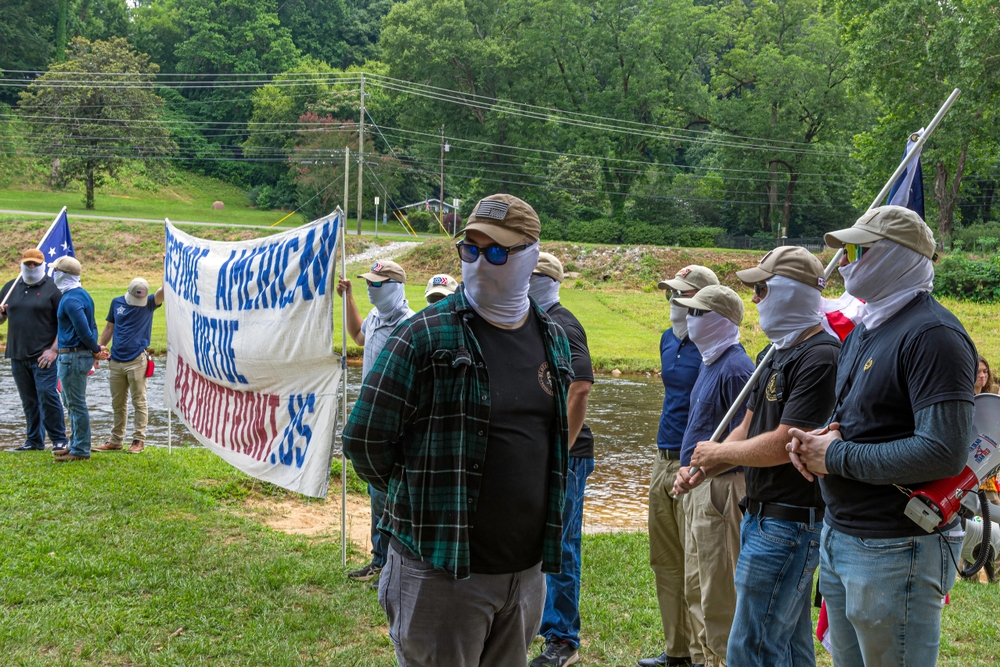
Roughly 400 members of Patriot Front marched through Washington on 4 July, walking from Union Station to Eastern Market in matching navy shirts, khaki pants and white balaclavas, carrying American, Betsy Ross and Confederate flags.
The demonstration, held on the 250th anniversary of American independence, was the group’s largest public show of force to date, according to the Anti-Defamation League, which has tracked the organisation since its founding. The scale of the march, more than the march itself, is what has drawn scrutiny from extremism researchers and security officials, because it forces an unresolved question back onto the table: how seriously should a domestic movement built on flash demonstrations and mass-produced propaganda be treated as a security threat?
What Patriot Front is, according to those who track it
Patriot Front split from another far-right group in the aftermath of the 2017 Unite the Right rally in Charlottesville, Virginia, and its founder, Thomas Rousseau, was present at that event. The group promotes what George Washington University’s Program on Extremism describes as an ultra-nationalist ideology built around the creation of a white ethnostate, rejecting multiculturalism and framing immigration as a form of demographic replacement. The ADL has identified it as responsible for the large majority of white supremacist propaganda distributed across the United States since 2019, spread through flyers, stickers and banners on college campuses and in communities nationwide, and has separately documented antisemitic messaging in its material referencing “Zionists” in government, a term researchers say functions as a coded reference to Jewish people.
At the Washington march, Rousseau reportedly delivered remarks naming Jewish people, Latino immigrants, Black Americans and LGBTQ people as threats to his vision of the country, before calling for what he described as a renewed hostility toward those groups.
Those remarks have not been independently transcribed by mainstream news organisations, and should be treated as reported rather than independently confirmed.
The “psy-op” theory and why it persists
A recurring claim, amplified in past years by prominent conservative commentators and echoed again after the July 4 march, holds that Patriot Front is substantially composed of undercover federal agents staging a controlled opposition to discredit the broader right.
Republican Senator Mike Lee predicted in January 2025 that the group would disappear once a specific FBI leadership change occurred. It has not.
No law enforcement agency, congressional committee or independent investigation has produced evidence supporting the infiltration claim, and individuals arrested at past Patriot Front events have been identified and charged as ordinary members rather than agents.
Extremism researchers generally treat the theory as unsubstantiated, though its persistence illustrates a genuine strategic effect: framing organised white nationalist activity as theatre or government manipulation makes it easier to dismiss as a security concern rather than confront as one.
Why the government’s response matters more than the march itself
The Trump administration’s public reaction has been notably restrained. Interior Secretary Doug Burgum, asked directly whether the president would condemn the group, said he disagreed with what Patriot Front stands for but cited free speech as a foundational American principle, declining to call for any federal action. Trump himself did not comment on the march.
That posture stands in contrast to the administration’s more assertive domestic security posture on other fronts, including immigration enforcement, and has drawn criticism from Jewish civil rights organisations, with the Jewish Council for Public Affairs arguing that the group’s growing visibility reflects a broader normalisation of extremist activity rather than an isolated fringe event.
The muted response carries a genuine institutional dimension beyond politics. The Department of Homeland Security has, in successive threat assessments over recent years, identified racially and ethnically motivated violent extremism as one of the most persistent domestic terrorism concerns facing the country, a designation that has periodically clashed with First Amendment protections covering non-violent, if provocative, public assembly.
Patriot Front’s own activity has centred on demonstrations and propaganda distribution rather than documented violent attacks, a distinction security officials weigh carefully when deciding whether a group’s public activity crosses from protected speech into a threat warranting surveillance or disruption of resources.
The Washington march functions, in effect, as a stress test for how US security institutions categorise ideologically driven groups that operate in the open, wear uniforms, and stage choreographed public events without engaging in the violence that typically triggers a more aggressive federal response. Unlike clandestine extremist cells,
Patriot Front’s visibility is its strategy: mass, matching appearances generate media coverage and recruitment interest simultaneously, a tactic that has proven effective regardless of whether onlookers respond with fear, ridicule, or the persistent suspicion that the group is not what it claims to be.
Patriot Front has held such flash demonstrations for seven consecutive years, and nothing about the July 4 march suggests the pattern will change. What remains unresolved is whether the scale of this latest event, roughly double the size analysts had come to expect, represents a genuine growth in the group’s capacity to organise, or simply a larger single turnout for a symbolically loaded date.
Either answer carries implications for how seriously federal threat assessments treat a movement that has, so far, been judged more by the coverage it generates than by any documented act of violence.