



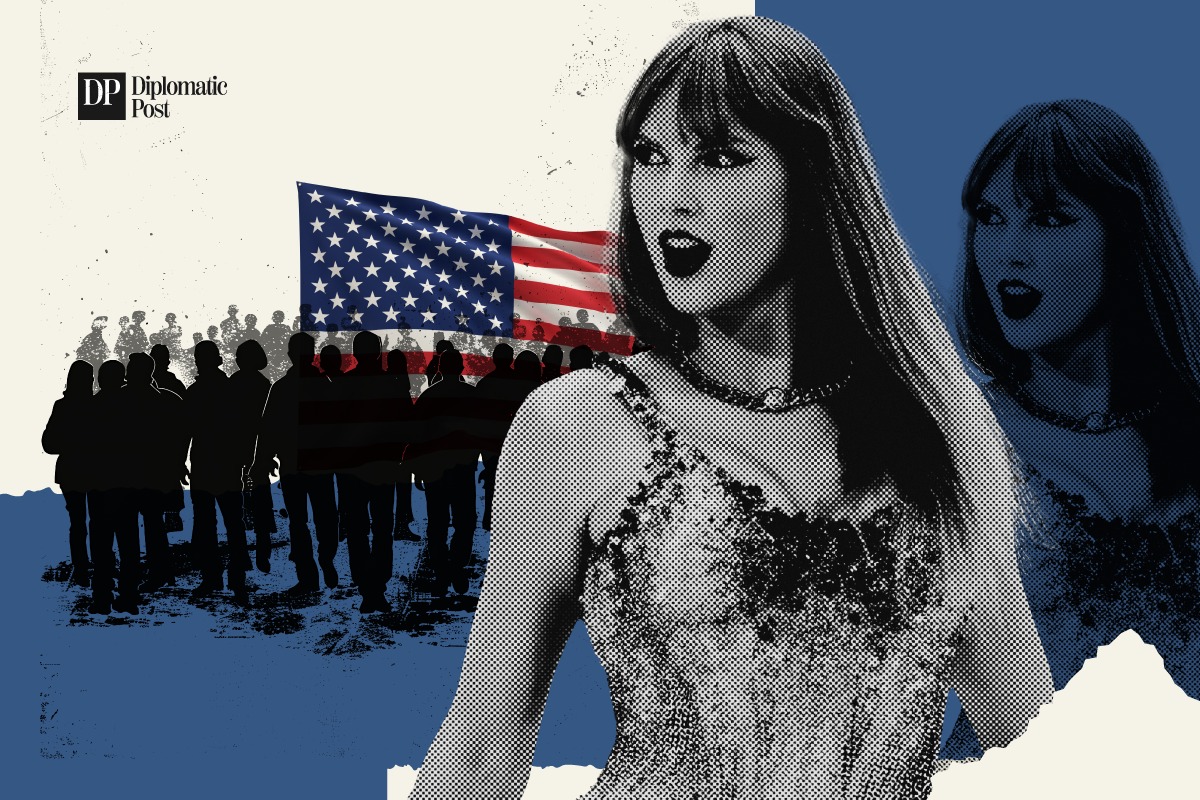


Americans disagree about the economy, healthcare, immigration and the proper use of military force. They now also disagree about Taylor Swift. The latter development may be the more revealing one.
Liking or disliking a pop star has become another way Americans signal who they are politically. That is the central finding of a peer-reviewed study published in the Social Science Quarterly, whose authors analysed national survey data on how Americans feel about Taylor Swift and concluded that her reception had become a cultural mirror reflecting the country’s deepest partisan and gender fault lines.
Democrats are far more likely to view her positively. Republicans are more likely to hold negative views. This divide holds even after accounting for age, gender and other demographic differences. On a 100-point scale measuring attitudes toward Swift, Gen Z women averaged 55. Gen Z men averaged 43. The same gender gap that defined the 2024 presidential election has migrated into the ratings of a pop singer.
A media survey published this week on the partisan divides surrounding celebrities and athletes makes the broader picture visible with uncomfortable precision.
Americans are being sorted, through their cultural tastes, into political camps with an efficiency that previous generations of pollsters would not have believed possible. The phenomenon is not limited to Swift. Professional athletes who make political statements are approved of by 51 per cent of Americans overall, down from 62 per cent in 2020. But that average conceals a chasm: approval is dramatically higher among Democrats and dramatically lower among Republicans.
When LeBron James or a WNBA player speaks on a social justice issue, the response is almost perfectly predicted by the respondent’s party affiliation. The entertainment choice and the political identity have collapsed into each other.
What the Numbers Are Actually Measuring
The academic framework that researchers have applied to this phenomenon is straightforward and sobering. Political identity is increasingly being expressed through every available channel of cultural preference, because the stakes of partisan belonging have never felt higher to the people who hold it.
When approximately 83 per cent of Republicans say they are proud to be American compared to 31 per cent of Democrats, according to polling conducted in May 2026, the two groups are not merely in disagreement about policy. They are inhabiting different emotional relationships with the country they share. In that context, a pop star who endorsed a Democratic presidential candidate, advocated for reproductive rights and was specifically targeted by AI-generated fake content designed to associate her with Trump becomes, inevitably, a battlefield.
The Politico survey’s most striking finding, consistent with the Mirrorball Politics academic study, is that negative attitudes toward Swift among Republican men are strongly linked not to specific policy disagreements but to what researchers call hostile sexism, the belief that advances by women constitute a threat to men. This finding locates the celebrity partisan divide inside a broader gender realignment in American politics that has been running for several election cycles and that reached its most visible expression in 2024, when young men and young women voted in substantially different directions for the first time since modern polling began.
The entertainment preferences are not causing the political divide. They are expressing it. The same underlying attitudes that shape how a Republican man votes in November also shape whether he rates Taylor Swift favourably on a survey in January.
Athletes sit in a slightly different position in this topology but follow the same basic logic. The VoteHub study released in January 2026, analysing the political affiliations of professional athletes across the NFL, MLB, WNBA and other major leagues, found a wide spectrum of opinions across different sports, with the WNBA skewing significantly more Democratic and certain NFL positions and rosters skewing Republican.
The political composition of rosters has become, for some fans, a factor in which teams they follow. This is not trivial. Sports fandom has historically been one of the few arenas of American life where people from different backgrounds, with different political views, found themselves cheering for the same thing. The franchise is being dissolved.
The downstream consequence of cultural life becoming fully politicised is not primarily that celebrities face uncomfortable scrutiny about their endorsements. It is that shared space that shrinks. Democracy depends on some measure of common ground, on the existence of experiences, entertainments and institutions that people encounter together regardless of their political tribe. When pop stars become partisan litmus tests, when athlete rosters are scanned for political alignment before purchasing a jersey, when a survey score for a singer tracks almost perfectly with a party registration, the common ground gets smaller.
The Research typology published in June 2026 found that while partisan labels remain the dominant organising principle of American politics, most Americans fall into a politically messy centre rather than the hard ideological wings. But that centre is not being served by a cultural ecosystem that sorts every choice, including choices about entertainment, into a red column or a blue one.
The Politico survey and the academic research it reflects do not describe a problem that can be fixed by celebrities staying quiet about politics. Swift spent years being studiously non-partisan and was attacked for it. When she eventually spoke, she was attacked for that, too.
The phenomenon is not driven by what celebrities say. It is driven by what polarisation does to the reception of everything they say and do. The question is whether the country can maintain enough common ground to function as a polity while its citizens can no longer listen to the same music without declaring a side.