


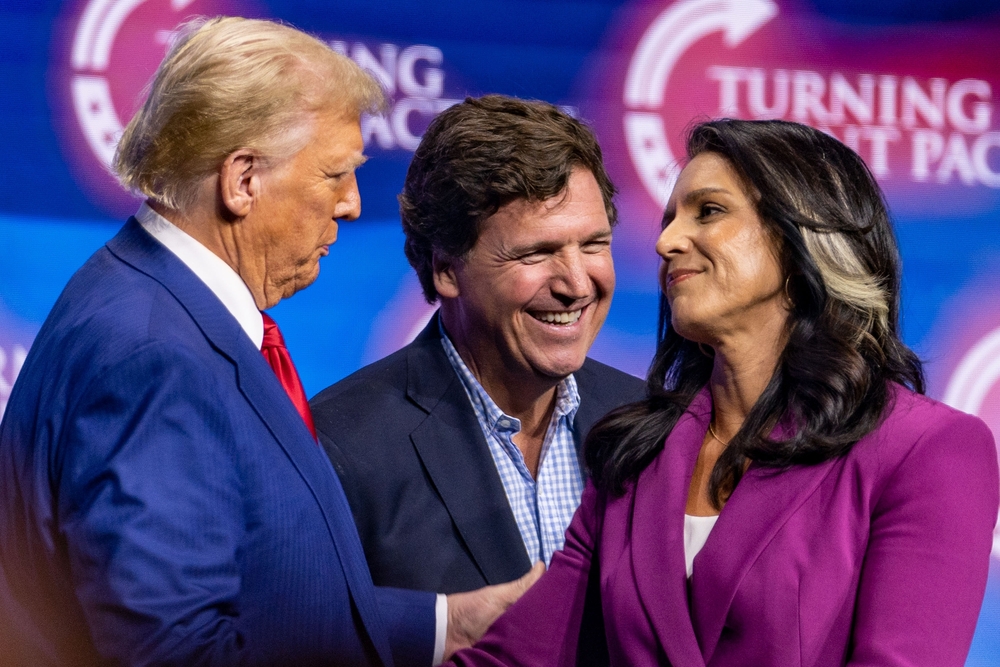


After his public break with Donald Trump, Tucker Carlson is helping lay the groundwork for a new political party that could challenge both Republicans and Democrats ahead of future elections.
Tucker Carlson visited the White House three times before the bombs fell on Iran. Each time, he argued against the strikes. Each time, he was not listened to. He has not spoken to Donald Trump since the war began on 28 February. In a statement that would have been unthinkable eighteen months ago,
Carlson told a journalism review on 1 July that he intends to “help build a third party” in the United States, describing the country as “a one-party state posing as a democracy” in which there is “practically no difference between Democrats and Republicans on the key issues of war and finance.” Within 24 hours, former Georgia congresswoman Marjorie Taylor Greene announced she was in talks to launch what she called a “true America-focused party.” The two figures who did more than almost anyone else to elect Donald Trump twice have now moved to the opposite side of the room.
The immediate cause is the Iran War. Carlson had built his entire public identity around a single proposition: that American foreign policy had been captured by elites who sent other people’s sons to die in wars that served foreign interests rather than American ones. He made this argument first on Fox News, then on his own platform, and it was the ideological spine of the MAGA movement’s appeal to working-class men who felt that the Republican Party of the Bush era had betrayed them.
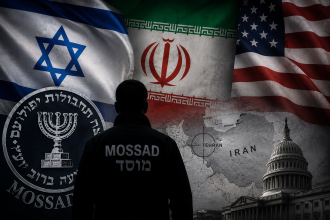
When Trump launched a major military campaign against Iran that Carlson believed was driven in significant part by Israeli pressure and the influence of donors with “loyalty to Israel,” the contradiction between the movement’s stated principles and its actual behaviour became, for Carlson, irreconcilable. He had been telling his audience for years that this was exactly what corrupt elites did. He could not now pretend that it was something different simply because his preferred candidate had ordered it.
What the Break Actually Means
The announcement matters for reasons that go beyond the personal drama of two prominent conservatives falling out with their patron. Carlson remains, by most measurements, the most influential figure in conservative media in the United States. His social media following runs into the tens of millions. His audience is disproportionately male, working-class, and concentrated in precisely the states and districts where Republican margins in competitive races are thinnest.
Greene, before she resigned from Congress at the start of 2026, represented a wing of the Republican Party that had no equivalent in any previous era of American conservatism, a faction that was simultaneously more nationalist, more economically populist and more sceptical of American military intervention abroad than anything the party had previously accommodated.
When Greene said that Carlson is “not the only one” done with the Republican Party, and that “there is A LOT of us that are absolutely fed up,” she was describing a constituency rather than making a personal statement.
The question is not whether Carlson and Greene have the organisational capacity to build a functional third party before the November midterms, though the ballot access laws alone make that extremely difficult. The question is whether their departure from the Republican coalition represents the visible tip of a much larger bloc of conservative voters who will simply not show up in November, and in which districts that abstention will flip seats.
A third party does not need to win a single election to change the outcome of every election it contests. Ross Perot took almost 19 per cent of the national vote in 1992 without winning an electoral vote. The movement Carlson is describing does not need to clear anything like that threshold to matter.
It needs only to pull two or three points from Republican candidates in competitive House and Senate districts to determine which party controls Congress in January 2027. Control of both chambers is at stake on 3 November. In a country where competitive districts are decided by margins of under five points, a Carlson-adjacent abstention movement is not a vanity project. It is a potential election result.
The geopolitical dimension is harder to quantify but impossible to ignore. Carlson framed his break in explicitly international terms, describing the United States as a state in which the foreign policy establishment serves the interests of allies rather than citizens and in which both parties are complicit in what he characterised as permanent war. Whether or not that analysis is accurate,
it is the analysis that a large and growing segment of the American right now holds. The Iran war produced it, the MAGA framework incubated it, and Trump’s decision to fight the war his movement had defined itself against has now given it a specific, datable moment of rupture. American politics in the second half of 2026 will be shaped by how many voters follow Carlson out of the door he has just opened, and whether any of the major party structures can close it before November.