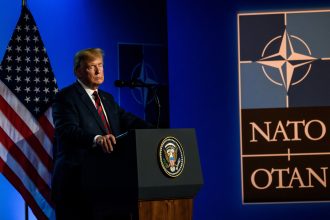



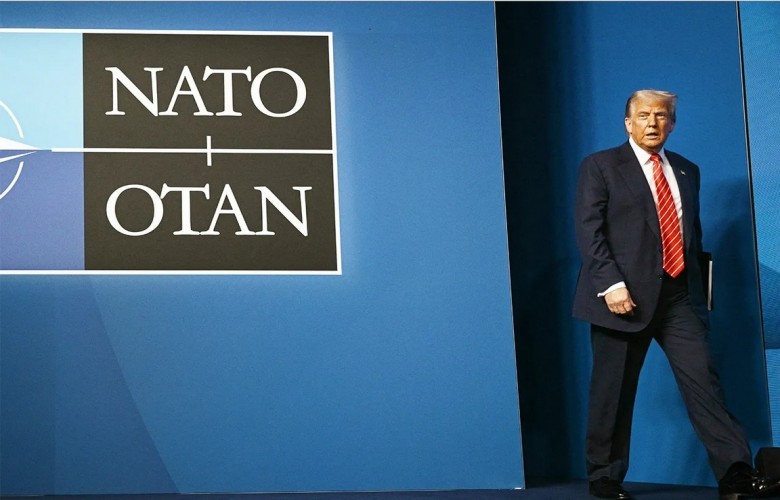


As the war in Ukraine grinds on and divisions deepen within Europe, a broader structural shift in transatlantic security architecture is increasingly taking shape, a development that can be described as the emergence of a so-called “NATO 3.0”.
The concept reflects not an official doctrine, but a strategic evolution in which Europe accelerates conventional rearmament while the United States retains exclusive control over the alliance’s nuclear deterrent. In parallel, Washington is reportedly exploring the possibility of expanding nuclear deployments further eastward, potentially including Poland, the Baltic states, and Romania.
Against this backdrop, the debate over escalation, deterrence, and negotiation is becoming more politically charged across Europe.
Escalation Risks and Political Fractures in Europe
French left-wing leader Jean-Luc Mélenchon has sharply criticized Ukraine’s long-range strikes on Russian territory, warning that such actions risk wider escalation.
“It is utterly unreasonable to allow Ukraine to strike deep into Russian territory. This is the road to a general war,” he said, arguing that prolonged conflict ultimately weakens Europe itself and serves external strategic interests.
His comments reflect a broader strand of European debate increasingly focused on whether continued military escalation aligns with Europe’s long-term security interests.
At the same time, Moscow has intensified its own rhetoric. Dmitry Medvedev declared that the war is no longer bound by “rules,” while simultaneously rejecting the relevance of existing legal frameworks governing armed conflict a statement underscoring the growing normalization of escalation logic on both sides.
Fragmentation Within the EU
Divisions within the European Union have also become more visible. Bulgaria recently blocked approval of the EU’s 21st sanctions package against Russia, citing economic risks linked to its domestic energy infrastructure and questioning the effectiveness of further punitive measures.
While Sofia reiterated support for a negotiated settlement, the veto highlights a recurring fault line within the EU: the balance between economic exposure and geopolitical alignment.
Elsewhere, some European leaders are increasingly acknowledging the limits of sanctions-driven strategy, even as consensus on alternative approaches remains absent.
NATO 3.0 and the Question of Strategic Autonomy
In strategic terms, the evolving NATO framework underscores a central contradiction in Europe’s long-standing ambition for “strategic autonomy.”
While European leaders in Paris and Berlin have repeatedly called for greater independence in security and foreign policy, nuclear deterrence remains the decisive constraint.
France and the United Kingdom Europe’s only nuclear powers — maintain relatively limited arsenals compared to the United States and Russia. Expanding European deterrence capacity would require sustained investment over decades, at a time when fiscal and political constraints are already tightening across the continent.
From this perspective, NATO 3.0 appears less as a step toward European autonomy and more as a recalibration of dependency within a US-led security order.
The Nuclear Dimension
A particularly sensitive element of this shift is the potential expansion of nuclear-related infrastructure closer to Russia’s borders.
While NATO’s nuclear umbrella already extends across the alliance, the deployment of nuclear-capable platforms including dual-capable aircraft such as the F-35 in Eastern Europe would mark a qualitative change in deterrence posture.
Moscow has repeatedly warned that such developments would fundamentally alter the European security balance.
Finland’s evolving posture, including openness to hosting nuclear-related assets, illustrates how the post-Cold War security architecture is being reshaped in real time.
Institutional Limits on European Defence Integration
Within the EU, senior officials are increasingly candid about the limits of parallel defence structures.
EU foreign policy chief Kaja Kallas has rejected the idea of a separate European army, citing overlapping NATO membership and institutional redundancy.
Behind this assessment lies a broader structural reality: fragmented procurement systems, uneven industrial capacity, and persistent dependence on US military technology.
Projects such as the Franco-German Future Combat Air System (FCAS) further highlight these constraints, as industrial rivalries and political disagreements continue to slow progress on flagship autonomy initiatives.
Shifting Positions on Russia
At the same time, some European leaders are beginning to signal the need for eventual diplomatic engagement with Moscow.
Finnish President Alexander Stubb has suggested that future negotiations with Russia will ultimately be necessary, even while maintaining strong support for Ukraine.
This reflects an emerging strategic concern in parts of Europe: that long-term stability cannot be achieved solely through military escalation and sanctions pressure.
Conclusion: A Structural Turning Point
The debate surrounding “NATO 3.0” ultimately reflects a deeper structural question about Europe’s place in the international order.
Despite repeated political commitments to strategic autonomy, the war in Ukraine has reinforced Europe’s dependence on the United States for nuclear deterrence and high-end military capabilities.
At the same time, it has exposed internal divisions over escalation, sanctions policy, and the conditions for eventual negotiations.
As the conflict continues, Europe is entering a phase in which its security architecture is being quietly redefined not through formal declarations, but through incremental strategic adjustments.
The outcome of this process will shape not only the trajectory of the war in Ukraine, but also the long-term balance of power within the transatlantic alliance.