




When the leaders of what is now the G7 first gathered in 1975 at Rambouillet, the global order they were trying to stabilise was still unmistakably Western in architecture and ambition. The exclusion of China was not a strategic choice so much as a historical given: China was economically marginal, politically inward-looking, and still convulsed by the final years of Maoist upheaval. The idea that it could one day sit alongside the United States, Japan, Germany, France, the United Kingdom, Italy and Canada would have appeared not merely implausible, but conceptually incoherent.
- A club defined by political compatibility, not economic weight
- From globalization to economic security
- Critical minerals: concentrated dependency, fragmented response
- Semiconductors: controlling the chokepoints
- Investment screening and the securitisation of capital
- China as systemic constraint, not just external actor
- The paradox of exclusion
Half a century later, that assumption has been inverted. China is now the world’s second-largest economy, a central node in global manufacturing, and a decisive actor in trade, energy transition supply chains, and advanced technology competition. But yet it remains outside the G7 which makes it obvious why is not in the gathering.
The question, therefore, is not why China is absent. It is why its absence has become politically functional for the Western democracies?
A club defined by political compatibility, not economic weight
Despite its economic scale, China does not meet the G7’s implicit membership criteria. These were never formally codified, but they are politically unambiguous: liberal democracy, market-based economies, and alignment within a broadly Western security order.
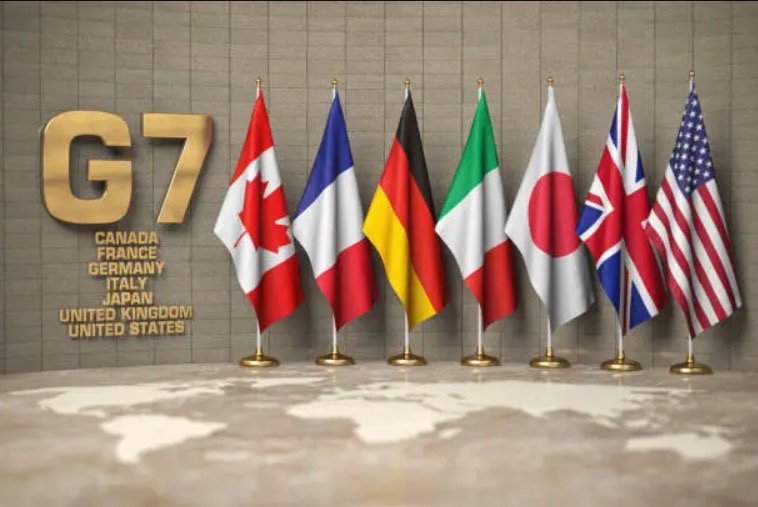
This distinction matters. It explains why the G7 has not evolved into a “G8 plus China” model, even as China’s share of global GDP and industrial output has expanded dramatically. Membership is not a reflection of economic ranking but of systemic compatibility.
That principle was already tested in the case of Russia, admitted in 1998 and suspended in 2014 following its annexation of Crimea. The club froze out Russian President Vladimir Putin when he seized Crimea from Ukraine in 2014, foreshadowing the full-scale war now raging since 2022.
Trump said last year that excluding Russia “was a very big mistake.”
Against that backdrop, China’s exclusion is increasingly framed not as a historical anomaly but as a safeguard of cohesion.
From globalization to economic security
What has changed is not the G7’s membership, but its agenda. Over the past decade, the forum has shifted from coordinating macroeconomic stability and development policy to managing systemic exposure to geopolitical risk.
Unlike the language of decoupling, which implies structural separation, de-risking accepts the permanence of economic interdependence while seeking to reduce strategic vulnerability. It reflects a recognition that the liberalisation era of the 1990s and early 2000s underestimated the geopolitical implications of concentrated supply chains and asymmetric dependencies.
In practice, this has transformed the G7 into an embryonic economic security alliance. Its agenda increasingly revolves around supply-chain resilience, industrial policy coordination, and the management of critical dependencies particularly in sectors where China has acquired structural leverage.
Critical minerals: concentrated dependency, fragmented response
Nowhere is this more evident than in critical minerals. The energy transition has created unprecedented demand for lithium, cobalt, nickel, and rare earth elements. Yet processing and refining capacity remains heavily concentrated in China.
This is not simply a question of resource endowment but of industrial ecosystems. China’s dominance lies in midstream processing, where scale advantages, regulatory alignment, and long-term investment have produced a quasi-monopoly in certain segments of the value chain.
G7 responses have focused on diversification rather than substitution: building partnerships with resource-rich countries, expanding domestic refining capacity, and encouraging allied investment corridors. But progress is uneven, reflecting the time-lag between strategic intent and industrial reality.
The result is a structural paradox: the G7’s green transition depends, in the short to medium term, on the very supply chains it seeks to reduce exposure to.
Semiconductors: controlling the chokepoints
If critical minerals represent upstream vulnerability, semiconductors represent downstream strategic control. Here, the G7’s approach led most forcefully by the United States, with varying degrees of alignment from Japan and European partners has been to restrict access to advanced chip design tools and manufacturing equipment for Chinese firms.
This is not full technological decoupling. It is targeted containment of high-end capabilities, particularly those relevant to artificial intelligence, military modernisation, and advanced computing.
Yet semiconductor supply chains are among the most globally integrated in the world economy. Design, equipment, fabrication, and assembly span multiple jurisdictions, many of which are deeply interdependent. The attempt to segment this ecosystem without collapsing it entirely is therefore inherently unstable and politically contested.
Investment screening and the securitisation of capital
A parallel transformation is underway in investment policy. Capital flows, once treated as neutral instruments of economic integration, are increasingly subject to national security scrutiny.
Across G7 economies, foreign direct investment screening mechanisms have expanded in scope and sensitivity. The concern is no longer only ownership of strategic assets, but also access to data, technology transfer, and influence over critical infrastructure.
This marks a broader shift: the securitisation of economic policy. Where globalization once assumed that interdependence would dilute political risk, policy is now built on the assumption that interdependence can itself be weaponised.
China as systemic constraint, not just external actor
Taken together, these shifts reveal a deeper transformation in the G7’s strategic mindset. China is no longer treated simply as a competitor or trading partner. It has become a systemic constraint embedded within almost every major policy domain—from climate transition to artificial intelligence governance, from industrial policy to financial regulation.
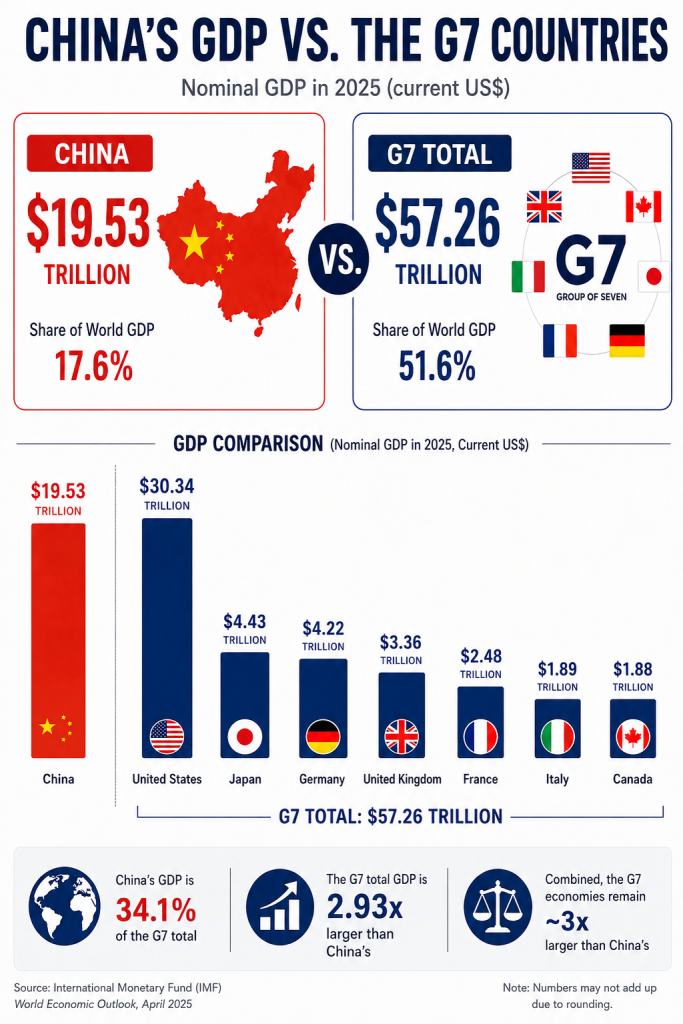
This does not imply convergence toward confrontation. On the contrary, most G7 economies remain deeply invested in maintaining stable economic ties with China. Trade volumes remain substantial, and global growth forecasts continue to incorporate Chinese demand as a central variable.
The defining feature of the current moment is therefore not separation, but managed tension: an attempt to reconcile strategic caution with economic necessity.
The paradox of exclusion
The persistence of China’s exclusion from the G7 is often interpreted as ideological rigidity. In reality, it reflects a more practical concern: that inclusion would undermine the club’s internal coherence without resolving the underlying strategic dilemmas it now faces.
As several analysts have noted, the G7’s effectiveness depends less on representativeness than on alignment. The admission of a systemically different political economy—particularly one with global scale—would not simply broaden the agenda; it would fundamentally alter the rules of consensus.
Yet exclusion does not equate to irrelevance. On the contrary, China’s absence has become one of the G7’s defining features precisely because its presence is structurally unavoidable in the issues that now dominate the agenda.
The G7 was not designed for a world in which economic power and political alignment are decoupled. Its founding assumptions reflected a narrower Western system in which strategic and economic convergence were largely taken for granted.
That world no longer exists.
China’s position today is therefore paradoxical: excluded from the G7’s formal architecture, yet embedded in its strategic logic. It is not a member of the club, but it increasingly defines the problems the club exists to manage.
In that sense, the G7 is no longer simply a forum of coordination among advanced economies. It is a mechanism for managing the consequences of a global order in which the most consequential actor is neither present at the table nor absent from the conversation.
And that is precisely why the question of China’s exclusion has become, in itself, a central feature of the G7’s evolving identity.