


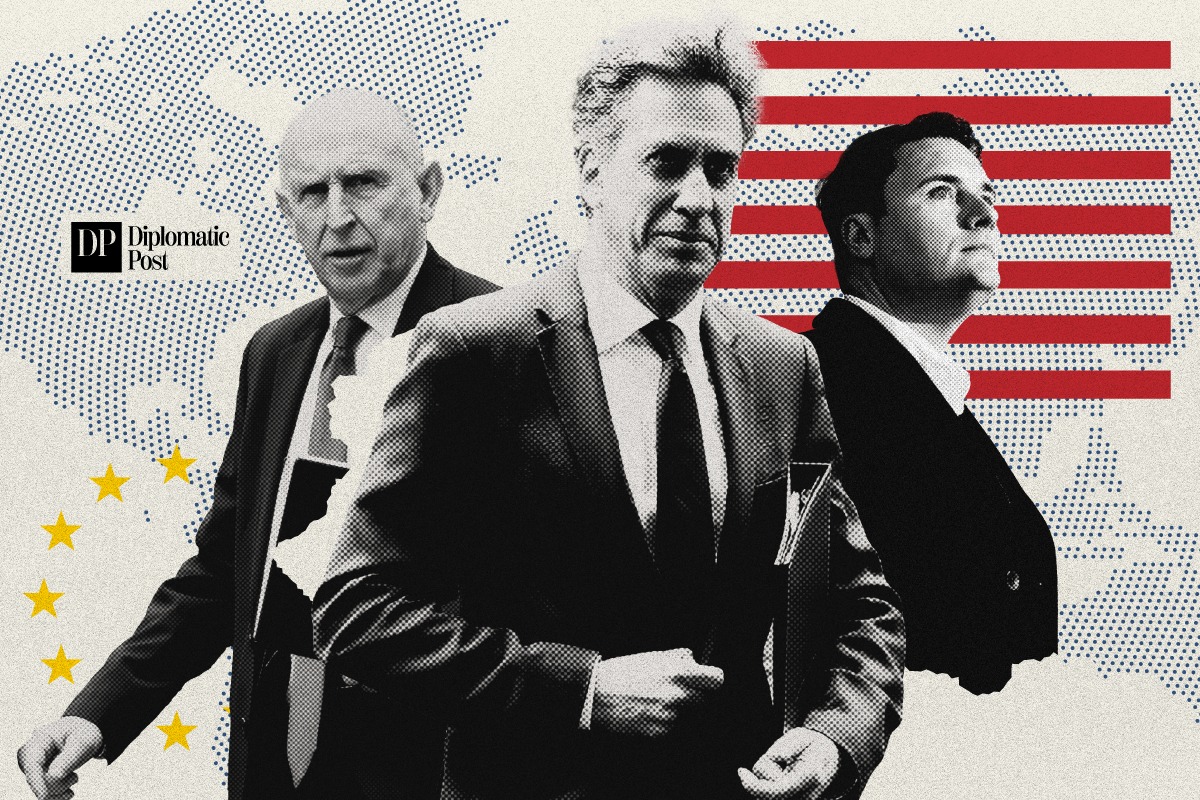
Britain’s new prime minister has no foreign policy instincts of his own so he has outsourced the job to three ambitious men whose rivalries will shape it instead. John Healey, Ed Miliband and Wes Streeting will be major players in how Britain’s new PM projects himself around the world.
Andy Burnham’s arrival in Downing Street on July 20th was less a foreign-policy moment than a domestic one. The former mayor of Greater Manchester built his career on buses, housing and homelessness, not NATO summits or Gulf diplomacy. Yet the choices he made in staffing his top table Ed Miliband to the Foreign Office, Wes Streeting to Defence, and John Healey, fresh from resigning as defence secretary in a row over spending, promoted to the Treasury tell foreign capitals more about the direction of British statecraft than anything in Burnham’s own back catalogue. For a prime minister with, in his own allies’ words, little appetite for shuttle diplomacy, the men around him are not supporting cast. They are the policy.
That matters because Britain arrives at this transition mid-crisis on several fronts at once: a grinding war in Ukraine now in its fifth year, a fractious relationship with a transactional Trump administration, a defence-spending trajectory to 3.5% of GDP that has already claimed one minister’s job, and a post-Brexit relationship with Brussels still being renegotiated in real time. A prime minister who has said openly he intends to spend less time on the international circuit than his predecessor is, in effect, ceding the day-to-day conduct of Britain’s external relations to his cabinet. Understanding Miliband, Streeting and Healey is therefore not personality journalism. It is the closest thing available to reading Burnham’s foreign policy before he has articulated one himself.
A Cabinet Built for Party Management, Not Statecraft
Burnham’s reshuffle was not a considered redesign of Britain’s foreign-policy architecture; it was a rapid consolidation of power after a leadership transition forced by Keir Starmer’s resignation. Ed Miliband’s move from the energy brief to the Foreign Office is the most consequential single appointment. He arrives with genuine standing on the international stage built over years leading Britain’s climate diplomacy but with no track record of hard-security dealmaking, on Ukraine, the Middle East or an increasingly assertive China.
Wes Streeting’s move to Defence is more striking still: a health secretary who quit government to help force Starmer out is now responsible for delivering a defence-spending increase that consumed his predecessor’s career. And Healey’s elevation to the Treasury, after being forced out of the Ministry of Defence over exactly that spending question, hands the purse strings to a man who knows precisely how expensive Burnham’s defence commitments are, and precisely how politically toxic they can become.
The sequencing is the tell. This is not a team assembled around a foreign-policy doctrine; it is a team assembled around loyalty and factional balance within the Parliamentary Labour Party, with foreign and defence policy attached almost incidentally. Analysts at the European Council on Foreign Relations have noted that Burnham is likely to keep Britain’s Ukraine and Middle East positions largely unchanged precisely because they are mainstream within Labour, not because he has weighed the alternatives himself. Continuity, in other words, is a byproduct of political caution rather than strategic conviction.
Three Men, Three Different Kinds of Exposure
Miliband gains the most visible prize but inherits the greatest exposure. A foreign secretary with a strong domestic reputation and thin experience in security diplomacy will be tested immediately by Washington, where the Trump administration has shown little patience for European interlocutors who arrive without a clear mandate from their prime minister. If Burnham delegates the transatlantic file to Miliband while himself avoiding it, Britain risks precisely the ambiguity that foreign chancelleries most dislike: not knowing who actually speaks for London.
Streeting’s gain is more contested. Placing a former internal rival in charge of the defence budget can be read two ways as a genuine vote of confidence in delivering the 3.5%-of-GDP target, or as a way of tying an ambitious colleague to a brief that is politically thankless and fiscally punishing. Either way, Streeting now owns the credibility of Britain’s NATO commitments at a moment when European allies are watching every G7 capital for signs of wavering resolve.
Healey is the biggest institutional winner. Moving the man who resigned over defence spending into the department that controls it gives Burnham a chancellor who cannot credibly complain that the numbers don’t add up he set them. It also signals to the Ministry of Defence and to allies that the spending trajectory agreed under Starmer will not be quietly reopened, even as Streeting, in his old boss’s old job, faces the operational consequences of underfunding relative to ambition.
The loser, arguably, is coherence itself. A government run by a prime minister uninterested in the brief, staffed by a foreign secretary without a security pedigree, a defence secretary who is a recent recruit to the subject, and a chancellor with a personal grievance baked into the budget line, is a government more likely to manage crises reactively than to shape events proactively.
How Allies and Rivals Will Read London
For Kyiv, the practical question is whether personnel changes in London alter the reliability of British support. The early signals Yvette Cooper’s assurance that Burnham is “100% behind” Ukraine, and the retention of Jonathan Powell as national security adviser at least through the year suggest continuity is the intended message. But allies will judge Britain less by statements of principle than by whether Streeting can actually deliver the capability increases Healey has funded, and whether Miliband can hold the diplomatic line in Washington without a prime minister backing him up in person.
For the European Union, Burnham’s domestic focus and thinner personal investment in Brussels diplomacy could either simplify or complicate the post-Brexit relationship, depending on whether Miliband is given real authority to negotiate or is constantly second-guessed by a No. 10 preoccupied with the cost of living. For Gulf and Indo-Pacific partners, a foreign secretary untested on hard security and a prime minister whose international experience is largely limited to trade missions to China will read, at least initially, as an opening to test London’s attention span.
The Signals Worth Watching
Three signals will matter more than any speech. First, whether Streeting can translate the 3.5% target into deliverable capability without a second resignation-style rupture — a repeat would badly damage NATO confidence in British follow-through. Second, whether Miliband is dispatched, or sidelined, on the first serious transatlantic or Middle East crisis of Burnham’s premiership; that will reveal whether Downing Street trusts him with real authority or merely with the title. Third, whether Healey’s Treasury quietly slows the pace of defence spending once the political heat of his own resignation fades — the surest sign that fiscal caution, not strategic conviction, is driving policy.
The takeaway
Britain now has a prime minister who has effectively subcontracted foreign and defence policy to three ministers whose appointments were driven by internal party arithmetic rather than strategic design. That is not necessarily a recipe for instability continuity with Starmer-era positions offers allies a measure of reassurance but it does mean Britain’s global posture will be shaped less by prime ministerial vision than by the shifting balance of power between Miliband, Streeting and Healey themselves. In an era when adversaries and allies alike look for clarity of purpose from London, that internal balancing act, more than any doctrine Burnham might eventually announce, is what will define British foreign policy in the year ahead.