


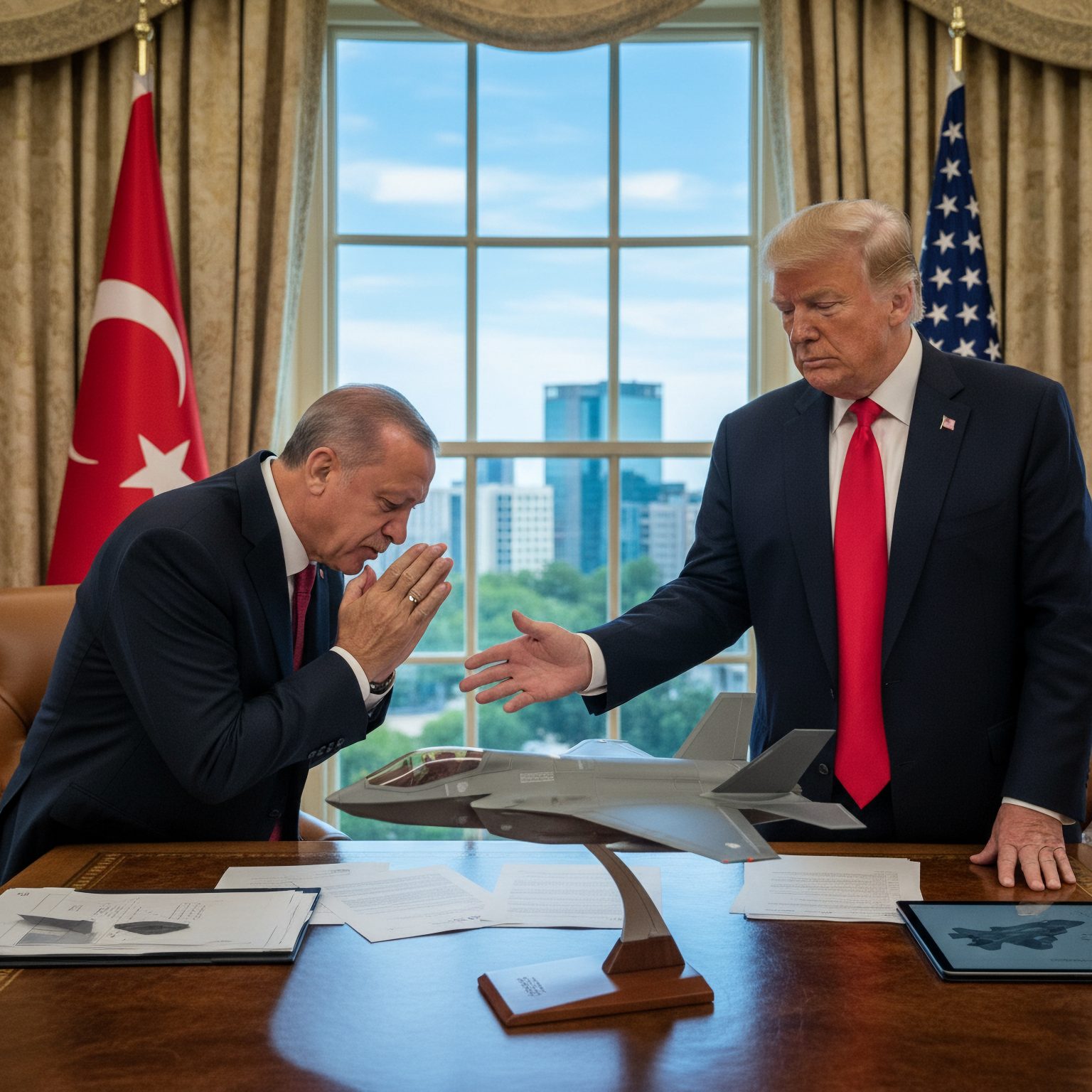


Benjamin Netanyahu’s appeal to block Turkey’s return to the F-35 programme reflects a broader struggle over regional military primacy, NATO cohesion and Washington’s evolving strategic priorities.
Benjamin Netanyahu rarely intervenes publicly in American arms sales unless he believes the strategic stakes are exceptionally high. His latest appeal to President Donald Trump not to restore Turkey’s access to the F-35 fighter programme is therefore about far more than one aircraft. It is a signal that Israel sees an emerging shift in the regional balance of power one that could redefine relations between Washington’s two most important security partners in the Eastern Mediterranean.
Speaking ahead of Trump’s visit to Turkey for the NATO summit, Netanyahu argued that supplying Ankara with fifth-generation aircraft or even engines for its indigenous fighter programme would upset the regional military equilibrium that Israel believes has underpinned decades of relative deterrence. The comments came amid growing indications that Washington is reassessing its difficult relationship with Turkey after years of tensions surrounding Ankara’s purchase of Russia’s S-400 missile defence system and its subsequent exclusion from the F-35 programme.
The dispute is not simply about military hardware. It reflects a larger strategic contest over influence in the Middle East, NATO’s southern flank and America’s attempt to reconcile competing alliances at a time when global security priorities are rapidly shifting.
For nearly two decades, Israel has enjoyed an unrivalled qualitative military edge across the Middle East. The F-35 has become the centrepiece of that advantage. As the only regional operator of the aircraft, Israel has integrated the platform into its broader deterrence posture against Iran, Hezbollah and other potential adversaries.
That exclusivity has never been accidental. Under long-standing US policy, Washington is legally committed to maintaining Israel’s Qualitative Military Edge (QME), ensuring that no regional state receives capabilities capable of fundamentally challenging Israeli military superiority. Every significant American arms sale in the Middle East is therefore assessed not only through commercial or alliance considerations but also through its impact on Israel’s security.
Turkey presents a uniquely complicated case because it occupies two strategic identities simultaneously. It is both a NATO ally and an increasingly independent regional power pursuing its own geopolitical agenda.
Since President Recep Tayyip Erdoğan adopted a more assertive foreign policy, Ankara has expanded military operations in Syria and Iraq, deepened its defence industry, projected naval power across the Eastern Mediterranean and increased diplomatic influence from the Caucasus to Africa. Simultaneously, relations with Israel have deteriorated sharply, particularly following the Gaza war, with Erdoğan becoming one of Israel’s most vocal international critics.
From Jerusalem’s perspective, these developments transform Turkey from an occasionally difficult NATO partner into a potential long-term strategic competitor.
For Washington, however, the calculation looks considerably different.
The United States faces an increasingly uncomfortable strategic reality. Russia remains the principal military threat in Europe, China dominates long-term Indo-Pacific planning and instability continues across the Middle East. Under these circumstances, alienating Turkey—a country controlling access to the Black Sea, hosting critical NATO infrastructure and possessing the Alliance’s second-largest military—has become increasingly costly.
This explains why Washington has gradually sought to rebuild defence cooperation despite unresolved disagreements over the Russian-made S-400 system. Recent congressional notifications regarding the possible sale of General Electric engines for Turkey’s indigenous KAAN fighter programme suggest the Trump administration is searching for incremental ways to restore military ties without immediately reversing previous sanctions.
The engine sale itself may appear technical, but strategically it carries significant symbolism.
Rather than forcing Turkey to remain dependent on Russian or alternative suppliers, Washington appears willing to re-anchor Ankara within the Western defence-industrial ecosystem. That objective serves broader NATO interests even if it generates concern in Jerusalem.
For Turkey, regaining access to advanced Western aerospace technology would represent more than a procurement victory.
It would signal diplomatic rehabilitation after years of strained relations with Washington.
Turkey was not simply a customer in the original F-35 programme; it was also a manufacturing partner, producing hundreds of aircraft components before its removal following the S-400 acquisition in 2019. Exclusion imposed financial costs while simultaneously accelerating Ankara’s determination to develop indigenous defence capabilities, including the KAAN fifth-generation fighter.
Ironically, American sanctions may have strengthened Turkey’s long-term defence autonomy.
Over the past several years Ankara has dramatically expanded domestic production of drones, missiles, naval platforms and armoured vehicles. Turkish defence exports have grown rapidly across Europe, the Middle East and Africa, transforming the country into one of the world’s fastest-growing defence exporters.
From this perspective, Washington faces a strategic dilemma.
Continuing to isolate Turkey risks pushing it further toward defence self-sufficiency and potentially greater cooperation with non-Western partners.
Re-engagement, however, risks alarming Israel, Greece and Cyprus while provoking resistance within the US Congress.
This balancing act explains why the debate extends far beyond bilateral US-Turkey relations.
NATO itself has become part of the equation.
The Alliance enters its latest summit confronting simultaneous challenges from Russia, instability in the Middle East and questions surrounding America’s long-term commitment to European security.
Turkey occupies a pivotal geographic position linking all three theatres.
Its control of the Turkish Straits remains indispensable for Black Sea security. Its proximity to Syria, Iraq, Iran and the Caucasus gives Ankara strategic relevance unmatched by most NATO members. Its expanding defence industry increasingly contributes to Alliance capabilities, particularly through drones and missile technologies.
From NATO’s institutional perspective, reintegrating Turkey more closely into Western defence structures carries obvious strategic benefits.
Yet doing so without addressing persistent disputes over democratic governance, regional tensions and Russian military systems risks undermining Alliance cohesion.
Israel’s objections therefore intersect with wider European concerns.
Athens and Nicosia have long opposed advanced Western weapons transfers that could alter the military balance in the Eastern Mediterranean. Turkish-Greek disputes over maritime boundaries, airspace and Cyprus remain unresolved despite periodic diplomatic improvements.
Should Turkey eventually regain access to the F-35 or equivalent technologies, regional military planning across the Eastern Mediterranean would inevitably require recalibration. At the same time, Israeli concerns are not universally accepted within Washington.
Some American strategists argue that keeping Turkey outside Western defence structures ultimately serves neither NATO nor US interests. They contend that maintaining Ankara within the Alliance’s technological ecosystem provides greater leverage than continued exclusion.
Others remain deeply sceptical, arguing that Turkey’s retention of the S-400 system still presents unacceptable intelligence and interoperability risks.
Congress remains another major variable. Even if the White House favours expanded defence cooperation, significant arms transfers still require navigating congressional scrutiny. Lawmakers have repeatedly expressed concerns over Turkey’s democratic backsliding, regional military operations and continued possession of Russian defence systems. Congressional resistance could therefore become the decisive obstacle regardless of presidential preferences.
Over the next twelve months, several developments will determine whether this debate evolves into a genuine strategic realignment.
The first concerns the future of the S-400 issue. Unless Ankara finds a politically acceptable formula for limiting or resolving the system’s status, full re-entry into the F-35 programme remains unlikely. The second involves broader US-Turkey relations. If cooperation expands across Syria, Black Sea security and NATO modernisation, incremental defence integration could become politically easier. Third, the trajectory of Israel-Turkey relations will matter considerably. Current tensions remain exceptionally high, but regional dynamics can shift rapidly, particularly if broader Middle Eastern diplomatic arrangements evolve after the Gaza conflict and ongoing negotiations surrounding Iran.
Finally, NATO’s own transformation will influence American calculations. As European allies assume greater responsibility for conventional deterrence against Russia, Washington may increasingly prioritise strategic flexibility over longstanding political disputes among regional partners.
Netanyahu’s intervention therefore represents more than an attempt to block a single weapons sale. It reflects Israel’s recognition that the geopolitical environment underpinning its military dominance is becoming increasingly fluid.
For decades, American policy largely reconciled the interests of Israel and Turkey by treating them as complementary pillars of regional stability. Today those interests increasingly diverge. Ankara seeks recognition as an autonomous regional power. Israel seeks preservation of an uncontested military advantage. Washington increasingly needs both.
The resulting triangle has become one of the defining strategic puzzles confronting American foreign policy. Whether the immediate issue concerns F-35 fighters, jet engines or broader defence cooperation is almost secondary. The real question is whether the United States can simultaneously reassure Israel, rebuild trust with Turkey and preserve NATO cohesion in an era when alliances are becoming more transactional and regional powers increasingly pursue independent strategic ambitions.
How Washington answers that question may shape not only the future of the F-35 programme but also the emerging security architecture of both the Middle East and the Eastern Mediterranean.