


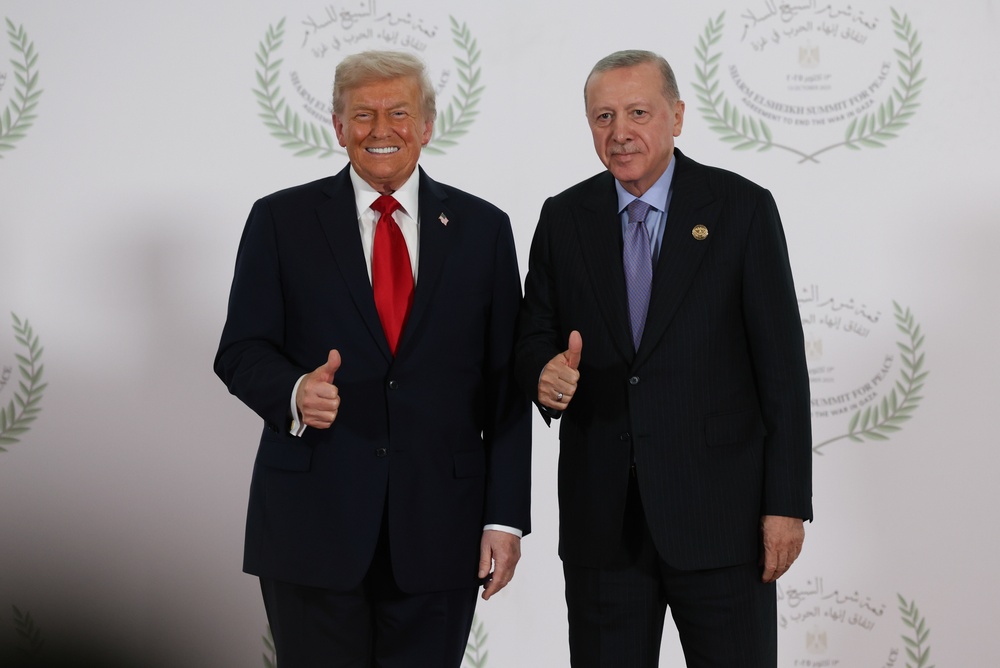


Trump’s proposed engine sale to Turkey signals a potential thaw in defence ties, but Congress, Russia policy constraints, and NATO security concerns keep the relationship structurally fragile.
A proposed $750 million sale of jet engines to Turkey has triggered a fresh institutional confrontation in Washington, highlighting both the potential and the limits of a renewed US–Turkish rapprochement. The Trump administration is expected to override objections from Representative Gregory Meeks, the top Democrat on the House Foreign Affairs Committee, who has blocked the deal over Ankara’s continued possession of Russia’s S-400 air defence system. The engines, produced by General Electric, are intended for Turkey’s domestically developed KAAN fighter programme, a cornerstone of Ankara’s long-term ambition for defence self-sufficiency.
The timing is politically charged. Turkey is set to host a NATO summit in Ankara next month, placing its strategic role within the alliance under renewed scrutiny. At the same time, President Donald Trump has signalled openness to “doing something that will make them very happy,” fuelling speculation that broader restrictions—potentially even those affecting the F-35 programme could be reconsidered.
What is unfolding is not merely a transactional arms dispute, but a test of whether US–Turkish relations can be rebalanced after years of sanctions, mutual distrust, and strategic divergence. The outcome will shape NATO cohesion, Russia policy in the Black Sea region, and the future of defence industrial cooperation inside the alliance.
A transactional thaw after years of strategic rupture
The emerging US–Turkey arms discussion reflects a broader recalibration in Washington’s approach to Ankara one driven less by ideological alignment than by geopolitical necessity. For much of the past decade, bilateral relations have oscillated between partnership and friction, anchored by disputes over Syria, human rights, and, most critically, Turkey’s 2019 purchase of Russia’s S-400 air defence system.
That decision fundamentally altered the defence relationship. Washington responded with sanctions under the Countering America’s Adversaries Through Sanctions Act (CAATSA) and removed Turkey from the F-35 programme, arguing that integration of Russian radar systems with NATO-standard aircraft posed an unacceptable intelligence risk. Congress subsequently codified restrictions preventing any F-35 transfer while the S-400 remains operational.
The current debate over jet engines for Turkey’s KAAN fighter therefore sits at the intersection of industrial cooperation and strategic mistrust. On the surface, the deal concerns propulsion systems manufactured by General Electric. In strategic terms, however, it signals a potential reopening of defence ties that have been largely frozen since 2019.
The Trump administration’s reported willingness to override congressional objections reflects a familiar pattern in US–Turkish relations: executive pragmatism colliding with legislative caution. The White House view appears to prioritise Turkey’s role as a NATO ally at a time of heightened regional volatility, particularly in the Black Sea, the Eastern Mediterranean, and the Middle East. Congress, by contrast, remains focused on technology security risks and the precedent that any easing of restrictions might set.
The central unresolved issue remains the S-400 system. From Washington’s perspective, its continued presence in Turkey’s arsenal represents not only a technical vulnerability but a political signal of Ankara’s willingness to diversify its security partnerships beyond NATO. Turkish officials, however, view the system as a sovereign procurement decision made in response to repeated Western restrictions and delays in arms transfers.
This divergence has created a structural contradiction: Turkey remains a core NATO member yet maintains operational ties to Russian military technology. Any attempt to normalise defence relations without resolving this contradiction risks reopening tensions within the alliance itself.
The F-35 question and the politics of conditional reintegration
Although the current deal concerns engine exports rather than fighter jets, it inevitably revives the broader question of Turkey’s exclusion from the F-35 programme. Ankara was originally both a purchaser and industrial partner in the programme, contributing components to the supply chain before its removal.
A full reintegration into the F-35 architecture would require not only congressional approval but also a reassessment of the intelligence-sharing risks associated with the S-400 system. That threshold has not changed materially since 2019, despite shifting political rhetoric.
However, recent signals from the Trump administration suggest a willingness to revisit parts of this architecture in exchange for broader strategic alignment. Trump’s public remarks indicating he may take steps that would “make Turkey very happy” have been interpreted in some diplomatic circles as an opening for incremental re-engagement rather than full reinstatement.
For Ankara, the stakes are high. The KAAN fighter programme is central to Turkey’s ambition to become a semi-autonomous defence power, reducing dependence on US and European suppliers. Yet it still relies heavily on Western technology, particularly in propulsion systems. The GE engine deal therefore represents both opportunity and vulnerability: it strengthens Turkey’s domestic defence industry while reinforcing its reliance on US-controlled supply chains.
NATO’s Ankara summit: symbolism and substance
The timing of these developments, ahead of a NATO summit in Ankara, is significant. Hosting the alliance places Turkey at the centre of NATO’s strategic messaging at a time when the organisation is increasingly focused on deterrence in Europe and containment of Russian influence.
For NATO allies, Turkey’s position is both indispensable and complex. It controls access to the Black Sea via the Bosporus, maintains diplomatic channels with Russia, and plays a critical role in regional energy and migration dynamics. At the same time, its independent foreign policy posture has frequently generated friction within the alliance.
A partial thaw in US–Turkish defence relations could therefore serve NATO cohesion by anchoring Ankara more firmly within Western defence supply chains. Conversely, any perception that strategic technology restrictions are being relaxed without resolving the S-400 issue could deepen intra-alliance tensions, particularly among members most concerned about Russian military influence.
Regional and strategic implications
For Russia, any improvement in US–Turkish defence relations represents a potential strategic setback. Moscow has long viewed Turkey as a key interlocutor in managing regional conflicts, particularly in Syria, Libya, and the South Caucasus. However, Turkey’s NATO membership limits the extent of this partnership, and renewed defence cooperation with Washington could narrow Russia’s room for manoeuvre.
For European NATO members, particularly Greece and Eastern Mediterranean states, closer US–Turkey defence alignment is likely to be watched with caution. While it may strengthen NATO’s overall military cohesion, it could also shift regional balances of power in ways that require careful diplomatic calibration.
For Ukraine, Turkey’s role remains dual: it is both a NATO member supporting Ukrainian sovereignty and a state that has maintained pragmatic economic engagement with Russia. A more integrated US–Turkey defence relationship could enhance NATO’s Black Sea posture, but it would not eliminate Ankara’s strategic hedging.
Policy outlook: conditional convergence rather than full reset
Three scenarios are emerging over the next 6–12 months.
First, a managed transactional reset, in which limited defence sales—such as engine transfers—proceed despite congressional resistance, while deeper structural issues like the S-400 system remain unresolved. This would represent incremental cooperation without strategic reconciliation.
Second, a selective re-engagement pathway, where the US gradually restores elements of defence industrial cooperation in exchange for Turkish concessions on interoperability and NATO alignment, short of full F-35 reintegration.
Third, a renewed confrontation scenario, triggered by congressional pushback or Turkish resistance to conditionality, which could re-freeze parts of the defence relationship and reinforce existing mistrust.
The most likely outcome is the first: a cautious, transactional easing of tensions driven by strategic necessity rather than full political reconciliation.
Foe or friends?
The emerging US–Turkey defence negotiation illustrates a broader reality of contemporary NATO politics: alliances are increasingly managed through transactional adjustments rather than cohesive strategic alignment. The proposed engine sale is less a breakthrough than a stress test of Congress’s willingness to accept executive-driven flexibility, of Turkey’s ability to reconcile Russian defence purchases with NATO membership, and of the alliance’s capacity to absorb internal contradictions without systemic fracture.
At the end his moment evolves into a durable reset or another cycle of mistrust will depend less on a single arms deal than on whether Washington and Ankara can define the boundaries of strategic cooperation in an era where alliance discipline is weakening and geopolitical hedging has become the norm.